Every food in our database except meat and fish, ranked by protein per 100 g. Dairy and eggs are included and marked, so if you are vegan you can read straight down the Suits column — 22 of the top 25 are plant-only, and 7 of the top ten.
Dried herbs and spices are excluded, along with garlic, chilli, and drinks. Per 100 g they dominate almost every nutrient ranking — dried oregano is 42 g fibre — but nobody eats them in 100 g quantities, so including them would push genuinely useful foods off the list. Figures are per 100 g of the edible portion as catalogued on each food page: dry weight for grains and legumes, raw unless the food page says otherwise.
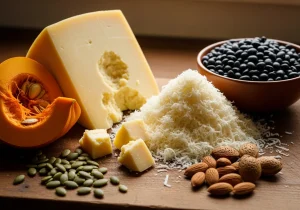
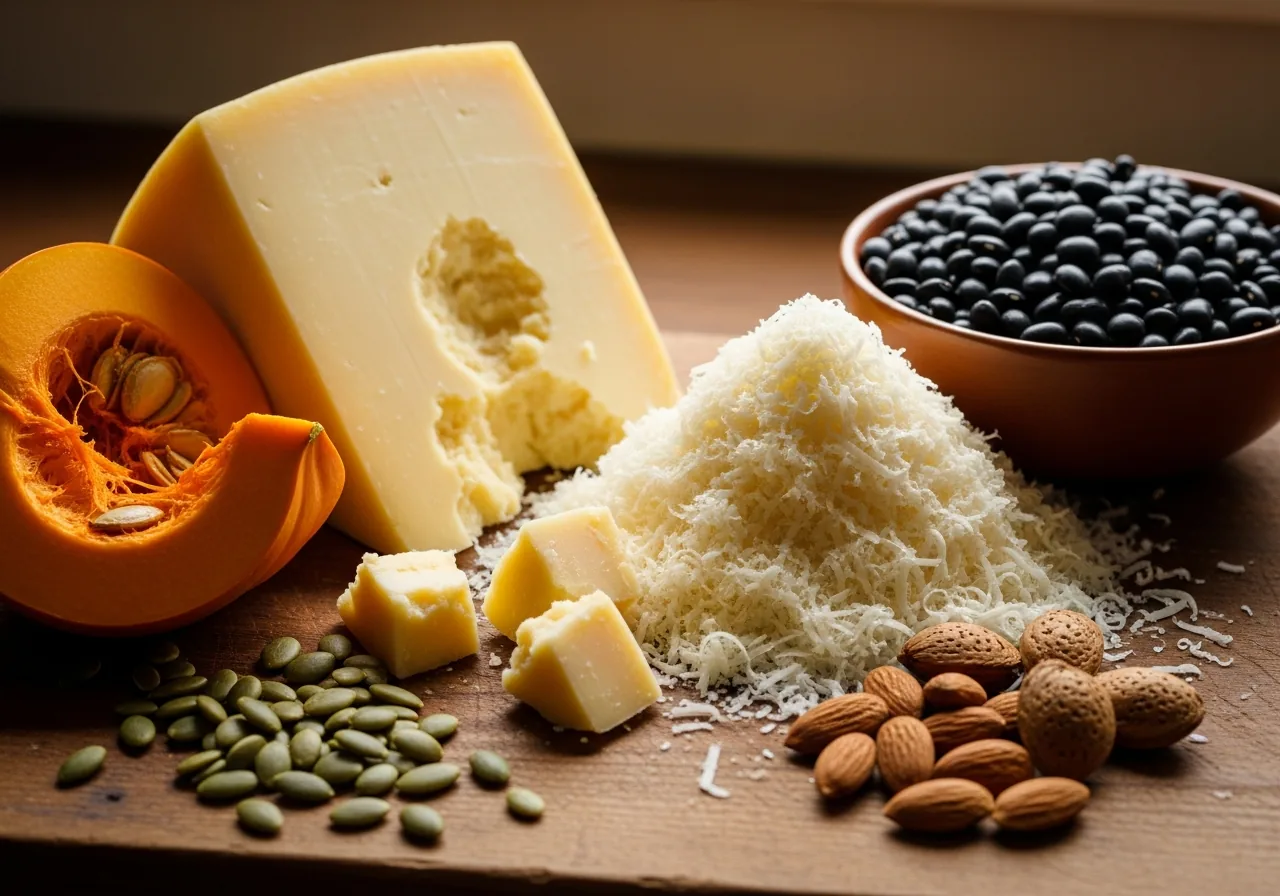
Parmesan — top of the list
| Total Fat | 25 g |
|---|---|
| Saturated Fat | 14.85 g |
| Sodium | 1175 mg |
| Potassium | 92 mg |
| Total Carbohydrate | 3.22 g |
| Dietary Fiber | 0 g |
| Total Sugars | 0.11 g |
| Protein | 35.75 g |
Vegetarian foods highest in protein, per 100 g
| # | Food | Protein per 100 g | Calories per 100 g | Protein per 100 kcal | Suits |
|---|---|---|---|---|---|
| 1 | Parmesan | 35.8 g | 392 kcal | 9.1 g | Vegetarian |
| 2 | Pumpkin Seeds | 29.9 g | 555 kcal | 5.4 g | Vegan |
| 3 | Black Beans | 24.4 g | 341 kcal | 7.2 g | Vegan |
| 4 | Cheddar Cheese | 24.2 g | 410 kcal | 5.9 g | Vegetarian |
| 5 | Peanut Butter | 24.0 g | 632 kcal | 3.8 g | Vegan |
| 6 | Lentils | 23.6 g | 360 kcal | 6.6 g | Vegan |
| 7 | Kidney Beans | 22.5 g | 337 kcal | 6.7 g | Vegan |
| 8 | Mozzarella | 22.2 g | 299 kcal | 7.4 g | Vegetarian |
| 9 | Almonds | 21.5 g | 626 kcal | 3.4 g | Vegan |
| 10 | Pinto Beans | 21.4 g | 347 kcal | 6.2 g | Vegan |
| 11 | Chickpeas | 21.3 g | 383 kcal | 5.6 g | Vegan |
| 12 | Pistachios | 20.5 g | 598 kcal | 3.4 g | Vegan |
| 13 | Tempeh | 20.3 g | 192 kcal | 10.6 g | Vegan |
| 14 | Sunflower Seeds | 18.9 g | 609 kcal | 3.1 g | Vegan |
| 15 | Flaxseed | 18.0 g | 545 kcal | 3.3 g | Vegan |
| 16 | Sesame Seeds | 17.7 g | 573 kcal | 3.1 g | Vegan |
| 17 | Cashews | 17.4 g | 565 kcal | 3.1 g | Vegan |
| 18 | Tofu | 17.3 g | 144 kcal | 12.0 g | Vegan |
| 19 | Chia Seeds | 17.0 g | 517 kcal | 3.3 g | Vegan |
| 20 | Walnuts | 14.6 g | 730 kcal | 2.0 g | Vegan |
| 21 | Quinoa | 14.1 g | 368 kcal | 3.8 g | Vegan |
| 22 | Hazelnuts | 13.5 g | 641 kcal | 2.1 g | Vegan |
| 23 | Wholewheat Pasta | 13.5 g | 362 kcal | 3.7 g | Vegan |
| 24 | Buckwheat | 13.2 g | 343 kcal | 3.9 g | Vegan |
| 25 | Oats | 13.2 g | 379 kcal | 3.5 g | Vegan |
Reading the table
Parmesan tops it at 35.8 g per 100 g, but portion size decides how much that is worth: hard cheese is eaten 15–30 g at a time, while lentils and beans are eaten in far larger portions. The last column is the corrective — Tofu delivers 12.0 g of protein per 100 kcal, which is what matters when calories are a constraint.
The highest plant-only source here is Pumpkin Seeds at 29.9 g. Note that the pulses and grains are measured dry: lentils at 23.6 g per 100 g roughly triple in weight once cooked, so a cooked portion carries about a third of the figure shown. Tofu and tempeh are measured as eaten.
Do you need to combine proteins?
No — that advice has been out of date for decades. It came from a 1971 popular book and was withdrawn by its own author in a later edition. Plant proteins are individually lower in one or another essential amino acid, most often lysine in grains and methionine in pulses, but the body keeps a pool of free amino acids that covers the gaps across a day. Eating a reasonable variety over the course of a day is enough; rice does not have to meet beans at the same meal.
Soy is the practical exception to the whole discussion — tofu, tempeh and edamame carry all the essential amino acids in useful proportions on their own, as do dairy and eggs for vegetarians who eat them.
What to watch beyond protein
Protein is usually the easiest part of a vegetarian diet to get right. The nutrients that actually need attention are elsewhere:
- Vitamin B12 is the non-negotiable one. It is essentially absent from plant foods, so vegans need fortified foods or a supplement — this is not optional, and prolonged deficiency causes nerve damage that does not fully reverse. Vegetarians eating dairy and eggs usually get enough. See vitamin B12.
- Iron from plants is non-haem and absorbed far less readily than the iron in meat. Pairing it with vitamin C at the same meal substantially increases absorption; tea and coffee with the meal reduce it. See iron.
- Zinc is both lower and less well absorbed from pulses and grains, because phytates bind it. Soaking, sprouting and fermenting all reduce phytate — part of why tempeh is more than the sum of its soybeans. See zinc.
Common questions
How much protein do vegetarians need? The same as anyone else by body weight, with a modest practical uplift often suggested for diets built mainly on pulses and grains — partly digestibility, partly amino acid profile. Roughly 1.6 g per kg of bodyweight per day covers people doing resistance training; see foods for muscle growth.
Is plant protein worse than animal protein? Not in any way that matters if total intake is adequate and sources vary. Gram for gram animal protein is more digestible and higher in leucine, so the adjustment is quantity and variety rather than any need for powders or supplements.
Do vegetarians need protein powder? Rarely. The foods on this list reach the same daily totals as an omnivorous diet at ordinary portion sizes, and powder is a convenience rather than a requirement. It earns its place mainly where appetite, schedule or a very high training volume makes whole food impractical.