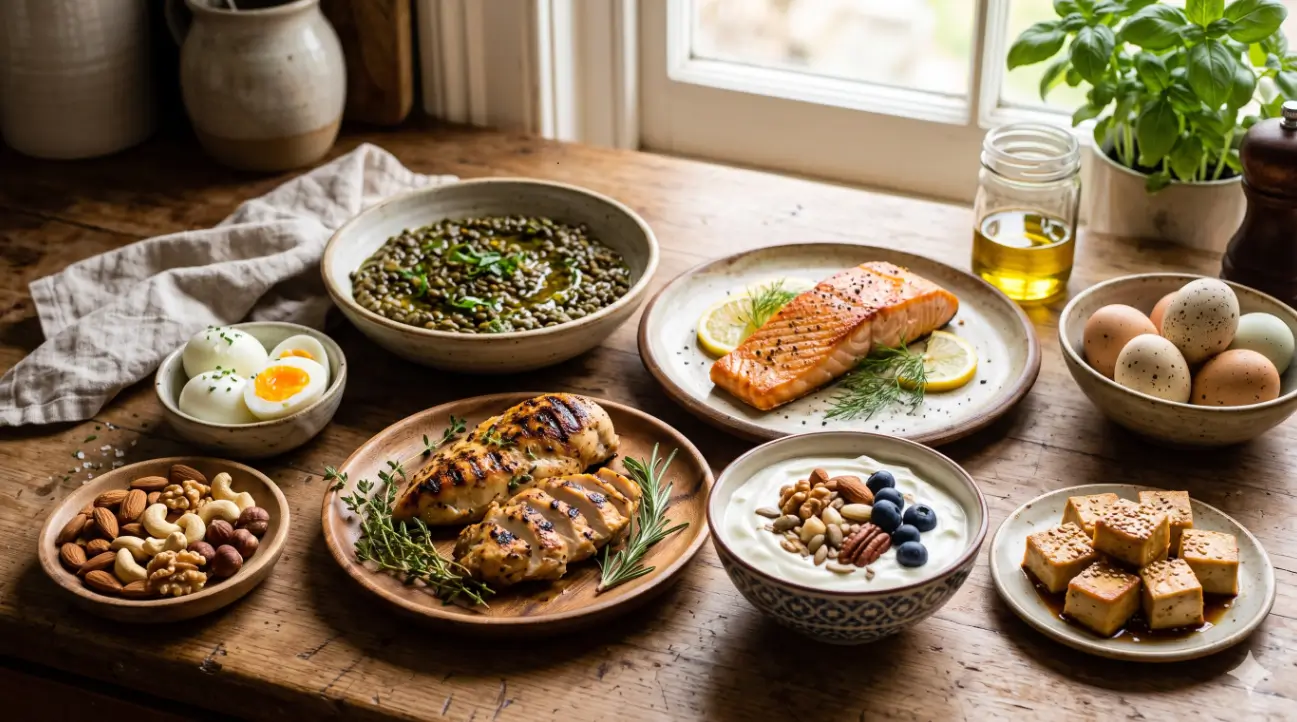
Ask a roomful of people how much protein they should eat and you will get a roomful of confident, contradictory answers. One person quotes a government number that sounds reassuringly precise. Another is shovelling chicken and shakes toward some figure they half-remember from a fitness forum. A third is quietly worried that all this protein is, somehow, bad for them. The honest answer is more interesting than any single number, because the right amount depends on who you are, what your body is doing, and what you are trying to achieve. Survival and thriving are not the same target.
The short answer, and why it misleads
The figure most often cited is the Recommended Dietary Allowance: roughly 0.8 grams of protein per kilogram of body weight per day. For a 70 kg adult that is about 56 grams. It is a real, carefully derived number, and that is exactly the problem with how it gets used. The RDA was set to prevent deficiency in nearly all healthy people. It is the amount that keeps you from running a measurable nitrogen deficit, losing muscle you cannot afford to lose, and developing the frank signs of protein shortfall.
In other words, it is a floor. It answers the question “how little can I eat before something goes wrong?” — not “how much should I eat to feel strong, recover well, and hold on to muscle as I age?” Treating the RDA as a target is like treating the minimum passing grade as the goal of an education. For sedentary adults in energy balance it may be perfectly adequate. For almost everyone who is active, ageing, dieting, or simply hoping to thrive rather than merely avoid deficiency, the useful range sits higher.
What protein actually does
To understand the numbers, it helps to remember what you are really eating. Dietary protein is a delivery system for amino acids — twenty of them, strung together in chains your body takes apart and reassembles into whatever it needs that day. Of those twenty, nine are essential: your body cannot synthesise them, so they must arrive on a fork. The rest you can build yourself, given raw materials.
What gets built is almost everything. The contractile fibres of muscle, yes, but also the collagen in skin and tendon, the enzymes that run your metabolism, the antibodies of your immune system, the transport proteins that ferry iron and fat through your blood, and many of the hormones that signal between organs. Protein is structural and functional at once — scaffolding and machinery. It is also the only macronutrient that contains nitrogen, which is why protein balance is measured in nitrogen and why no amount of carbohydrate or fat can substitute for it. Unlike fat, the body keeps no dedicated protein store to draw down; the “reserve” is your own working tissue. Fall short for long enough and the body cannibalises muscle to keep the essential machinery running.
How much you actually need, by situation
Here is where the single number dissolves into a spectrum. Protein needs slide with body size, activity, age and goal.
Lightly active adults
If you are reasonably healthy, weight-stable and not training hard, somewhere between 1.0 and 1.2 g/kg per day is a sensible, comfortable zone — modestly above the RDA, with room for an ordinary life. For our 70 kg example that is roughly 70 to 85 grams a day, easily reached with protein at each meal and no special effort.
Resistance training and athletes
Once you are regularly challenging your muscles, the picture changes. Training creates small amounts of muscle-protein breakdown and a heightened demand for the amino acids that drive repair and growth. The evidence here is reasonably strong and consistent: most people building or maintaining muscle do well in the region of 1.6 to 2.2 g/kg per day. Beyond roughly 2.2 g/kg the returns for muscle-building flatten out for most people — extra protein is not harmful, but it stops doing extra work. A good source of lean protein here is something like chicken breast or lean beef, though fish such as salmon and canned tuna earn their place too.
Older adults: anabolic resistance and sarcopenia
This is the section the RDA serves worst, and it deserves real attention. From roughly the fifth decade onward, most people begin to lose muscle mass and strength — a slow, quiet process called sarcopenia that, left unchecked, ends in frailty, falls and lost independence. Part of the cause is a phenomenon called anabolic resistance: ageing muscle responds less efficiently to a given dose of protein than young muscle does. The same meal that comfortably triggers muscle-building in a 25-year-old may barely register in a 75-year-old.
The implication is almost counter-intuitive: the people most often told to eat lightly may need more protein per kilogram, not less. Many researchers in the field now argue that healthy older adults are better served by something nearer 1.2 to 1.6 g/kg per day, with a particular emphasis on getting enough at each meal rather than loading it all at dinner. Pairing that protein with resistance exercise is the single most powerful lever against age-related decline that we know of. Easily chewed, protein-dense foods help: Greek yoghurt, cottage cheese, eggs and kefir all carry protein without much effort. There is one honest caveat: for older adults with diagnosed kidney disease the calculus changes, and protein targets should be set with a clinician.
Weight loss and calorie deficit
When you eat less than you burn, your body looks for tissue to break down — and it does not politely confine itself to fat. Without enough protein and a reason to keep it, muscle goes too. Eating more protein during a deficit does two things: it blunts that muscle loss, helping you lose fat rather than lean mass, and it is the most satiating of the macronutrients, so you feel fuller on fewer calories. A target of 1.6 to 2.0 g/kg — sometimes expressed relative to a goal or lean body weight — is well supported here. Foods that deliver a lot of protein for few calories are worth knowing: cod, shrimp, turkey breast and plain Greek yoghurt all punch above their calorie weight.
Distribution and the leucine idea
Total daily protein matters most, but when you eat it is not nothing. Muscle protein synthesis appears to respond in a roughly dose-dependent way up to a point and then plateau — which is why eating most of your protein in one enormous evening meal is less efficient than spreading it across the day. A practical rule of thumb is to aim for 20 to 40 grams of protein per meal, three or four times a day. Older adults and larger or heavily-trained people sit at the upper end of that range, partly because of the anabolic resistance described above.
Behind this sits the amino acid leucine, which acts as something of a trigger for the muscle-building machinery. The concept of a per-meal “leucine threshold” — a dose large enough to flip the switch — is a useful way to think about why a token sprinkle of protein does less than a proper serving. It is a model, not a law, and you should not count leucine grams at the table; the simpler takeaway is to make each meal carry a real, complete protein rather than a trace. As for the fabled post-workout “anabolic window,” the urgency has been considerably overstated. The window is closer to several hours than several minutes, and for most people total daily intake swamps the timing.
Quality and completeness
Not all protein is interchangeable, because not all protein carries the full set of essential amino acids in useful proportions. A complete protein supplies all nine essentials in good amounts; an incomplete one is short on at least one. Most animal foods — meat, fish, eggs, dairy — are complete and highly digestible, which is part of why they are so efficient. Most individual plant foods are incomplete: grains tend to run low on lysine, legumes low on methionine.
That sounds like a problem and largely is not, for two reasons. First, the shortfalls are complementary — combine a grain with a legume and the gaps fill each other in, an idea called protein complementation. The old worry that you had to engineer this at every single meal has been retired; eating a variety of plant proteins across the day does the job. Second, several plant foods are complete on their own. Soy and edamame are the standout examples, supplying all nine essentials, and quinoa comes close. There is also the question of digestibility: animal proteins are generally absorbed more completely, while some plant proteins are bound up with fibre and anti-nutrients that modestly reduce what you take in — one reason plant-based eaters benefit from aiming a little higher.
Hitting your target on a plant-based plate
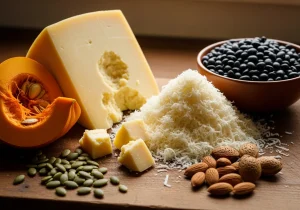
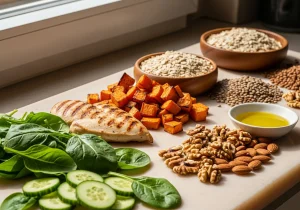
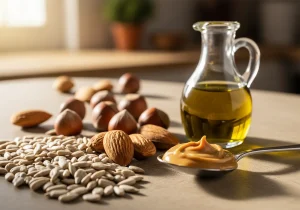
None of this makes adequate protein hard for vegetarians or vegans — it makes variety and volume the strategy rather than a single hero food. Lentils, chickpeas and black beans form a reliable backbone; soy foods do heavy lifting; seeds and nuts such as pumpkin seeds, almonds, walnuts, chia seeds and peanut butter add meaningful amounts; and grains like oats and quinoa contribute more than people expect. A well-built whole-food plant-based diet or a thoughtful vegetarian diet can comfortably meet even an athlete’s needs. Two things deserve attention beyond protein itself: plant-based eaters should keep an eye on iron and zinc, both of which are less readily absorbed from plants, and on calcium if dairy is off the menu.
A word on supplements
Protein powders occupy a strange place in the culture — treated by some as essential and by others as a con. The truth is duller and more useful: they are a convenience, not a magic ingredient. Whey digests quickly and is rich in leucine; casein digests slowly; soy and pea are solid plant-based options for those avoiding dairy. A shake is a perfectly reasonable way to top up a day that fell short, or to get protein in when whole food is impractical. But there is nothing in a tub that a plate of food cannot also provide, usually with fibre, micronutrients and satiety thrown in. Whole food first; powder to fill the gap.
Can you have too much?
This is where a persistent myth deserves to be dismantled. The claim that high protein intakes “wreck your kidneys” took hold because people with existing kidney disease are often advised to restrict protein to ease the load on damaged organs. That advice is sound — and it was wrongly generalised to everyone. In people with healthy kidneys, there is no good evidence that higher protein intakes cause kidney damage. Studies in athletes and trainees eating well above the RDA, sometimes for years, have not shown the harm the myth predicts.
There is no formally established upper limit for protein the way there is for some vitamins and minerals. That does not mean infinitely more is infinitely better. The real cost of overdoing protein is not toxicity but opportunity: every excess gram of chicken or whey is a gram of room you did not give to vegetables, fruit, legumes, whole grains and the fibre and phytonutrients that come with them. A diet that is all protein is poorer for what it crowds out. The genuine upsides, meanwhile, are worth restating — protein’s effect on satiety and the preservation of lean mass makes it one of the most useful tools in weight management, which is a real benefit, not a fear. The one honest caveat remains: if you have chronic kidney disease or another condition that alters protein handling, your numbers should be set by someone who knows your case.
Putting it together
So, how much do you actually need? For most active adults, a sensible target lands around 1.2 to 1.6 g/kg per day — higher if you are training hard, dieting, or older and fighting muscle loss; lower if you are sedentary and simply maintaining. That is comfortably above the deficiency-preventing RDA and squarely in the territory of thriving rather than merely surviving.
Building it is less daunting than the arithmetic suggests. Anchor each of your three or four daily meals with a real, complete protein in the 20-to-40-gram range — eggs or Greek yoghurt at breakfast, a generous serving of fish, poultry, tofu or beans at lunch and dinner — and the day’s total tends to take care of itself. Lean on whole foods: the lean meats, the oily fish like sardines and salmon, the dairy, and a rotating cast of legumes, soy and seeds. Browse the food database to check what a serving of any of these actually delivers, and read more in our other articles on building a diet that works for the long haul. The RDA tells you how to avoid going wrong. This is how you build a body that keeps working — strong, resilient, and well-fed — for decades.
This article is general information, not medical or dietary advice. If you have kidney disease or another condition affecting protein needs, talk to a qualified professional who knows your situation.