Ask a room of cardiologists and dietitians to name the best-studied way to eat, and you will hear two answers more than any other: the Mediterranean diet and DASH. They sit at the top of nearly every evidence ranking, year after year. What rarely gets said out loud is how much the two patterns resemble one another. Strip away the branding and you find the same foundation — vegetables and fruit by the bowlful, whole grains, beans and lentils, nuts and seeds, very little ultra-processed food or added sugar. They are less rival philosophies than two dialects of the same plant-forward language. The interesting differences are real, but they are details on a shared blueprint, and understanding them is how you choose well.
This is a comparison of two patterns that mostly agree. We will look at where each came from and what it was built to do, what the trial evidence actually shows (and how confident we can be in it), what a typical day looks like on each, and how to decide which deserves the larger share of your plate — or whether, as is often the wisest answer, you should simply blend them.
Two different origin stories
The clearest way to understand these diets is to understand what each was made for, because their intentions are not the same.
DASH — Dietary Approaches to Stop Hypertension — is the more engineered of the two. It did not grow out of a culture or a coastline; it was designed in controlled feeding trials in the 1990s with a single, specific goal: lower blood pressure. Researchers built a pattern rich in the nutrients that move blood pressure in the right direction — potassium, magnesium and calcium from vegetables, fruit and low-fat dairy — while deliberately holding down sodium, saturated fat and sugar. The DASH diet is, in other words, a hypothesis that was tested and confirmed before it was ever a household name. That heritage shows in its precision: it comes with serving targets and, in its stricter form, an explicit sodium ceiling.
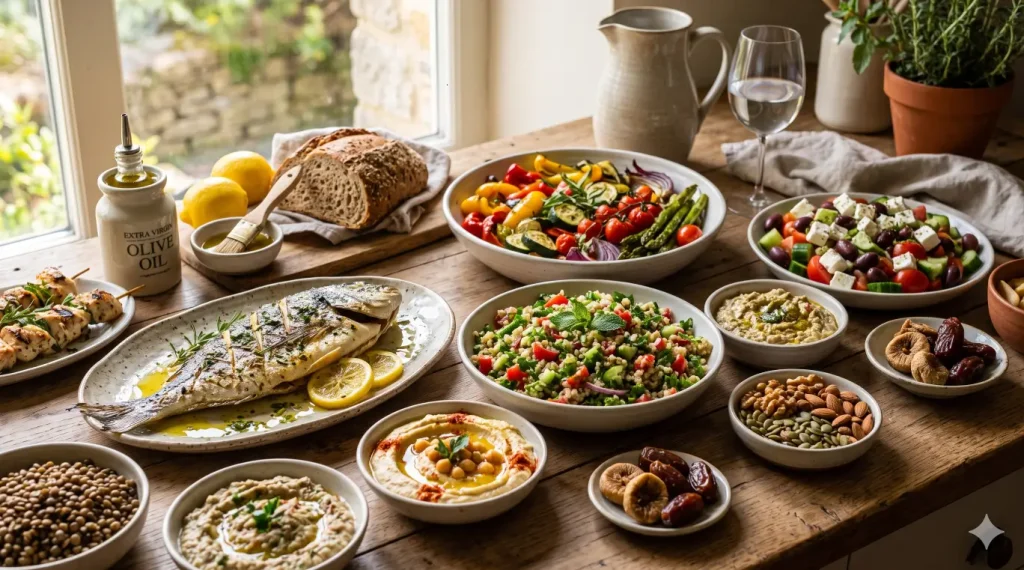
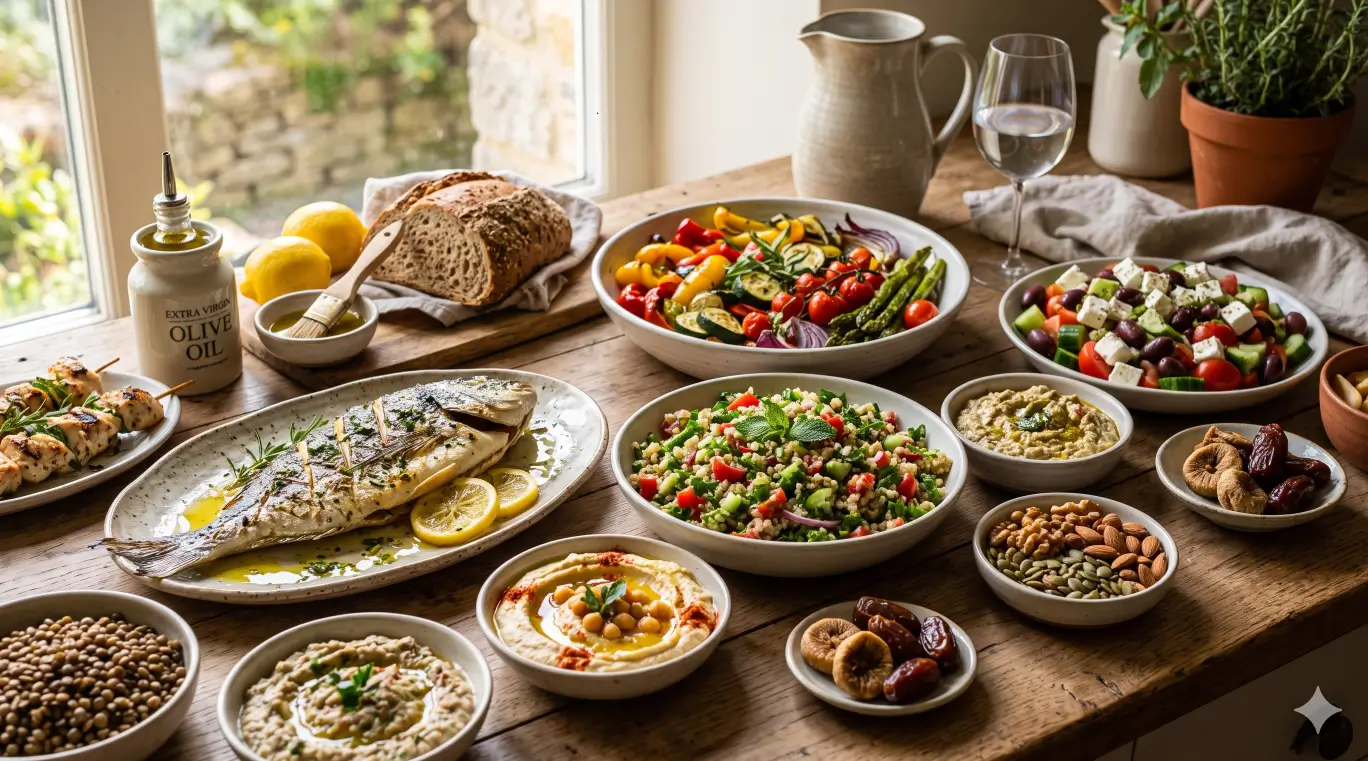
The Mediterranean diet has the opposite biography. It was not invented but observed — a reconstruction of how people traditionally ate in places like Crete and southern Italy in the mid-twentieth century, where heart disease was strikingly rare despite a fat-rich diet. The signature was the fat itself: generous extra-virgin olive oil, not butter. Around it sat fish and seafood, nuts and legumes, abundant vegetables and fruit, and, in cultural context, moderate wine taken with food. It is a pattern with a place and a table behind it, which is part of why it has proven so durable: people do not so much follow it as live in it.
The large overlap most comparisons skip
Before the differences, the agreements — because they are the bulk of the story. Both patterns are built on the same core, and if you adopted only what they share, you would already have most of the benefit of either.
- Vegetables and fruit, in volume. Leafy greens like spinach and kale, cruciferous vegetables such as broccoli, the humble tomato — these are the base layer of both plates.
- Whole grains over refined. Oats, brown rice and other intact grains, rather than white bread and pastry.
- Legumes as a staple, not an afterthought. Lentils, chickpeas and black beans appear on both shopping lists, prized for fibre and plant protein.
- Nuts and seeds. Walnuts and almonds earn a daily handful in each.
- Minimal ultra-processed food and added sugar. Both quietly crowd out packaged snacks, sugary drinks and refined carbohydrate — arguably their single most important shared move.
This overlap is so substantial that the people who eat closest to one pattern tend to score well on the other almost by accident. It also overlaps heavily with the broader whole-food, plant-based approach. If you want a fuller map of both, the diets archive and the foods index show how the same ingredients recur across patterns.
Where they genuinely diverge
The differences are fewer than the similarities, but they matter because they point at different goals.
The signature fat
This is the cleanest dividing line. The Mediterranean pattern leans on monounsaturated fat from olive oil and the fats in fish and nuts, and treats this fat as central rather than something to minimise. DASH was designed within a lower-total-fat framework and gets a meaningful share of its calcium and protein from low-fat dairy — think plain non-fat Greek yoghurt — which the Mediterranean pattern uses more sparingly, favouring oil instead.
Sodium
DASH is explicit about salt; reducing sodium is part of its mechanism, and the classic studies tested a standard and a lower-sodium version, with the lower one performing best for blood pressure. The Mediterranean diet is less prescriptive here. It tends to be lower in sodium than a typical Western diet simply by being less processed, but it sets no firm ceiling — a difference that matters most if blood pressure is your reason for choosing.
Fish, dairy and wine
The Mediterranean pattern puts more deliberate emphasis on oily fish — Atlantic salmon and sardines — for their long-chain omega-3 fats, and it makes room for moderate wine within a cultural, with-meals context that DASH does not formally include. DASH, conversely, leans harder on dairy. Neither difference is enormous in practice, but they shape the texture of the week.
The evidence, graded honestly
Both diets are unusually well supported, but the kind of evidence behind each differs, and that distinction should guide how confidently you read any claim.
DASH and blood pressure: high confidence, narrow target. DASH’s headline benefit rests on randomised controlled feeding trials — the strongest design we have, because researchers supplied the food and could attribute changes directly to the diet. The finding that it lowers blood pressure, with a further reduction when sodium is cut, is about as robust as nutrition evidence gets. The honest caveat is one of scope: those trials measured blood pressure, a risk marker, over weeks to months. They were not long-term studies of whether DASH-eaters go on to have fewer heart attacks or live longer. The link from lower blood pressure to fewer cardiovascular events is well established from other research, so the inference is reasonable — but it is an inference, not something DASH’s own trials demonstrated.
Mediterranean and hard outcomes: strong, but more observational. The Mediterranean pattern has what DASH largely lacks — evidence tied to events that actually matter to people, not just markers. It carries the strongest body of evidence for reduced cardiovascular events, and it is consistently associated with better metabolic health and longer life. Some of this comes from large randomised trials, including the well-known PREDIMED study, which tested a Mediterranean diet supplemented with olive oil or nuts against a lower-fat comparison. Much of the rest, though — particularly the longevity signal — comes from observational cohorts. These studies follow people who chose how to eat, which means the results can be coloured by everything else that travels with health-conscious eating: more exercise, more sleep, fewer cigarettes, more money. Researchers adjust for these factors, but adjustment is never perfect, so the longevity findings deserve a slightly more cautious grade than the cardiovascular-trial evidence.
A general caution applies to both. Dietary-pattern research is genuinely hard: people misremember what they ate, patterns drift over years, and you can rarely blind anyone to the food on their plate. The convergence is what should reassure us — many study designs, many populations, pointing the same way. Treat any single dramatic statistic with suspicion, and trust the direction of the whole.
A typical day on each
Patterns are easier to judge on the plate than on paper.
A Mediterranean day
Breakfast might be oats with almonds and fruit, or wholegrain bread with tomato and a drizzle of olive oil. Lunch leans on a large salad built around lentils or chickpeas, plenty of vegetables, olives and olive oil, perhaps a little cheese. Dinner is often fish — grilled sardines or salmon — with roasted vegetables and a wholegrain, finished with fruit and nuts rather than dessert. Olive oil is the connective tissue of the whole day.
A DASH day
Breakfast might be oats with banana and a serving of non-fat Greek yoghurt. Lunch is a grain bowl of brown rice, black beans and vegetables, kept light on salt and seasoned with herbs, citrus and spice instead. Dinner pairs a modest portion of lean protein or fish with two generous vegetable servings — say broccoli and a baked sweet potato — and the snacks are fruit, unsalted nuts or more yoghurt. The day is engineered to be high in potassium, calcium and magnesium and deliberately low in sodium.
Notice how much the two days rhyme. Swap the olive oil for yoghurt, watch the salt a little more closely, and a Mediterranean day quietly becomes a DASH one.
Which one fits you?
Because the overlap is so large, this is rarely a high-stakes choice. Lean on the differences only where they map onto what you actually want.
Lean DASH if blood pressure is the priority. If you have raised blood pressure, a family history of hypertension, or your clinician has flagged sodium, DASH was purpose-built for exactly this and has the cleanest trial evidence to match. Its structure — explicit servings, a sodium target, dairy for calcium — is an advantage when you want a measurable goal. Foods rich in dietary nitrates, such as beetroot and leafy greens, fit naturally within it and are themselves linked to healthier blood pressure.
Lean Mediterranean for cardiovascular risk, longevity and sheer liveability. If your concern is broader heart health or the long game, the Mediterranean pattern has the strongest outcome evidence and, for many people, the better odds of lasting — because it is built around flavour, olive oil and the pleasure of eating rather than restriction. It is also kind to those avoiding dairy. The fish, nuts and seeds bring omega-3s and plant compounds such as the lignans in seeds and walnuts that a lower-fat pattern may include less of.
Or simply blend them — the quietly best answer for most people. Nothing forces a choice. A Mediterranean base that borrows DASH’s discipline on salt and its low-fat dairy gives you the trial-grade blood-pressure benefit and the outcome-and-enjoyment strengths at once. Build the plate from the shared core — vegetables, fruit, whole grains, legumes, nuts — then use olive oil generously, keep an eye on sodium, eat fish a couple of times a week, and let yoghurt and beans share the protein load. That hybrid is, more or less, what the evidence as a whole points toward.
The real lesson of pitting these two against each other is how rarely it ends in a knockout. Both ask you to eat mostly plants, mostly unprocessed, with a named fat you can build meals around. Get that right and the remaining choice — olive oil or yoghurt, a strict salt target or a relaxed one — is fine-tuning. For more on the foods that anchor both, browse the foods index, and for related deep-dives, see the articles archive.
This article is general information, not medical or dietary advice. If you take blood-pressure medication or have a medical condition, talk to your clinician before changing how you eat.