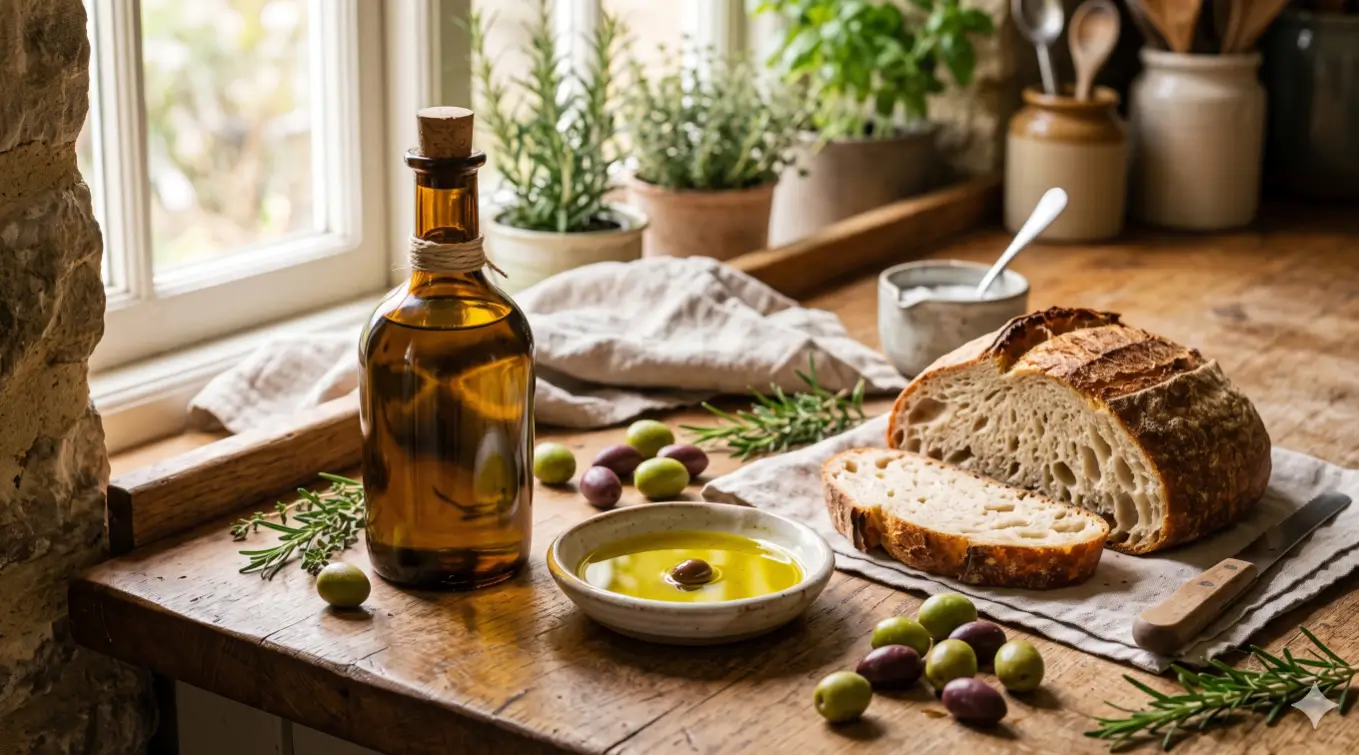
Pour two olive oils into two glasses and they can look like twins: the same gold-green sheen, the same fatty richness when you swirl them. Chemically, their backbone really is nearly identical. But one of them will catch at the back of your throat with a peppery sting, and the other will slide down smooth and say almost nothing. That sting is the whole story. It is the taste of the compounds that refined oil leaves behind, and it is roughly where the interesting health evidence lives. “Extra virgin” is not marketing varnish on the same product. It is a different thing in the glass.
The grades, demystified
Olive oil is graded less by where it comes from than by how it was made and how flawless the result is. There are really two worlds: oils pressed mechanically from the fruit, and oils rescued chemically from what the first pressing could not sell.
Extra virgin olive oil (EVOO) sits at the top. It is pressed from olives by purely mechanical means — crushing and separating, no heat that would damage it, no solvents — and it must pass both a laboratory bar and a tasting panel. Chemically, the headline number is free acidity: extra virgin must come in very low, a sign the fruit was sound and handled quickly. Crucially, a trained panel must find zero sensory defects and at least a whisper of fruitiness. It is, in effect, a fresh fruit juice that happens to be fat.
Virgin olive oil is the same mechanical process, but the oil is allowed slightly higher acidity and a minor defect or two. Perfectly good; just a notch down.
Refined olive oil — sold as “pure” or, confusingly, “light” — is where the second world begins. When a batch is too flawed or too acidic to sell as virgin, it is refined: deodorised, bleached and neutralised until the off-flavours and the free acidity are stripped out. What is left is a clean, neutral fat. “Light” refers to flavour and colour, by the way, never to calories — every olive oil is pure fat, around 120 calories a tablespoon. Most bottles labelled simply “olive oil” are mostly refined oil with a splash of virgin added back for taste.
Olive pomace oil is the bottom rung: oil solvent-extracted from the leftover paste of skins, pulp and pits after pressing, then refined. It is a legitimate cooking fat, but it is the furthest thing from a fresh juice.
What extra virgin has that refined oil doesn’t
Here is the part that matters. The refining that cleans up a flawed oil is not gentle. It strips out the very compounds that make extra virgin distinctive — and those compounds are not the fat. They are the minor constituents riding along in it.
The stars are the polyphenols. Oleocanthal is the one you can feel: it is responsible for that peppery catch at the back of the throat, sharp enough in a good oil to make you cough. Hydroxytyrosol and oleuropein are bitterer notes, antioxidants that also help the oil resist going rancid. Alongside them ride vitamin E and the chlorophyll that lends young oil its green cast. Refining removes most of this. You can keep the fat and lose nearly everything else — which is exactly what “pure” olive oil is.
So when people argue about whether olive oil is “healthy,” they are often talking past each other, because they are talking about two different liquids. The phenolic content is also why taste is a genuine signal here, not snobbery — more on that below.
The fat profile, which they do share
Strip away the polyphenols and what remains is the same across grades: a fat dominated by monounsaturated oleic acid, with modest amounts of saturated and polyunsaturated fat. That monounsaturated backbone is genuinely favourable, and it is shared by extra virgin and refined oil alike. If all you want is to replace butter or a less stable oil with a stable monounsaturated fat for frying, plain refined olive oil does that job perfectly well and cheaply.
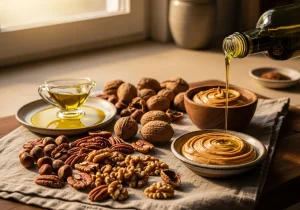
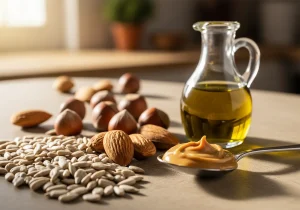
The same oleic-rich, plant-fat pattern shows up across the foods that tend to keep olive oil good company — the walnuts and almonds in a Mediterranean pantry, the oily fish like Atlantic salmon and sardines. Olive oil’s edge over those is not the fat. It is everything the fat carries.
The health evidence, graded honestly
The strongest claim that can be made cleanly is this: diets built around extra virgin olive oil, in the context of a broadly Mediterranean way of eating, are consistently associated with better cardiovascular outcomes. That signal turns up across many observational cohorts and at least one large randomised trial, and it points reliably in the same direction. The evidence for the overall Mediterranean diet pattern is about as good as nutrition evidence gets.
The famous reference point is PREDIMED, a Spanish randomised trial that assigned people at cardiovascular risk to a Mediterranean diet supplemented with either extra virgin olive oil or nuts, against a control group advised to cut fat. The olive-oil households were given generous quantities — on the order of a litre a week per household — precisely so that olive oil was a real, daily feature rather than a token drizzle. The trial’s direction favoured the Mediterranean-with-EVOO pattern for heart-related events. It is worth knowing the trial had its analysis revisited and re-published over a randomisation issue; the headline conclusion survived, but it is a fair reminder that even the best nutrition trials are messy.
The proposed mechanism for the polyphenols is where things get genuinely interesting and where it is easiest to overclaim. Oleocanthal has been shown in the laboratory to act a little like ibuprofen — dampening the same inflammatory enzymes, which is poetically why both share that throat-stinging quality. This is a real and intriguing finding. It is also a long way from “a salad dressing is a painkiller.” The doses, the context and the human relevance are all unsettled. Treat it as a plausible piece of why, not as a reason to pour another glass.
A sober summary: strong and consistent for the dietary pattern; reasonable for extra virgin olive oil specifically as part of it; mechanistically interesting but uncertain for any single compound in isolation. Observational nutrition research can show that olive-oil-eaters fare better; it struggles to prove the oil is the cause rather than the company it keeps. Keep that humility.
The smoke-point myth
You will often hear that extra virgin olive oil is too delicate to cook with — that it has a low smoke point and turns harmful the moment a pan gets warm. This is largely a myth, and it persists because smoke point is the wrong yardstick.
What actually matters for a cooking fat is oxidative stability: how well it resists breaking down into off-flavours and degradation products under heat. On that measure, extra virgin olive oil does well — better than its reputation — and part of the reason is precisely those polyphenols and antioxidants, which protect the oil as it heats. Its high monounsaturated content helps too. For the everyday reality of a home kitchen — sautéing garlic, roasting broccoli, softening onions, frying an egg — extra virgin is a perfectly sound, even preferable, choice.
The honest caveat is one of economy, not safety. Heat does gradually degrade the delicate polyphenols and aromas you paid a premium for. So the sensible split is practical: cook with a decent everyday extra virgin or a plain refined oil, and save your finest, peppery, expensive bottle for finishing — raw, off the heat, where its flavour and its phenolics arrive intact. A thread of good oil over lentils, warm chickpeas, a ripe tomato, or wilted kale is where extra virgin earns its keep.
How to buy well
Most of what a bottle wants to tell you is on the label, if you know where to look.
- Hunt for a harvest or pressing date, not just “best before”. Olive oil is a fresh product that fades; the harvest date tells you how fresh, while a best-before two years out tells you almost nothing.
- Buy dark glass or tin. Light is one of the great enemies of olive oil. Clear bottles on a bright shelf are already losing the plot. Tins and dark green glass protect what is inside.
- Look for protected-origin or quality seals. A genuine protected-designation mark or a credible regional seal is not a guarantee, but it raises the floor.
- Trust the taste test. Good extra virgin should taste of something: fruity, then bitter, then peppery, often with that cough-prompting kick at the finish. Bitterness and pepperiness are not flaws — they are the literal taste of the polyphenols. An oil that tastes of nothing, or faintly greasy and stale, is telling you what it lost.
If you want to go deeper on a single bottle, our extra virgin olive oil profile lays out the nutrition numbers, and the wider foods index is a good way to build the rest of the pantry around it.
Storing it so it lasts
The same three enemies that ruin oil on the shop shelf ruin it in your kitchen: light, heat and air. Each one accelerates oxidation, the slow chemical staling that turns bright oil flat and eventually rancid, and that quietly degrades the polyphenols along the way.
So keep the bottle cool, dark and sealed. A cupboard away from the hob beats a pretty cruet next to the stove. Re-cap it after every use to limit air. Buy a size you will finish within a few months rather than a catering tin you will nurse for a year, and resist decanting your good oil into a clear glass bottle on the windowsill — that is sunlight doing slow damage in plain sight.
How much, in practice
There is no need to medicalise this. In the trials and traditional diets where olive oil looks best, it is not a supplement taken by the spoonful but the everyday fat of the kitchen — a few tablespoons a day woven through cooking and dressing, in the low tens of grams. That is roughly the PREDIMED household’s litre-a-week, shared out across meals and people.
The most useful framing is to stop thinking of olive oil as a health product and start thinking of it as the thing that makes vegetables and pulses worth eating every day. It is what carries flavour onto spinach and roasted red peppers, the binding fat of the DASH and Mediterranean patterns alike. Used that way, generously and on real food, the dose tends to take care of itself. For more in this vein, the articles archive covers the rest of the Mediterranean pantry.
Buy extra virgin. Pay attention to the date and the bottle. Keep it in the dark. Let the peppery ones do their work raw, and don’t be afraid to cook with the rest. That is most of what “extra virgin” really buys you — not a miracle, but a genuinely better liquid, and a good reason to eat more plants.
This article is general information, not medical or dietary advice.