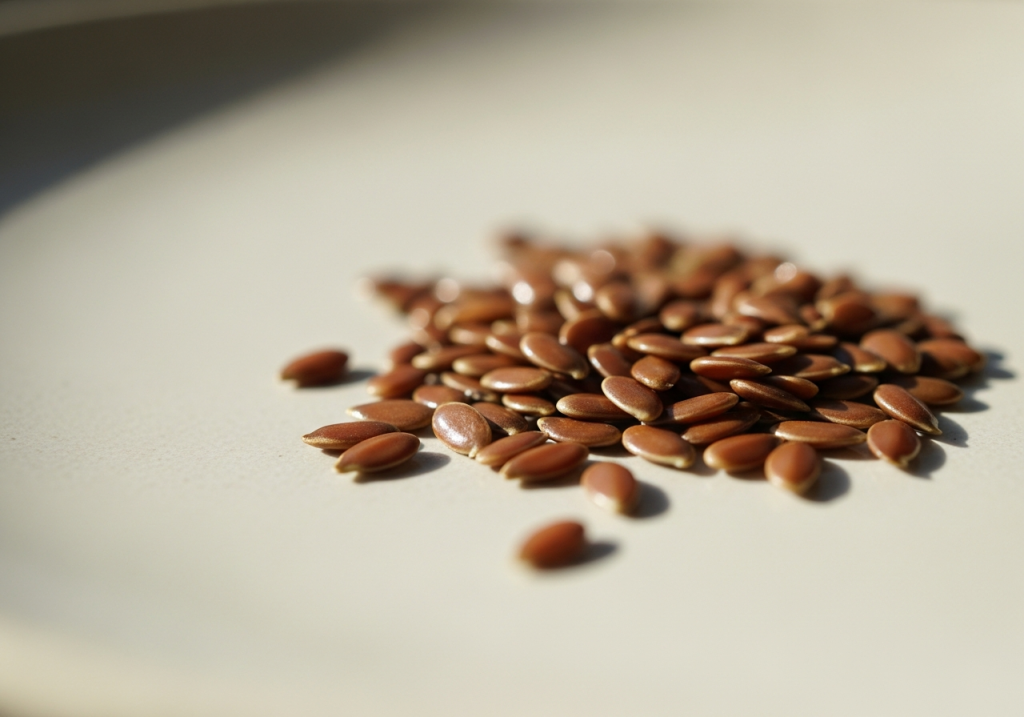
Flaxseed is the richest common plant source of alpha-linolenic acid (ALA), the short-chain omega-3 fatty acid that the body can partially convert into the longer-chain EPA and DHA found in fish. A 10 g portion of ground flaxseed delivers roughly 2.4 g of ALA, useful lignans and both soluble and insoluble fibre. That combination is why flaxseed appears in research on heart health and blood sugar control.
Compounds & anti-nutrients in Flaxseed
Per 100 g, Flaxseed is a notable dietary source of these active compounds. Tap any to see its full sources map and how to work with it.
- Selenium 135.9 µg 247.1% DV
- Copper 1.34 mg 149.3% DV
- Manganese 2.4 mg 104.6% DV
- Magnesium 372.1 mg 88.6% DV
- Dietary Fibre 23.13 g 82.6% DV
- Phosphorus 556.4 mg 44.5% DV
- Zinc 4.74 mg 43.1% DV
- Iron 5.78 mg 32.1% DV
- Vitamin B6 0.39 mg 23.1% DV
- Calcium 229.9 mg 17.7% DV
- Potassium 793.4 mg 16.9% DV
- Choline 78.7 mg 14.3% DV
- Phytates 2,700 mg
- Lignans 300 mg
- Omega-3 19.42 g
- Monounsaturated Fat 5.94 g
- Oxalates 2.9 mg
Why flaxseed is good for you
Flaxseed’s omega-3 content is its headline, but the lignans are equally important. Lignans are plant polyphenols with weak oestrogenic and antioxidant activity, and flaxseed contains far more of them than any other common food. The fibre content is also high: partly soluble, which helps lower cholesterol, and partly insoluble, which supports bowel regularity. The caveats are bioavailability and form: whole flaxseed often passes through undigested, whereas ground flaxseed releases the nutrients.
Flaxseed nutrition at a glance
The label shows the numbers, but the practical message is that a tablespoon of ground flaxseed is a cheap, neutral-flavoured nutritional multiplier. Sprinkle it on oatmeal, blend it into smoothies, or add it to bread and muffin batter.
How to buy and use flaxseed
Buy ground flaxseed for nutrition; whole flaxseed is useful as a laxative but does not release ALA or lignans well. Store ground flaxseed in an airtight container in the fridge because the oils oxidise quickly at room temperature. Use it in oatmeal with blueberries, blended into smoothies, or stirred into yoghurt with oats and cinnamon. A tablespoon per day is enough for the evidence-based benefits.
Common questions
Is flaxseed better than fish oil? For ALA, yes — flaxseed is the richest plant source. For EPA and DHA, fish oil is far more efficient because the conversion from ALA is limited, especially in men.
Can I eat flaxseed every day? Yes — a tablespoon of ground flaxseed daily is well within safe intake and matches the amounts used in most trials.
Explore by health goal
Flaxseed is one of many foods that support these goals: