“High protein, low calorie” is really one measurement: how much protein a food delivers per calorie. This page ranks foods by grams of protein per 100 kcal, which is the number that decides whether a food helps when you are eating to a calorie target.
To qualify, a food has to supply at least 10 g of protein per 100 g and no more than 200 kcal. Both conditions are necessary. Ranked on ratio alone, white mushrooms — 3.1 g of protein and 22 kcal — would beat chicken breast, which tells you something true about mushrooms and nothing useful about protein. Dried herbs and spices are excluded, along with garlic, chilli, and drinks. Per 100 g they dominate almost every nutrient ranking — dried oregano is 42 g fibre — but nobody eats them in 100 g quantities, so including them would push genuinely useful foods off the list. Figures are per 100 g of the edible portion as catalogued on each food page: dry weight for grains and legumes, raw unless the food page says otherwise.
Tuna (canned, light) — top of the list
| Total Fat | 0.96 g |
|---|---|
| Saturated Fat | 0.21 g |
| Sodium | 247 mg |
| Potassium | 179 mg |
| Total Carbohydrate | 0 g |
| Dietary Fiber | 0 g |
| Total Sugars | 0 g |
| Protein | 19.44 g |
Highest protein per calorie
| # | Food | Protein per 100 g | Calories per 100 g | Protein per 100 kcal |
|---|---|---|---|---|
| 1 | Tuna (canned, light) | 19.4 g | 86 kcal | 22.6 g |
| 2 | Shrimp | 15.6 g | 71 kcal | 21.8 g |
| 3 | Cod | 17.8 g | 82 kcal | 21.7 g |
| 4 | Turkey Breast | 23.7 g | 114 kcal | 20.8 g |
| 5 | Tilapia | 19.0 g | 95 kcal | 20.1 g |
| 6 | Chicken Breast | 31.0 g | 165 kcal | 18.8 g |
| 7 | Pork Tenderloin | 21.6 g | 119 kcal | 18.2 g |
| 8 | Scallops | 12.1 g | 69 kcal | 17.5 g |
| 9 | Greek Yogurt (plain, nonfat) | 10.3 g | 61 kcal | 16.9 g |
| 10 | Lean Beef (95% lean) | 21.4 g | 137 kcal | 15.6 g |
| 11 | Lamb | 20.9 g | 143 kcal | 14.6 g |
| 12 | Rainbow Trout | 19.9 g | 141 kcal | 14.1 g |
| 13 | Mussels | 11.9 g | 86 kcal | 13.8 g |
| 14 | Duck | 18.3 g | 135 kcal | 13.6 g |
| 15 | Cottage Cheese | 10.4 g | 81 kcal | 12.9 g |
| 16 | Tofu | 17.3 g | 144 kcal | 12.0 g |
| 17 | Ground Turkey | 17.3 g | 153 kcal | 11.3 g |
| 18 | Tempeh | 20.3 g | 192 kcal | 10.6 g |
| 19 | Salmon (Atlantic) | 20.3 g | 197 kcal | 10.3 g |
| 20 | Edamame | 11.9 g | 121 kcal | 9.8 g |
| 21 | Eggs | 12.6 g | 143 kcal | 8.8 g |
How to read this
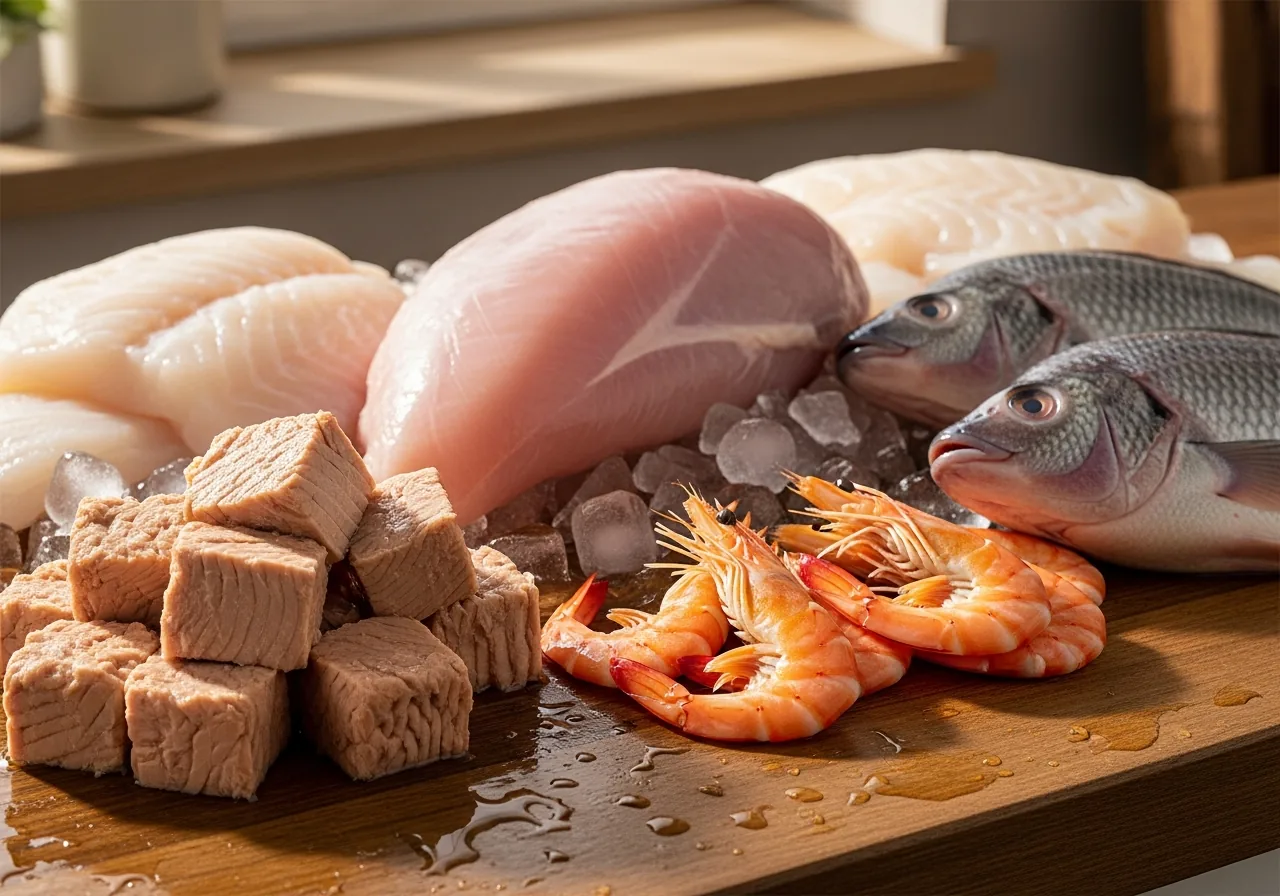
Tuna (canned, light) tops the list at 22.6 g of protein per 100 kcal. Protein carries about 4 kcal per gram, so that works out at roughly 90% of its calories coming from protein. Anything above 15 g per 100 kcal — around 60% of calories from protein — is exceptionally dense, and in practice that means lean fish, shellfish, poultry breast and non-fat dairy. Whole eggs sit near the bottom of this list not because they are a poor protein source but because their fat content brings calories with it.
Protein-dense foods are also the most satiating per calorie, which is the mechanism behind most of the appetite benefit people attribute to high-protein diets. That effect comes from the protein and the volume together, so pairing anything on this list with a high-fibre vegetable does more than either alone.
Common questions
What is the best high-protein, low-calorie food? Tuna (canned, light) leads this ranking at 22.6 g of protein per 100 kcal. Lean fish, shellfish, poultry breast and non-fat dairy occupy most of the top of the list, because they carry protein with very little fat alongside it.
Does eating more protein help with weight loss? Protein is the most satiating of the three macronutrients per calorie, which is the mechanism behind most of the appetite effect attributed to high-protein diets. It works by making it easier to eat less overall rather than through anything protein does directly — and volume matters as much as the protein itself, so pairing anything here with a high-fibre vegetable does more than either alone.
Are eggs a high-protein, low-calorie food? High-protein yes, low-calorie less so: whole eggs sit near the bottom of this ranking because their fat brings calories with it. That is a comment on this one narrow measurement rather than on eggs. A lower place here means calories arriving alongside the protein, which is also the reason salmon and eggs are worth eating in the first place.