This is a ranking of the 111 foods in our database by protein content per 100 g, taken from USDA measurements rather than estimates. Alongside each food you will find its calorie count and its protein density — grams of protein per 100 kcal — because those three numbers together answer a question that protein alone cannot.
Dried herbs and spices are excluded, along with garlic, chilli, and drinks. Per 100 g they dominate almost every nutrient ranking — dried oregano is 42 g fibre — but nobody eats them in 100 g quantities, so including them would push genuinely useful foods off the list. Figures are per 100 g of the edible portion as catalogued on each food page: dry weight for grains and legumes, raw unless the food page says otherwise.
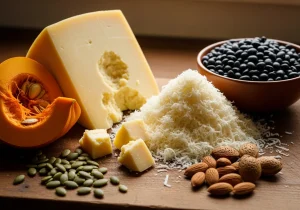
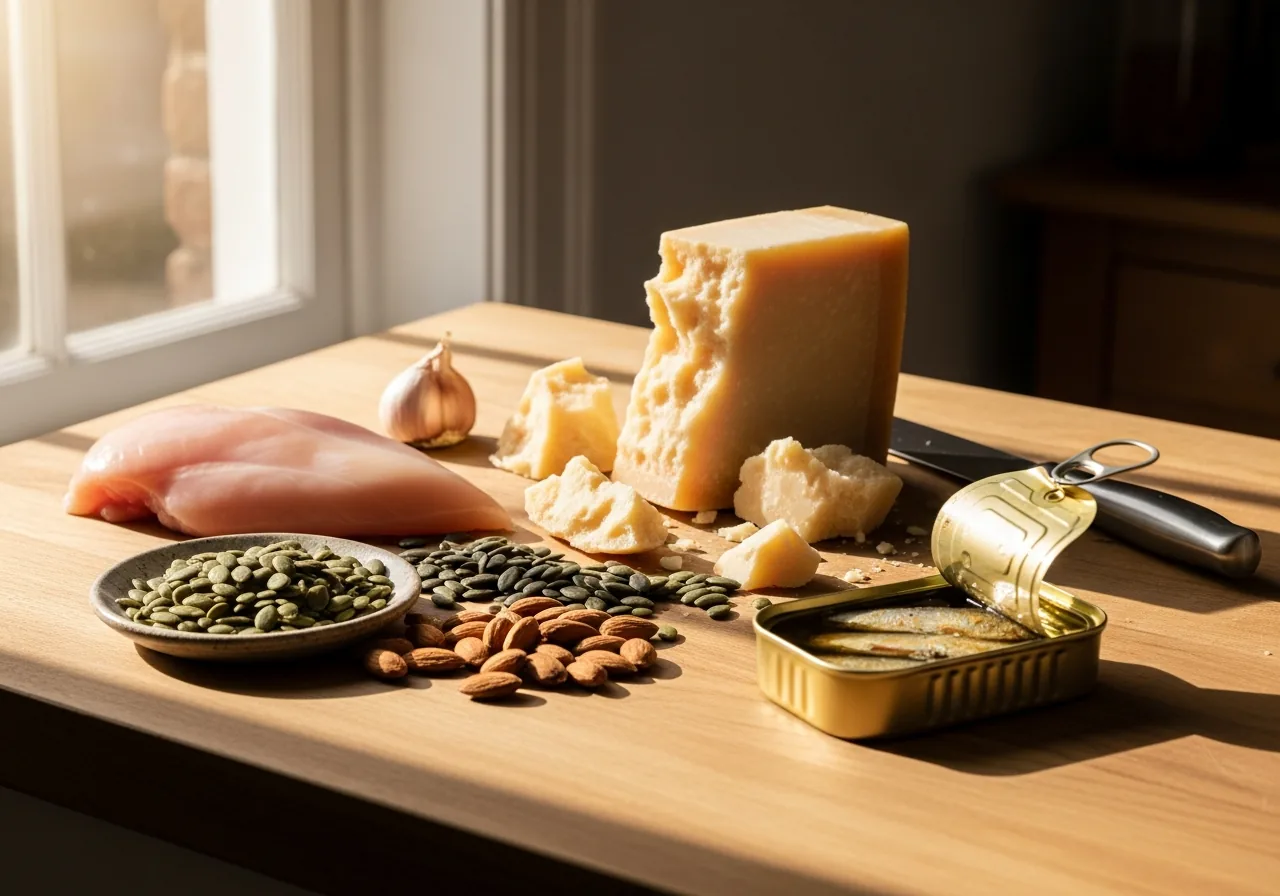
Parmesan — top of the list
| Total Fat | 25 g |
|---|---|
| Saturated Fat | 14.85 g |
| Sodium | 1175 mg |
| Potassium | 92 mg |
| Total Carbohydrate | 3.22 g |
| Dietary Fiber | 0 g |
| Total Sugars | 0.11 g |
| Protein | 35.75 g |
Foods highest in protein, per 100 g
| # | Food | Protein per 100 g | Calories per 100 g | Protein per 100 kcal |
|---|---|---|---|---|
| 1 | Parmesan | 35.8 g | 392 kcal | 9.1 g |
| 2 | Chicken Breast | 31.0 g | 165 kcal | 18.8 g |
| 3 | Pumpkin Seeds | 29.9 g | 555 kcal | 5.4 g |
| 4 | Sardines | 24.6 g | 208 kcal | 11.8 g |
| 5 | Black Beans | 24.4 g | 341 kcal | 7.2 g |
| 6 | Cheddar Cheese | 24.2 g | 410 kcal | 5.9 g |
| 7 | Peanut Butter | 24.0 g | 632 kcal | 3.8 g |
| 8 | Turkey Breast | 23.7 g | 114 kcal | 20.8 g |
| 9 | Lentils | 23.6 g | 360 kcal | 6.6 g |
| 10 | Kidney Beans | 22.5 g | 337 kcal | 6.7 g |
| 11 | Mozzarella | 22.2 g | 299 kcal | 7.4 g |
| 12 | Pork Tenderloin | 21.6 g | 119 kcal | 18.2 g |
| 13 | Almonds | 21.5 g | 626 kcal | 3.4 g |
| 14 | Pinto Beans | 21.4 g | 347 kcal | 6.2 g |
| 15 | Lean Beef (95% lean) | 21.4 g | 137 kcal | 15.6 g |
| 16 | Chickpeas | 21.3 g | 383 kcal | 5.6 g |
| 17 | Lamb | 20.9 g | 143 kcal | 14.6 g |
| 18 | Pistachios | 20.5 g | 598 kcal | 3.4 g |
| 19 | Tempeh | 20.3 g | 192 kcal | 10.6 g |
| 20 | Salmon (Atlantic) | 20.3 g | 197 kcal | 10.3 g |
| 21 | Rainbow Trout | 19.9 g | 141 kcal | 14.1 g |
| 22 | Tuna (canned, light) | 19.4 g | 86 kcal | 22.6 g |
| 23 | Tilapia | 19.0 g | 95 kcal | 20.1 g |
| 24 | Sunflower Seeds | 18.9 g | 609 kcal | 3.1 g |
| 25 | Mackerel | 18.6 g | 205 kcal | 9.1 g |
Why the top of the list is not the best protein food
Parmesan leads on grams per 100 g, but a portion is nearer 15 g than 100 g, and it brings 392 kcal per 100 g with it. Turkey Breast sits lower in the raw ranking and is the more efficient choice: 23.7 g of protein for 114 kcal, or 20.8 g per 100 kcal.
This is why the last column matters. Nuts, seeds and hard cheeses are protein-rich but calorie-dense; fish, poultry and low-fat dairy are protein-dense. Both belong in a diet. Which one belongs in a given meal depends on whether calories are a constraint. If they are, the protein-density ranking is the more useful list.
Plant and animal sources
Legumes, tempeh, tofu, nuts and seeds all appear in the top 25 on grams per 100 g. The practical differences are amino acid profile and what else arrives with the protein: beans and lentils bring substantial fibre, nuts bring unsaturated fat and calories, and animal sources bring vitamin B12 and more readily absorbed iron and zinc. Diets built on either can meet protein needs comfortably; mixed plant sources across a day cover the amino acid question without any need to combine them at a single meal.
Common questions
How much protein do you need a day? More than the minimum in most cases, and less than the internet suggests. It scales with body weight and activity rather than being a single number — see our guide to protein requirements.
What food has the most protein? Parmesan, at 35.8 g per 100 g across the 111 foods measured here. Grams per 100 g is only half the picture, though: portion size and the calories arriving alongside decide how useful that is in an actual meal, which is what the last column of the table is for.
Can you eat too much protein? In healthy people, intakes well above the recommended amount have not been shown to cause harm — past a point they simply stop adding benefit rather than becoming a problem. The picture differs for anyone with kidney disease, where protein intake is something to set with their own clinician.