If you want to eat a larger volume of food for fewer calories, this is the list to build meals around. It ranks the 111 foods in our database from the fewest calories per 100 g upwards, with the fibre and protein alongside — because those two decide whether a light food actually leaves you full.
Dried herbs and spices are excluded, along with garlic, chilli, and drinks. Per 100 g they dominate almost every nutrient ranking — dried oregano is 42 g fibre — but nobody eats them in 100 g quantities, so including them would push genuinely useful foods off the list. Figures are per 100 g of the edible portion as catalogued on each food page: dry weight for grains and legumes, raw unless the food page says otherwise.
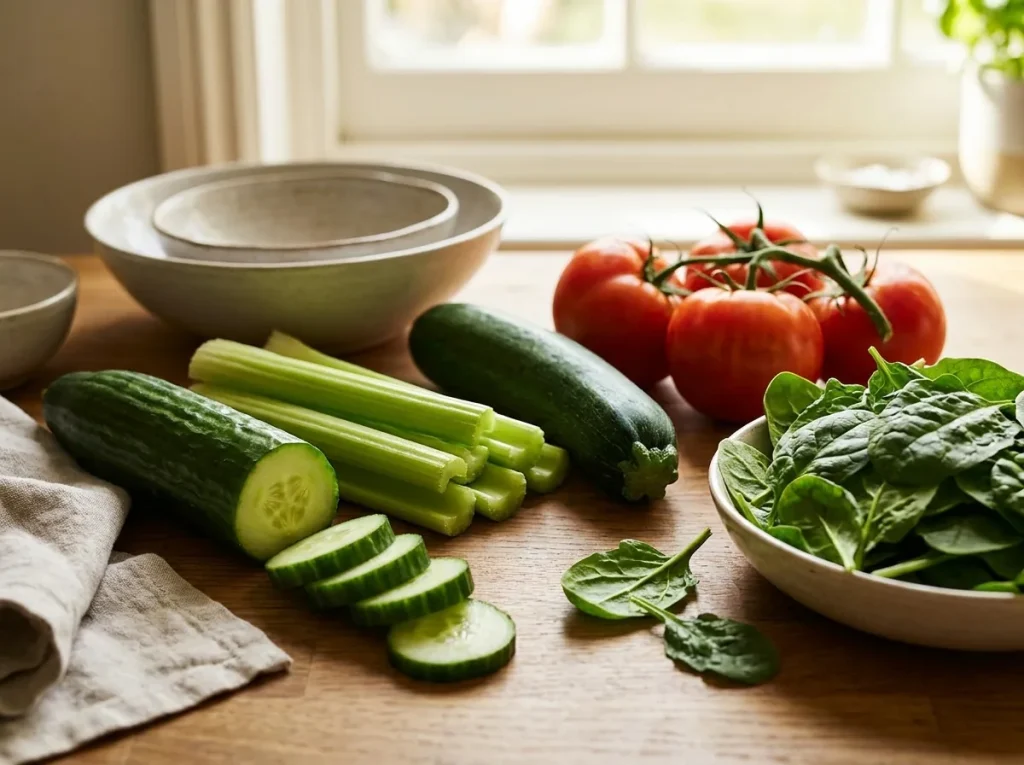
Cucumber — top of the list
| Total Fat | 0.18 g |
|---|---|
| Saturated Fat | 0.037 g |
| Sodium | 1.52 mg |
| Potassium | 170 mg |
| Total Carbohydrate | 2.95 g |
| Dietary Fiber | 0.5 g |
| Total Sugars | 1.67 g |
| Protein | 0.63 g |
Foods lowest in calories, per 100 g
| # | Food | Calories per 100 g | Fibre | Protein |
|---|---|---|---|---|
| 1 | Cucumber | 16 kcal | 0.5 g | 0.6 g |
| 2 | Celery | 17 kcal | 1.6 g | 0.5 g |
| 3 | Courgette (Zucchini) | 17 kcal | 1.0 g | 1.2 g |
| 4 | Tomato | 18 kcal | 1.2 g | 0.9 g |
| 5 | Rhubarb | 21 kcal | 1.8 g | 0.9 g |
| 6 | White Mushrooms | 22 kcal | 1.0 g | 3.1 g |
| 7 | Spinach | 23 kcal | 2.2 g | 2.9 g |
| 8 | Eggplant | 25 kcal | 3.0 g | 1.0 g |
| 9 | Pumpkin | 26 kcal | 0.5 g | 1.0 g |
| 10 | Cauliflower | 28 kcal | 1.9 g | 1.6 g |
| 11 | Asparagus | 28 kcal | 1.9 g | 1.4 g |
| 12 | Lemon | 29 kcal | 2.8 g | 1.1 g |
| 13 | Lime | 30 kcal | 2.8 g | 0.7 g |
| 14 | Grapefruit | 30 kcal | 1.1 g | 0.6 g |
| 15 | Watermelon | 30 kcal | 0.4 g | 0.6 g |
| 16 | Red Bell Pepper | 31 kcal | 1.2 g | 0.9 g |
| 17 | Cabbage | 31 kcal | 2.5 g | 1.0 g |
| 18 | Skim Milk | 34 kcal | 0.0 g | 3.4 g |
| 19 | Broccoli | 34 kcal | 2.6 g | 2.8 g |
| 20 | Kale | 35 kcal | 4.1 g | 2.9 g |
| 21 | Strawberries | 36 kcal | 2.0 g | 0.6 g |
| 22 | Peach | 39 kcal | 1.5 g | 0.9 g |
| 23 | Green Beans | 40 kcal | 3.0 g | 2.0 g |
| 24 | Carrot | 41 kcal | 2.8 g | 0.9 g |
| 25 | Papaya | 43 kcal | 1.7 g | 0.5 g |
Why the list is almost entirely vegetables and fruit
Water. It has no calories and it takes up space, so the more of it a food holds the lower its calorie density falls. Working back from the macronutrients, everything in the table above is somewhere between roughly 88 and 96% water by weight — cucumber, at the top, is about 96% — and that single variable does more work here than anything else.
The range across the whole database is wider than people expect: cucumber at 16 kcal per 100 g against extra virgin olive oil at 884 — a factor of 56 for the same weight of food. 35 of the 111 foods measured here come in under 50 kcal. See calorie density explained for how the full range is distributed.
Light is not the same as filling
This is the distinction the raw ranking hides. Cucumber is the lightest food here and one of the least satisfying — 0.5 g of fibre and 0.6 g of protein per 100 g means it adds volume and very little else. Further down the same table, white mushrooms, spinach, skim milk, broccoli and kale all stay under 40 kcal while carrying real protein, and kale brings 4.1 g of fibre for 35 kcal.
Those are the entries worth reaching for first. Fibre slows digestion and adds bulk that stays bulky; protein is the most satiating macronutrient per calorie. A food that is merely light gives you a full plate for twenty minutes.
One caveat on reading the table: a few entries are ranked accurately but rarely eaten in 100 g portions. Lemon and lime sit near the top because per 100 g is the unit, not because anyone eats a whole lemon. Take the vegetables, berries and melon as the practical volume foods.
How to use this
The move is not a diet of cucumber. It is to let the bulk of a meal come from this list and keep the flavour and staying power from elsewhere — a large base of vegetables, then a protein source and a measured amount of fat. You end up with a big plate, a moderate calorie count, and none of the sense of restriction that makes a way of eating collapse after three weeks.
Pairing is what makes it work. Anything here alongside a genuinely protein-dense food does more than either on its own; see high-protein, low-calorie foods for that side of the equation. And if the problem is the opposite one — struggling to eat enough — high-calorie foods covers it.
Common questions
What food has the lowest calories? Cucumber, at 16 kcal per 100 g across the 111 foods measured here, followed by celery and courgette (zucchini). All three are around 95% water, which is the reason rather than anything specific to those plants.
Are there any negative calorie foods? No. The idea is that chewing and digesting something like celery burns more energy than it supplies, and it does not hold up: digestion uses roughly 5–10% of the energy in a carbohydrate-rich food, so celery’s 17 kcal costs about 1 kcal to process. Very low is real; below zero is not. The useful version of the idea is exactly what this page is about — foods light enough that portion size stops mattering much.
Can you eat unlimited amounts of low-calorie foods? In practice you will stop long before it becomes a problem, because volume is self-limiting in a way calories are not. Two caveats worth knowing: a large jump in fibre causes bloating and discomfort if you make it suddenly rather than over a week or two, and “unlimited” tends to fall apart at the point where things are cooked in oil or dressed, which is where most of the calories in a vegetable-heavy meal actually come from.
Do low-calorie foods help you lose weight? They help by making a lower intake easier to sustain rather than through any effect of their own. People tend to eat a fairly consistent weight of food day to day, so shifting the composition towards foods that weigh a lot and carry little energy reduces the total without reducing the amount on the plate. That is a mechanism for adherence, which is usually the thing that decides the outcome.