Saturated fat is one of the more closely watched numbers on a nutrition label, particularly for anyone thinking about heart health. Below is a data-backed ranking of the foods in our database with the least saturated fat per 100 g.
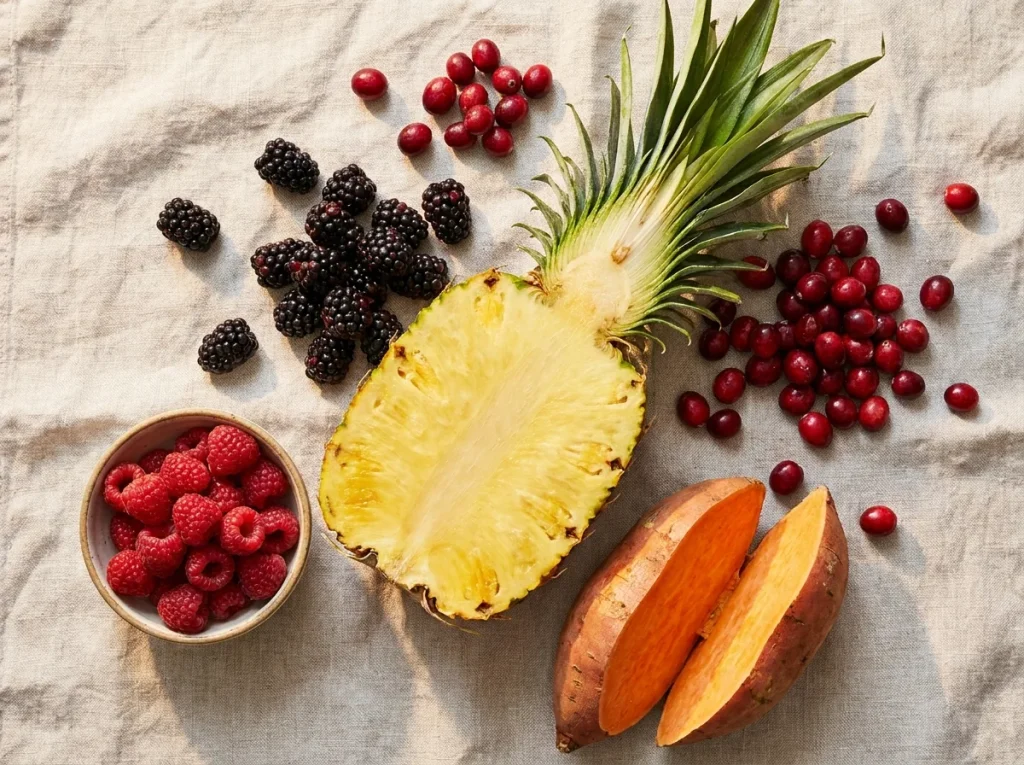
Brewed coffee and tea are left out of this ranking — Coffee would otherwise lead it — because they are almost entirely water, so they sit at or near zero in every nutrient table — true, but not a useful thing to learn from a list of foods.
| # | Food | Saturated Fat |
|---|---|---|
| 1 | Pineapple | 0.009 g |
| 2 | Blackberries | 0.01 g |
| 3 | Cranberry | 0.01 g |
| 4 | Grapefruit | 0.01 g |
| 5 | Sweet Potato | 0.018 g |
| 6 | Raspberries | 0.019 g |
| 7 | Elderberry | 0.02 g |
| 8 | Lime | 0.02 g |
| 9 | Orange | 0.02 g |
| 10 | Peach | 0.02 g |
| 11 | Pear | 0.02 g |
| 12 | Plum | 0.02 g |
| 13 | Strawberries | 0.02 g |
| 14 | Watermelon | 0.02 g |
| 15 | Butternut Squash | 0.021 g |
| 16 | Blueberries | 0.028 g |
| 17 | Kiwifruit | 0.029 g |
| 18 | Apple | 0.03 g |
| 19 | Apricot | 0.03 g |
| 20 | Beetroot | 0.03 g |
| 21 | Carrot | 0.03 g |
| 22 | Eggplant | 0.03 g |
| 23 | Potato | 0.03 g |
| 24 | Tomato | 0.03 g |
| 25 | Cabbage | 0.034 g |
Fruits and vegetables take every place in the top 25, which tracks with what the evidence generally shows: saturated fat concentrates mainly in animal fats, full-fat dairy, and a handful of tropical oils, rather than in plant foods. Legumes and whole grains are not far behind — lentils carry just 0.05 g per 100 g, and even chickpeas, one of the fattier pulses, stay under 1 g.
Common questions
Is all saturated fat equally a concern? Most current guidance treats saturated fat as a category to moderate rather than eliminate, generally in favour of unsaturated fats from foods like nuts, seeds, olive oil and oily fish. The wider pattern of your diet matters more than any single food.
Do plant foods ever contain much saturated fat? A few do — coconut and palm oil are the standout exceptions, both far higher in saturated fat than most other plant foods. Otherwise, saturated fat in a typical diet comes overwhelmingly from animal and dairy sources.