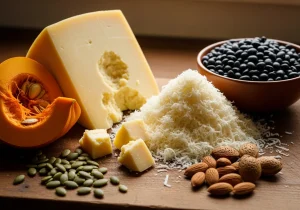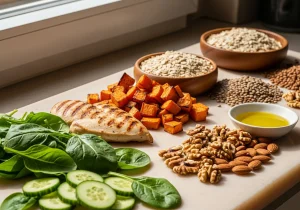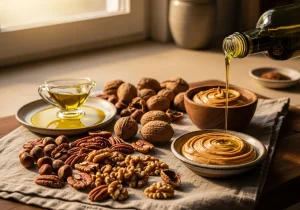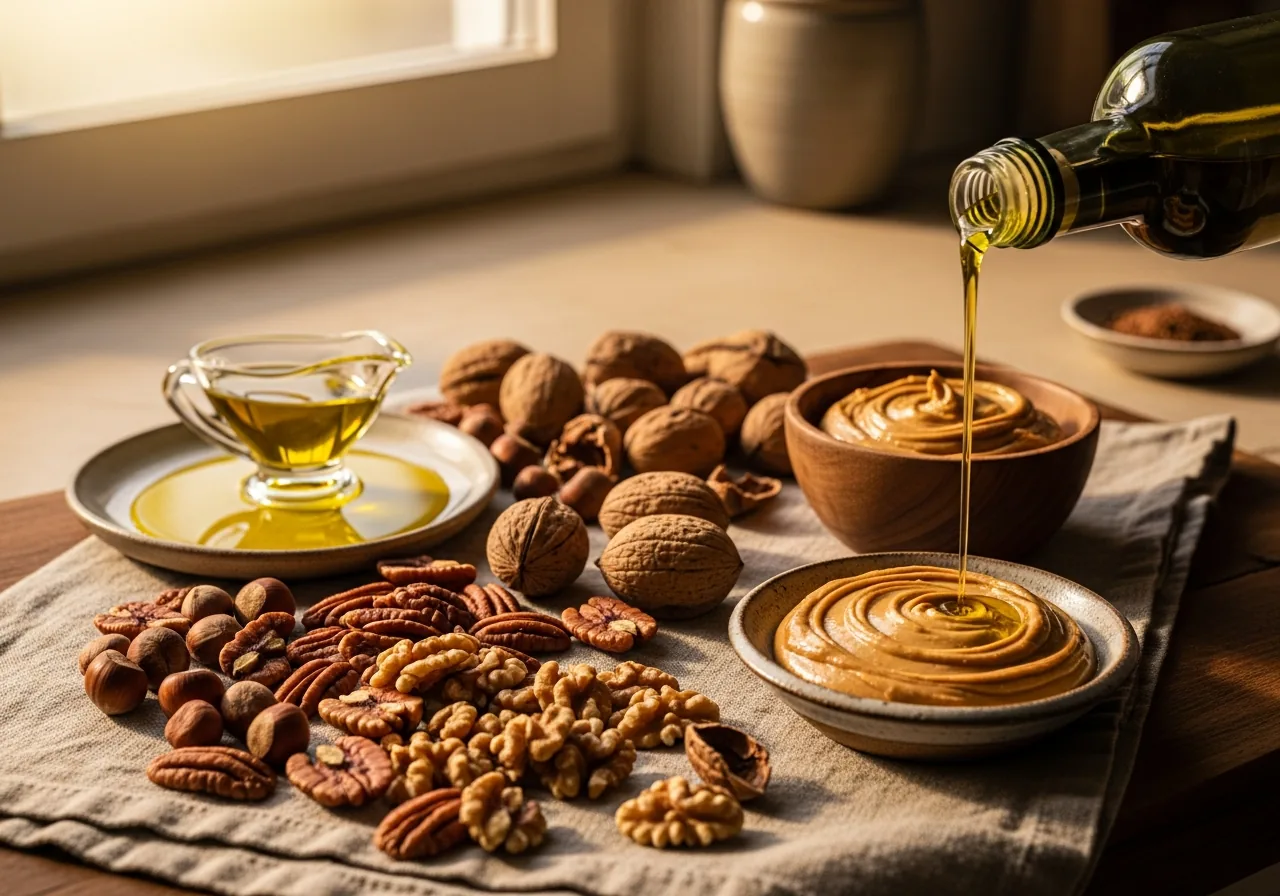
The most calorie-dense foods in this database are olive oil, nuts and seeds. Not biscuits, not fried food — those simply are not catalogued here. That makes this a more useful list than most, because it answers the question people actually have when they search for high-calorie foods: how do I get more energy into a day without eating an enormous volume of food?
Ranked by calories per 100 g, with the fat, carbohydrate and protein behind each number so you can see what is driving it. Dried herbs and spices are excluded, along with garlic, chilli, and drinks. Per 100 g they dominate almost every nutrient ranking — dried oregano is 42 g fibre — but nobody eats them in 100 g quantities, so including them would push genuinely useful foods off the list. Figures are per 100 g of the edible portion as catalogued on each food page: dry weight for grains and legumes, raw unless the food page says otherwise.
Extra Virgin Olive Oil — top of the list
| Total Fat | 100 g |
|---|---|
| Saturated Fat | 15.4 g |
| Sodium | 2 mg |
| Potassium | 1 mg |
| Total Carbohydrate | 0 g |
| Dietary Fiber | 0 g |
| Total Sugars | 0 g |
| Protein | 0 g |
Highest-calorie foods, per 100 g
| # | Food | Calories per 100 g | Fat | Carbs | Protein |
|---|---|---|---|---|---|
| 1 | Extra Virgin Olive Oil | 884 kcal | 100.0 g | 0.0 g | 0.0 g |
| 2 | Pecans | 750 kcal | 73.3 g | 12.7 g | 10.0 g |
| 3 | Walnuts | 730 kcal | 69.7 g | 10.9 g | 14.6 g |
| 4 | Hazelnuts | 641 kcal | 53.5 g | 26.5 g | 13.5 g |
| 5 | Peanut Butter | 632 kcal | 49.4 g | 22.7 g | 24.0 g |
| 6 | Almonds | 626 kcal | 51.1 g | 20.0 g | 21.5 g |
| 7 | Sunflower Seeds | 609 kcal | 48.4 g | 24.5 g | 18.9 g |
| 8 | Pistachios | 598 kcal | 45.0 g | 27.7 g | 20.5 g |
| 9 | Dark Chocolate (70–85%) | 598 kcal | 42.6 g | 45.9 g | 7.8 g |
| 10 | Sesame Seeds | 573 kcal | 49.7 g | 23.4 g | 17.7 g |
| 11 | Cashews | 565 kcal | 38.9 g | 36.3 g | 17.4 g |
| 12 | Pumpkin Seeds | 555 kcal | 40.0 g | 18.7 g | 29.9 g |
| 13 | Flaxseed | 545 kcal | 37.3 g | 34.4 g | 18.0 g |
| 14 | Chia Seeds | 517 kcal | 32.9 g | 38.3 g | 17.0 g |
| 15 | Cheddar Cheese | 410 kcal | 33.8 g | 2.1 g | 24.2 g |
| 16 | Parmesan | 392 kcal | 25.0 g | 3.2 g | 35.8 g |
| 17 | Chickpeas | 383 kcal | 6.3 g | 60.4 g | 21.3 g |
| 18 | Oats | 379 kcal | 6.5 g | 67.7 g | 13.2 g |
| 19 | Couscous | 376 kcal | 0.6 g | 77.4 g | 12.8 g |
| 20 | Millet | 376 kcal | 4.2 g | 74.4 g | 10.0 g |
| 21 | Quinoa | 368 kcal | 6.1 g | 64.2 g | 14.1 g |
| 22 | Brown Rice | 367 kcal | 3.2 g | 76.2 g | 7.5 g |
| 23 | White Rice | 365 kcal | 0.7 g | 80.0 g | 7.1 g |
| 24 | Wholewheat Pasta | 362 kcal | 2.7 g | 73.1 g | 13.5 g |
| 25 | Lentils | 360 kcal | 1.9 g | 62.2 g | 23.6 g |
Fat is what makes food calorie-dense
Fat supplies about 9 kcal per gram against roughly 4 for protein and carbohydrate, so fat content dominates the top of any calorie ranking. Extra Virgin Olive Oil is essentially pure fat and lands at 884 kcal per 100 g — the ceiling for any food. 16 of the top 25 get more than half their calories from fat.
Below roughly 400 kcal the driver changes. Grains, legumes and dried starches sit in the 350–390 band not because they are fatty but because they are dry: with the water removed, everything else concentrates. This is worth knowing, because dry weight is not how you eat them. Rice roughly triples in weight when cooked, so 365 kcal per 100 g of dry rice becomes something closer to 120 on the plate.
When you want calorie-dense food
Gaining weight, eating around a small appetite, recovering from illness, training at volume, or simply struggling to eat enough — in all of these the constraint is stomach space rather than willpower, and the foods at the top of this list solve it. A tablespoon of olive oil over vegetables or a handful of nuts adds 100–200 kcal without adding a course.
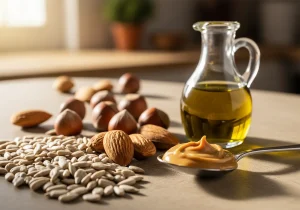
Nuts, seeds and extra virgin olive oil are the ones to reach for first: they are calorie-dense and nutrient-dense, bringing unsaturated fat, vitamin E, magnesium and fibre along with the energy. That combination is why they appear in this list and in our heart health recommendations at the same time, which surprises people who assume high-calorie means poor quality.
When you want the opposite
If the goal is eating more food for fewer calories, this list read upside down is not the answer — see foods lowest in calories, or calorie density explained for the principle that connects both ends.
Common questions
Are high-calorie foods unhealthy? No, and this list is the evidence. Calorie density describes energy per gram; it says nothing about nutritional quality. Olive oil, walnuts and pumpkin seeds are among the most calorie-dense foods measured and among the best-evidenced foods to eat.
Can you eat high-calorie foods and still lose weight? Yes — the useful move is accounting rather than avoidance. Calorie-dense foods are easy to eat past without noticing, which is a portion problem rather than a food problem. Weighing nuts once is usually more instructive than cutting them out.
What is the highest-calorie food? Extra Virgin Olive Oil, at 884 kcal per 100 g. Pure fat is the ceiling for any food, because fat supplies roughly twice the energy per gram of protein or carbohydrate — which is why the top of this list is oils, nuts and seeds rather than anything you would think of as junk.