Low-carb eating means different things to different people, but it always starts with knowing which foods are naturally lowest in carbohydrate. Below is a data-backed ranking of the foods in our database with the least carbohydrate per 100 g.
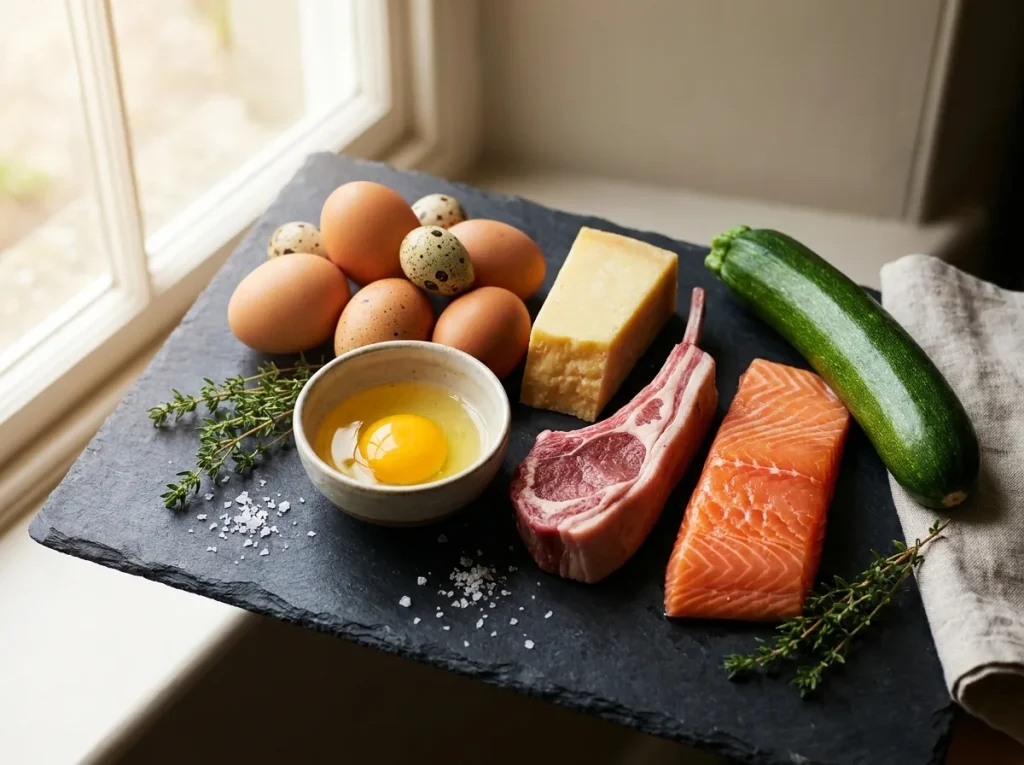
Dried herbs and spices, garlic and chilli, and brewed coffee and tea, are left out of this ranking — Coffee would otherwise lead it — because the spices are eaten a teaspoon at a time and the drinks are almost entirely water, so neither tells you anything useful in a table of 100 g food portions.
| # | Food | Carbohydrate |
|---|---|---|
| 1 | Chicken Breast | 0 g |
| 2 | Cod | 0 g |
| 3 | Extra Virgin Olive Oil | 0 g |
| 4 | Ground Turkey | 0 g |
| 5 | Lamb | 0.0 g |
| 6 | Lean Beef (95% lean) | 0 g |
| 7 | Mackerel | 0 g |
| 8 | Pork Tenderloin | 0 g |
| 9 | Rainbow Trout | 0 g |
| 10 | Salmon (Atlantic) | 0 g |
| 11 | Sardines | 0 g |
| 12 | Tilapia | 0 g |
| 13 | Tuna (canned, light) | 0 g |
| 14 | Turkey Breast | 0.14 g |
| 15 | Shrimp | 0.49 g |
| 16 | Eggs | 0.72 g |
| 17 | Duck | 0.94 g |
| 18 | Cheddar Cheese | 2.13 g |
| 19 | Mozzarella | 2.4 g |
| 20 | Tofu | 2.78 g |
| 21 | Cucumber | 2.95 g |
| 22 | Courgette (Zucchini) | 3.11 g |
| 23 | Scallops | 3.18 g |
| 24 | Parmesan | 3.22 g |
| 25 | White Mushrooms | 3.26 g |
Meat, fish, poultry, eggs and oils sit at or near zero, since carbohydrate is almost entirely a plant-food and dairy-sugar nutrient. If you’re building a lower-carb plate, these are your foundation; most non-starchy vegetables generally stay low too, while grains, legumes and fruit carry meaningfully more.
Why context matters more than the number alone
A “low-carb” food in isolation doesn’t tell you much about a whole diet — what you eat alongside it matters just as much. Many popular low-carb approaches pair these foundation foods with non-starchy vegetables and healthy fats rather than cutting carbohydrate to zero across the board.
Common questions
Is a low-carb diet the same as keto? Not quite — keto is a specific, very-low-carb approach designed to shift the body into ketosis, typically under 50g of carbs a day. “Low-carb” more broadly just means eating less than a typical diet, with much more flexibility on exactly where the line sits.
Do vegetables count as low-carb? Most non-starchy vegetables (leafy greens, peppers, broccoli, courgette) are genuinely low in carbohydrate. Starchy vegetables like potatoes, and grains and legumes, carry meaningfully more — useful to know if you’re tracking carbs closely.