Total fat gets less attention than saturated fat these days, but it’s still a useful number to know — especially if you’re managing calorie density or just want a clearer picture of what’s on your plate. Below is a data-backed ranking of the foods in our database with the least total fat per 100 g.
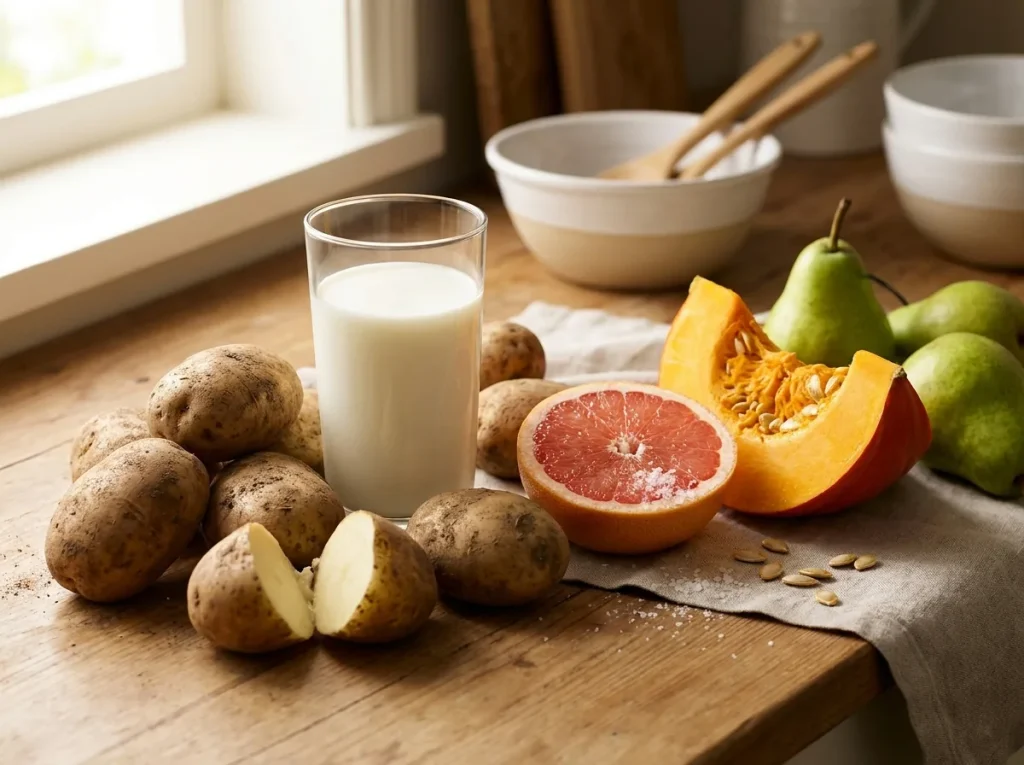
Brewed coffee and tea are left out of this ranking — Green Tea would otherwise lead it — because they are almost entirely water, so they sit at or near zero in every nutrient table — true, but not a useful thing to learn from a list of foods.
| # | Food | Total Fat |
|---|---|---|
| 1 | Skim Milk | 0.08 g |
| 2 | Potato | 0.09 g |
| 3 | Grapefruit | 0.1 g |
| 4 | Onion | 0.1 g |
| 5 | Pumpkin | 0.1 g |
| 6 | Orange | 0.12 g |
| 7 | Cranberry | 0.13 g |
| 8 | Red Bell Pepper | 0.13 g |
| 9 | Pear | 0.14 g |
| 10 | Artichoke | 0.15 g |
| 11 | Watermelon | 0.15 g |
| 12 | Celery | 0.16 g |
| 13 | Grapes | 0.16 g |
| 14 | Apple | 0.17 g |
| 15 | Beetroot | 0.17 g |
| 16 | Butternut Squash | 0.17 g |
| 17 | Cucumber | 0.18 g |
| 18 | Eggplant | 0.18 g |
| 19 | Cherries | 0.19 g |
| 20 | Raspberries | 0.19 g |
| 21 | Lime | 0.2 g |
| 22 | Rhubarb | 0.2 g |
| 23 | Tomato | 0.2 g |
| 24 | Pineapple | 0.21 g |
| 25 | Asparagus | 0.22 g |
Fruits, vegetables, most grains and lean proteins fill out this list. Skim milk and potato lead it, while naturally sweet fruits like orange and grapefruit stay low too — fat and sugar are independent numbers, not two sides of the same coin.
Common questions
Should I avoid fat altogether? No — fat is essential, and the type generally matters more than the total amount for most people. Unsaturated fats from foods like almonds, walnuts and oily fish are typically favoured over saturated fat, not avoided.
Why do some low-fat foods still have a lot of calories? Calories come from protein and carbohydrate too, not just fat. A food can be genuinely low in fat and still calorie-dense if it’s high in carbohydrate or sugar — each food’s full nutrition label tells the fuller story than any single number.