Anti-Inflammatory Diet
Reduce chronic low-grade inflammation with food and lifestyle choices backed by the best available evidence.
Key compounds
The evidence base for this goal focuses on several well-studied compounds.
- Gingerol — Gingerol is the warming, peppery compound that gives fresh ginger its characteristic heat and much of its renown as a folk remedy. Chemically a cousin of
- Omega-3 — Omega-3s are a family of essential polyunsaturated fats the body cannot make in meaningful amounts, so they must come from the plate. The two with the
- Curcumin — Curcumin is the active fraction of turmeric — only about 3% of the spice by weight, which is why concentration and absorption matter so much.
Best foods for this goal
The foods below are good practical choices.
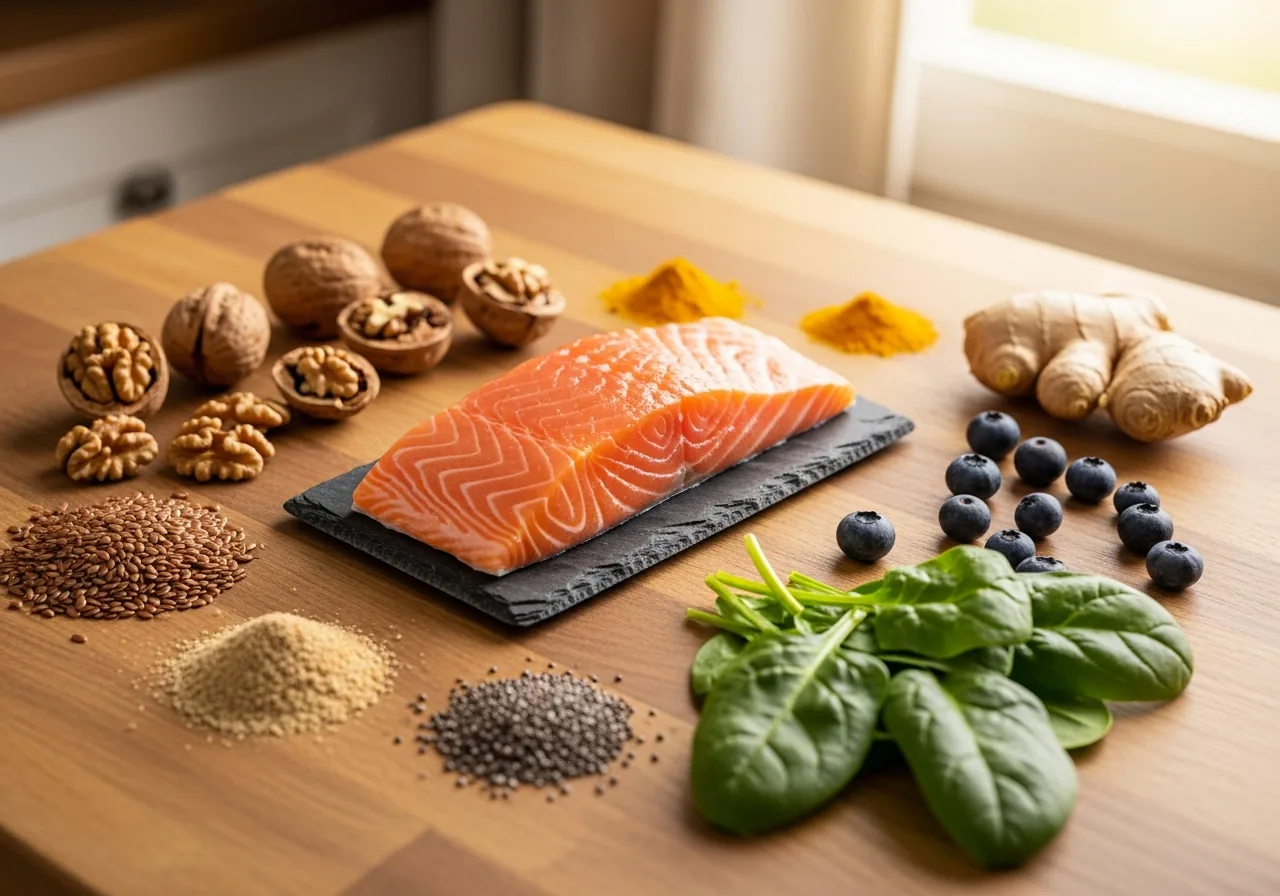
Salmon (Atlantic)
Nutrition Facts
Per 100 g, edible portion · values per 100 g
Calories
197
| Total Fat | 13.1 g |
|---|---|
| Saturated Fat | 2.28 g |
| Sodium | 49.5 mg |
| Potassium | 378 mg |
| Total Carbohydrate | 0 g |
| Dietary Fiber | 0 g |
| Total Sugars | 0 g |
| Protein | 20.3 g |
Omega-3 EPA & DHA, vitamin D, vitamin B12, selenium
Source: USDA FoodData Central (FDC 2684441); sugars: FDC 175167
Walnuts
Nutrition Facts
Per 100 g, edible portion · values per 100 g
Calories
730
| Total Fat | 69.7 g |
|---|---|
| Saturated Fat | 6.05 g |
| Sodium | 0 mg |
| Potassium | 424 mg |
| Total Carbohydrate | 10.9 g |
| Dietary Fiber | 5.21 g |
| Total Sugars | 2.61 g |
| Protein | 14.6 g |
Copper, manganese, plant omega-3 (ALA)
Glycemic index: 15
Source: USDA FoodData Central (FDC 2346394); sugars: FDC 170187
Flaxseed
Nutrition Facts
Per 100 g, edible portion · values per 100 g
Calories
545
| Total Fat | 37.3 g |
|---|---|
| Saturated Fat | 3.28 g |
| Sodium | 36.7 mg |
| Potassium | 793 mg |
| Total Carbohydrate | 34.4 g |
| Dietary Fiber | 23.1 g |
| Total Sugars | 1.6 g |
| Protein | 18 g |
Thiamine, magnesium, lignans, plant omega-3 (ALA)
Glycemic index: 1
Source: USDA FoodData Central (FDC 2262075)
Chia Seeds
Nutrition Facts
Per 100 g, edible portion · values per 100 g
Calories
517
| Total Fat | 32.9 g |
|---|---|
| Saturated Fat | 3.33 g |
| Sodium | 0 mg |
| Potassium | 642 mg |
| Total Carbohydrate | 38.3 g |
| Dietary Fiber | 34.4 g |
| Protein | 17 g |
Calcium, phosphorus, plant omega-3 (ALA)
Glycemic index: 1
Source: USDA FoodData Central (FDC 2710819)
Spinach
Nutrition Facts
Per 100 g, edible portion · values per 100 g
Calories
23
| Total Fat | 0.39 g |
|---|---|
| Saturated Fat | 0.06 g |
| Sodium | 79 mg |
| Potassium | 558 mg |
| Total Carbohydrate | 3.63 g |
| Dietary Fiber | 2.2 g |
| Total Sugars | 0.42 g |
| Protein | 2.86 g |
Vitamin K, folate, iron, magnesium, nitrates
Glycemic index: 15
Source: USDA FoodData Central (FDC 168462)
Blueberries
Nutrition Facts
Per 100 g, edible portion · values per 100 g
Calories
63.9
| Total Fat | 0.31 g |
|---|---|
| Saturated Fat | 0.028 g |
| Sodium | 0 mg |
| Potassium | 85.6 mg |
| Total Carbohydrate | 14.6 g |
| Dietary Fiber | 2.4 g |
| Total Sugars | 10 g |
| Protein | 0.7 g |
Vitamin C, vitamin K, manganese, anthocyanins
Glycemic index: 53
Source: USDA FoodData Central (FDC 2346411); sat-fat: FDC 171711
Turmeric
Nutrition Facts
Per 100 g, edible portion · values per 100 g
Calories
312
| Total Fat | 3.25 g |
|---|---|
| Saturated Fat | 1.84 g |
| Sodium | 27 mg |
| Potassium | 2080 mg |
| Total Carbohydrate | 67.1 g |
| Dietary Fiber | 22.7 g |
| Total Sugars | 3.21 g |
| Protein | 9.68 g |
Manganese, iron, curcumin
Source: USDA FoodData Central (FDC 172231)
Ginger
Nutrition Facts
Per 100 g, edible portion · values per 100 g
Calories
80
| Total Fat | 0.75 g |
|---|---|
| Saturated Fat | 0.2 g |
| Sodium | 13 mg |
| Potassium | 415 mg |
| Total Carbohydrate | 17.8 g |
| Dietary Fiber | 2 g |
| Total Sugars | 1.7 g |
| Protein | 1.82 g |
Gingerol, vitamin B6, magnesium
Source: USDA FoodData Central (FDC 169231)
Extra Virgin Olive Oil
Nutrition Facts
Per 100 g, edible portion · values per 100 g
Calories
884
| Total Fat | 100 g |
|---|---|
| Saturated Fat | 15.4 g |
| Sodium | 2 mg |
| Potassium | 1 mg |
| Total Carbohydrate | 0 g |
| Dietary Fiber | 0 g |
| Total Sugars | 0 g |
| Protein | 0 g |
Vitamin E, vitamin K, oleocanthal polyphenols
Source: USDA FoodData Central (FDC 748608); sugars: FDC 171413
Practical takeaways
Focus on consistency, variety and the overall dietary pattern. Smaller daily choices tend to outperform occasional large changes.
Common questions
Is one compound enough? Rarely. Whole foods and dietary patterns usually outperform single-compound strategies.
How fast can diet change inflammation or blood markers? It depends on the marker, the starting diet and lifestyle factors. Expect gradual trends rather than overnight shifts.