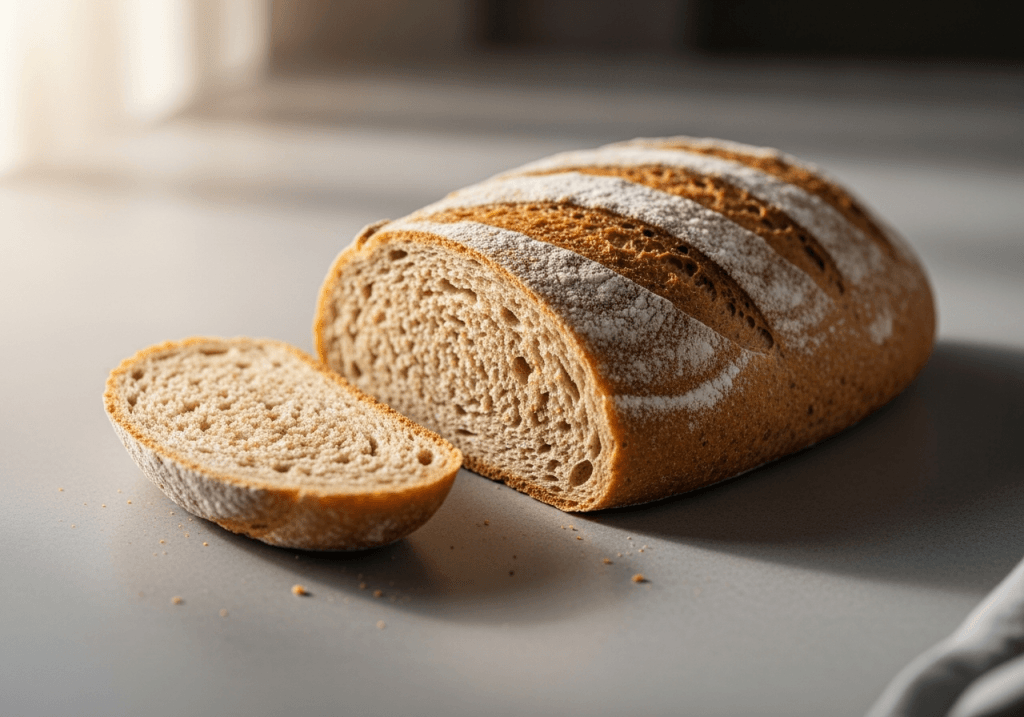
Whole wheat bread keeps the bran and germ, which gives it more fibre, magnesium, selenium and B vitamins than white bread. A typical two-slice portion supplies around 7–8 g of fibre and useful manganese, thiamine and niacin. That wholegrain profile is why whole wheat bread appears in research on heart health, blood sugar control and energy and performance.
Compounds & anti-nutrients in Whole Wheat Bread
Per 100 g, Whole Wheat Bread is a notable dietary source of these active compounds. Tap any to see its full sources map and how to work with it.
Why whole wheat bread is good for you
Refining wheat to white removes the bran and germ — the parts that hold most of the fibre, magnesium, manganese and B vitamins. Whole wheat bread retains those layers, so it delivers a slower glycaemic response and more micronutrients per slice. The fibre is partly soluble, which helps lower LDL cholesterol, and partly insoluble, which supports bowel regularity and gut bacteria.
Whole wheat bread nutrition at a glance
The label shows the numbers, but the practical message is that whole wheat bread is an everyday vehicle for fibre and B vitamins. The main quality variable is the loaf itself: some “whole wheat” breads contain mostly white flour with a little added bran, whereas 100% whole wheat loaves are nutritionally superior.
How to choose and use whole wheat bread
Choose loaves where the first ingredient is 100% whole wheat flour, not “wheat flour” or “enriched flour”. Check the label for fibre content — aim for at least 3–4 g per two slices. Use it as the base for sandwiches with lean beef and spinach, as toast with peanut butter, or as the side for soups and eggs. Keep it cool and dry, or freeze for longer storage.
Common questions
Is whole wheat bread gluten-free? No — wheat contains gluten. For gluten-free bread, choose loaves made from rice, oat, buckwheat or almond flour.
Is Ezekiel bread better? Sprouted-grain breads such as Ezekiel are lower in glycaemic index and higher in some micronutrients because the germination process breaks down antinutrients and changes the starch matrix. They are a good choice if you tolerate them.
Explore by health goal
Whole Wheat Bread is one of many foods that support these goals: