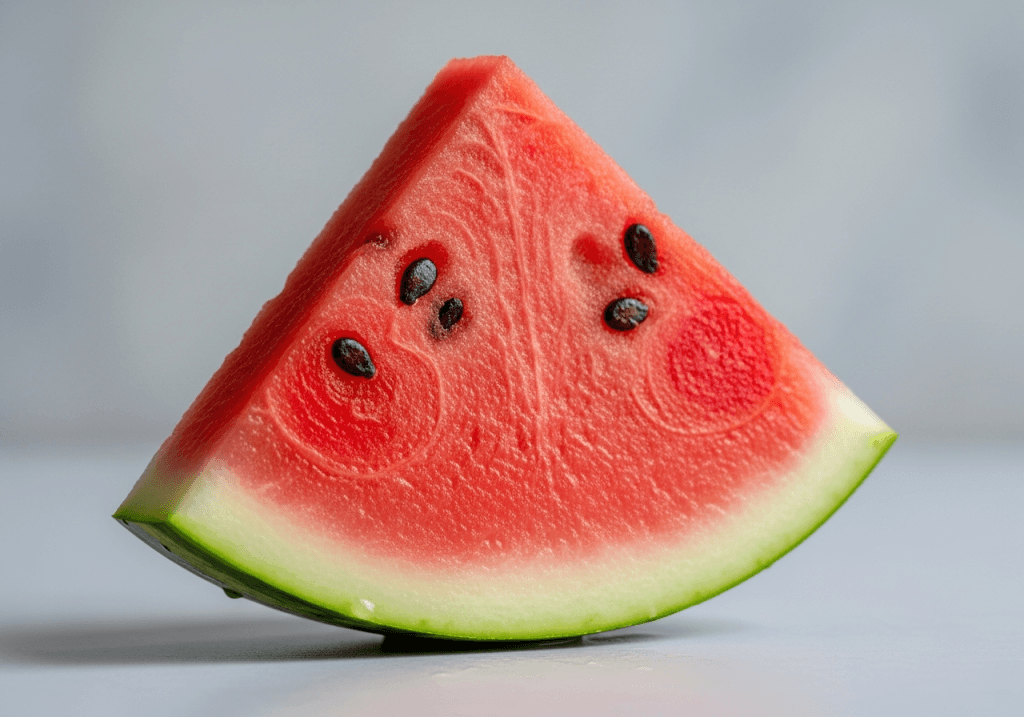
Watermelon is the summertime fruit that is 92% water, making it one of the most hydrating foods available, and whose red flesh contains lycopene — the same carotenoid that gives tomatoes their colour — alongside citrulline, an amino acid that improves blood flow and reduces exercise fatigue. That combination is why watermelons appear in research on heart health and energy and performance.
Compounds & anti-nutrients in Watermelon
Per 100 g, Watermelon is a notable dietary source of these active compounds. Tap any to see its full sources map and how to work with it.
Why watermelon is good for you
Watermelon’s lycopene content is high — roughly 91 µg per 100 g — and lycopene is linked to reduced cardiovascular mortality and prostate health in epidemiological studies. The citrulline content is unique: it is converted to arginine in the body, which improves nitric oxide production and blood flow, reducing exercise-induced fatigue in trials. The high water content makes watermelon useful for hydration, especially in hot weather.
Watermelon nutrition at a glance
The label shows the numbers, but the practical message is that watermelon is a low-calorie, hydrating fruit with a genuine lycopene and citrulline edge. It is not just water — the red flesh is biologically active.
How to buy and use watermelon
Choose heavy watermelons with a creamy-yellow underside and a hollow sound when thumped. Avoid watermelons with soft spots or no scent. Store whole at room temperature; store cut pieces in the fridge for a few days. Eat watermelon fresh as a snack, blend it into gazpacho with tomato and cucumber, grill slices as a side for feta and mint, or freeze into sorbet. Watermelon pairs well with feta, mint and lime. The white rind contains most of the citrulline and can be pickled or stir-fried.
Common questions
Is watermelon good for exercise? Yes — the citrulline content improves blood flow and reduces muscle fatigue, and the high water content supports hydration.
Does watermelon lower blood pressure? Some trials show modest reductions, probably via the citrulline->arginine->nitric oxide pathway. The effect is real but not a replacement for medication.
Explore by health goal
Watermelon is one of many foods that support these goals: