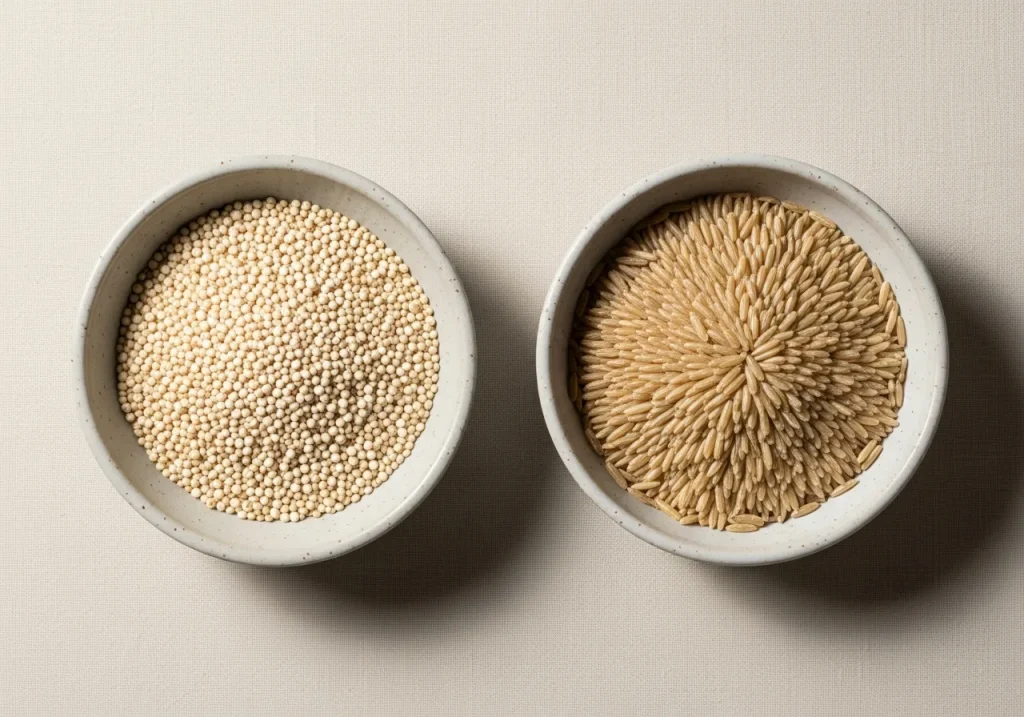
Quinoa beats brown rice on protein, fibre and potassium. Per 100 g dry it carries 14.1 g of protein to brown rice’s 7.5 g — nearly double — 7 g of fibre to 3.6 g, and 563 mg of potassium to 250 mg. Calories are almost identical, 368 against 367.
Quinoa is also a complete protein, meaning it supplies all the essential amino acids in useful proportions, which most grains do not. Brown rice’s advantages are practical rather than nutritional: it is cheaper, it keeps, and its flavour is neutral where quinoa is faintly grassy.
| Nutrient | Quinoa | Brown Rice |
|---|---|---|
| Calories | 368 kcal | 367 kcal |
| Protein | 14.12 g ✓ | 7.54 g |
| Total Carbohydrate | 64.16 g | 76.25 g |
| Dietary Fiber | 7 g ✓ | 3.6 g |
| Total Sugars | — | 0.66 g |
| Total Fat | 6.07 g | 3.2 g |
| Saturated Fat | 0.71 g | 0.59 g ✓ |
| Sodium | 5 mg | 5 mg |
Notable compounds in each
When to choose each
Reach for quinoa when the nutrition is what you are choosing on — nearly double the protein, roughly twice the fibre and well over twice the potassium, all for practically the same calories. Reach for brown rice on cost, on availability, and when you want a neutral base that will not compete with what is on top of it. Both are whole grains; neither is a poor choice.
Quinoa vs brown rice nutrition per 100g
⚠️ Both sets of figures are per 100 g dry, which is how grains are sold and labelled. Cooked, both roughly triple in weight as they absorb water, so a 100 g cooked portion is nearer 120–130 calories, not 370.
Brown rice carries more carbohydrate (76.3 g against 64.2 g) and less fat. Quinoa is technically a seed rather than a grain, which is where its higher protein and fat come from.
Common questions
Is quinoa healthier than brown rice? On the numbers, clearly — more protein, far more fibre and double the potassium for a similar calorie count, plus a complete amino acid profile. Brown rice is still a whole grain and a perfectly good staple; quinoa is simply denser in most things.
Does quinoa have more protein than rice? Yes — 14.1 g per 100 g dry against 7.5 g for brown rice, nearly double, and of better quality because it contains all the essential amino acids.
How many calories are in cooked quinoa? Around 120 per 100 g cooked. The 368 figure above is dry weight; quinoa roughly triples in weight as it absorbs water.
Why do you rinse quinoa before cooking? The seed coat carries saponins, which taste bitter and soapy. Most quinoa sold is pre-rinsed, but a quick rinse under cold water removes any that remains and costs nothing.