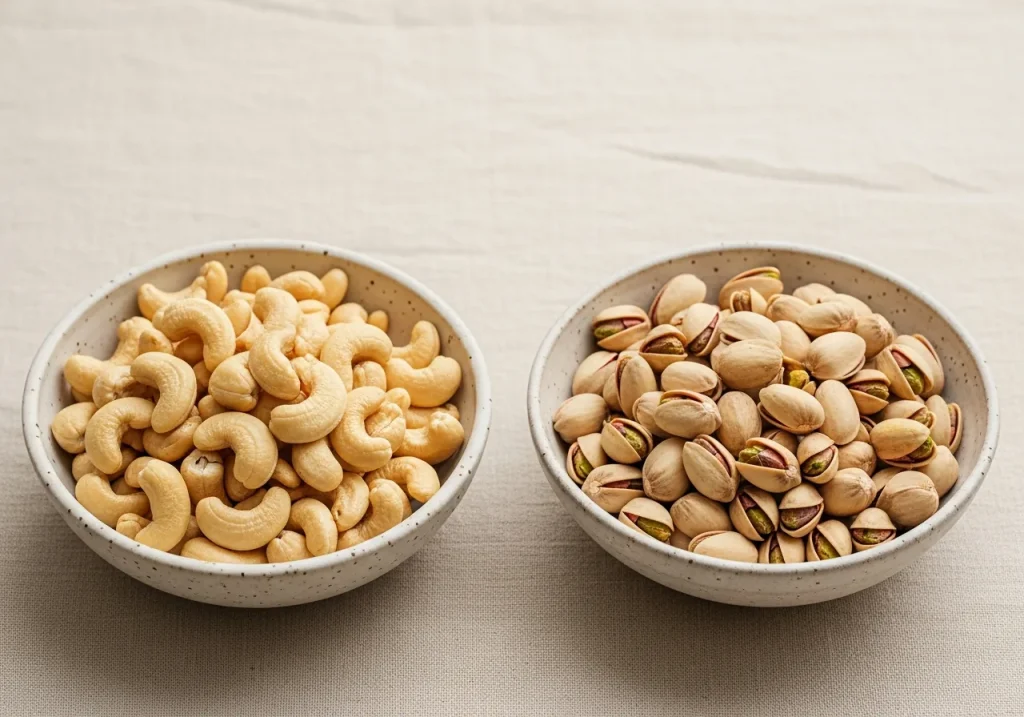
Pistachios beat cashews on protein, fibre and potassium; cashews are the lighter and starchier of the two. Per 100 g pistachios give 20.5 g of protein to cashews’ 17.4 g, 7 g of fibre to 4.1 g, and 947 mg of potassium to 638 mg — one of the highest potassium figures of any nut. Cashews come in lower on calories (565 against 598) and fat (38.9 g against 45 g).
The oddity is carbohydrate: cashews carry 36.3 g per 100 g against pistachios’ 27.7 g, which is high for a nut and is why cashews behave more like a starchy food in cooking — it is what lets them blend into a cream sauce.
| Nutrient | Cashews | Pistachios |
|---|---|---|
| Calories | 565 kcal | 598 kcal |
| Protein | 17.4 g | 20.5 g ✓ |
| Total Carbohydrate | 36.3 g | 27.7 g |
| Dietary Fiber | 4.1 g | 6.97 g ✓ |
| Total Sugars | 5.91 g ✓ | 7.66 g |
| Total Fat | 38.9 g | 45 g |
| Saturated Fat | 7.78 g | 5.91 g ✓ |
| Sodium | 4.76 mg | 0 mg ✓ |
Notable compounds in each
When to choose each
Reach for pistachios when you want the more nutrient-dense nut: more protein, over half as much fibre again, and standout potassium. They are also usually sold in shell, which slows eating down. Reach for cashews for their softer texture and higher starch, which is what makes them work blended into sauces and milks where pistachios would not.
Cashews vs pistachios nutrition per 100g
Both raw and unsalted. Salted and roasted versions of either carry several hundred milligrams of sodium per 100 g against the near-zero shown here.
A 30 g handful is around 170 calories of cashews or 180 of pistachios. Shelled weight is what is measured — a 100 g bag of pistachios in shell gives you closer to 50 g of nut.
Common questions
Which is healthier, cashews or pistachios? Pistachios, on the numbers: more protein, more fibre and substantially more potassium for a similar calorie count. Cashews are slightly lower in calories and fat if that is the deciding factor.
Are pistachios high in potassium? Yes — 947 mg per 100 g, among the highest of any nut. That is worth knowing in both directions: useful if you are trying to raise potassium intake, and worth flagging to your clinician if you have been told to limit it.
How many calories are in cashews vs pistachios? Cashews are 565 calories per 100 g and pistachios 598. A 30 g handful is roughly 170 and 180 respectively.
Why are cashews so high in carbs? Cashews are unusually starchy for a nut, at 36.3 g of carbohydrate per 100 g against 27.7 g for pistachios. It is a genuine feature of the seed rather than anything added, and it is why blended cashews thicken a sauce.