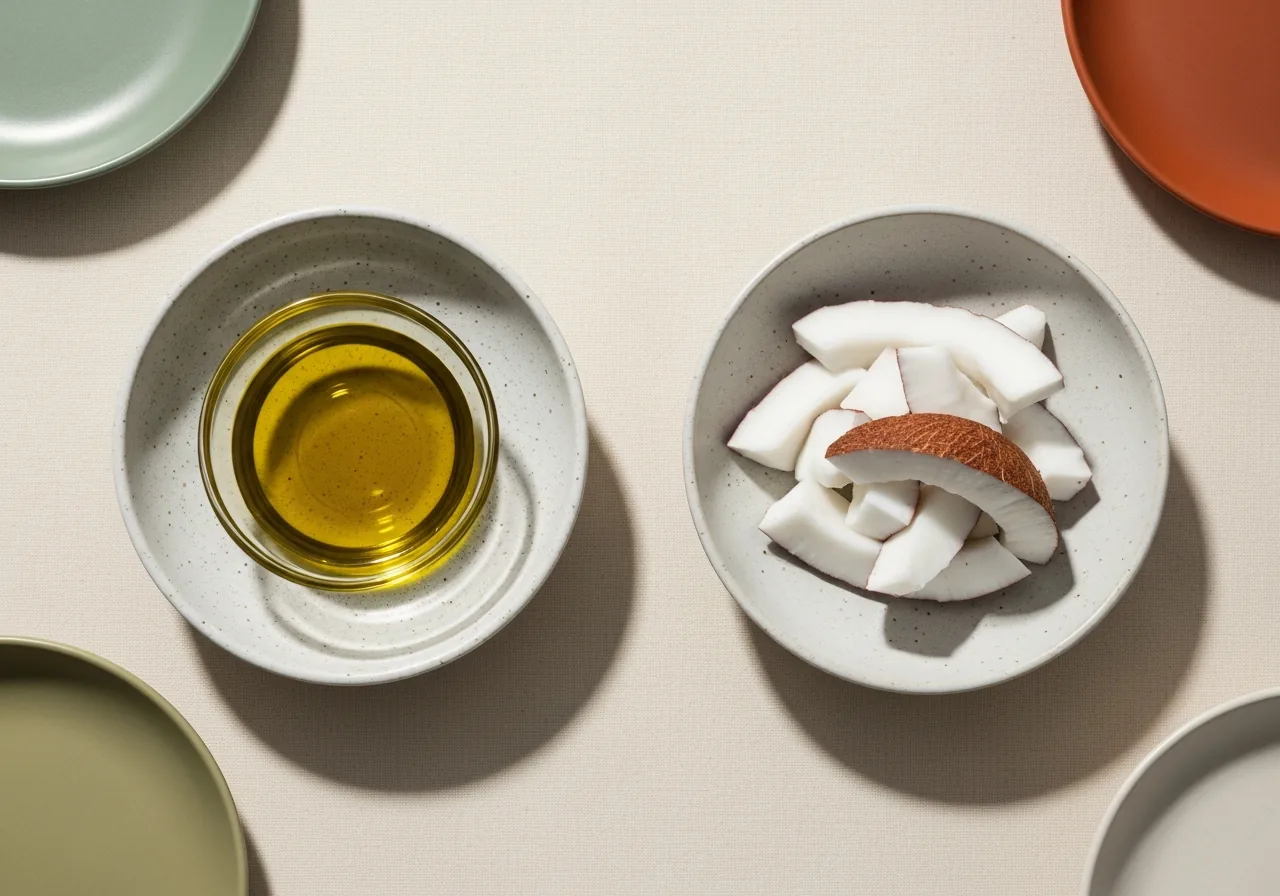
⚠️ This compares olive oil with coconut flesh, not coconut oil. That is a genuine difference in kind: olive oil is 100% fat at 884 calories per 100 g, while coconut flesh is a whole food at 354 calories, 33.5 g of fat, 9 g of fibre and 3.3 g of protein. Coconut oil would sit near olive oil at around 860 calories.
On the fat itself the comparison does hold, and it goes one way: coconut flesh carries 29.7 g of saturated fat per 100 g against olive oil’s 15.4 g — nearly twice as much from a third of the total fat. Olive oil’s fat is predominantly monounsaturated.
| Nutrient | Extra Virgin Olive Oil | Coconut |
|---|---|---|
| Calories | 884 kcal | 354.0 kcal |
| Protein | 0 g | 3.33 g ✓ |
| Total Carbohydrate | 0 g | 15.2 g |
| Dietary Fiber | 0 g | 9.0 g ✓ |
| Total Sugars | 0 g ✓ | 6.23 g |
| Total Fat | 100 g | 33.5 g |
| Saturated Fat | 15.4 g ✓ | 29.7 g |
| Sodium | 2 mg ✓ | 20.0 mg |
Notable compounds in each
Extra Virgin Olive Oil
When to choose each
Reach for extra virgin olive oil as a everyday cooking and dressing fat: it is overwhelmingly monounsaturated, it carries polyphenols that refined oils do not, and it is the fat with the strongest body of evidence behind it. Reach for coconut as a food rather than a fat — the flesh brings fibre and texture that oil cannot. If you are choosing a cooking oil specifically, this page is not the comparison you want; coconut oil is a different product again.
Olive oil vs coconut nutrition per 100g
100 g of olive oil is about seven tablespoons, so nobody consumes it at that scale — a tablespoon is around 120 calories. 100 g of coconut flesh is a realistic portion by comparison.
The saturated fat figures are the reason this comparison gets made at all. Health guidance has consistently favoured unsaturated fats over saturated ones, and while the case against saturated fat has been argued over, coconut has not been shown to be an exception to it.
Common questions
Is coconut oil healthier than olive oil? The evidence does not support that. Coconut oil is around 80–90% saturated fat against olive oil’s roughly 15%, and trials consistently show it raises LDL cholesterol more than unsaturated oils do. Olive oil has by far the stronger evidence base as an everyday fat.
How much saturated fat is in coconut? Coconut flesh carries 29.7 g per 100 g — nearly twice olive oil’s 15.4 g, and from a third of the total fat. Coconut oil is higher again.
Is coconut flesh good for you? It is a whole food with useful fibre — 9 g per 100 g — and some protein, which coconut oil has neither of. Its saturated fat content is high, so it suits being eaten as part of a varied diet rather than in quantity.
Which oil is best for cooking at high heat? Extra virgin olive oil is more heat-stable than its reputation suggests and is fine for most home cooking, including roasting and shallow frying. Its smoke point is lower than refined oils, so for genuinely high-heat work a refined oil is the practical choice.