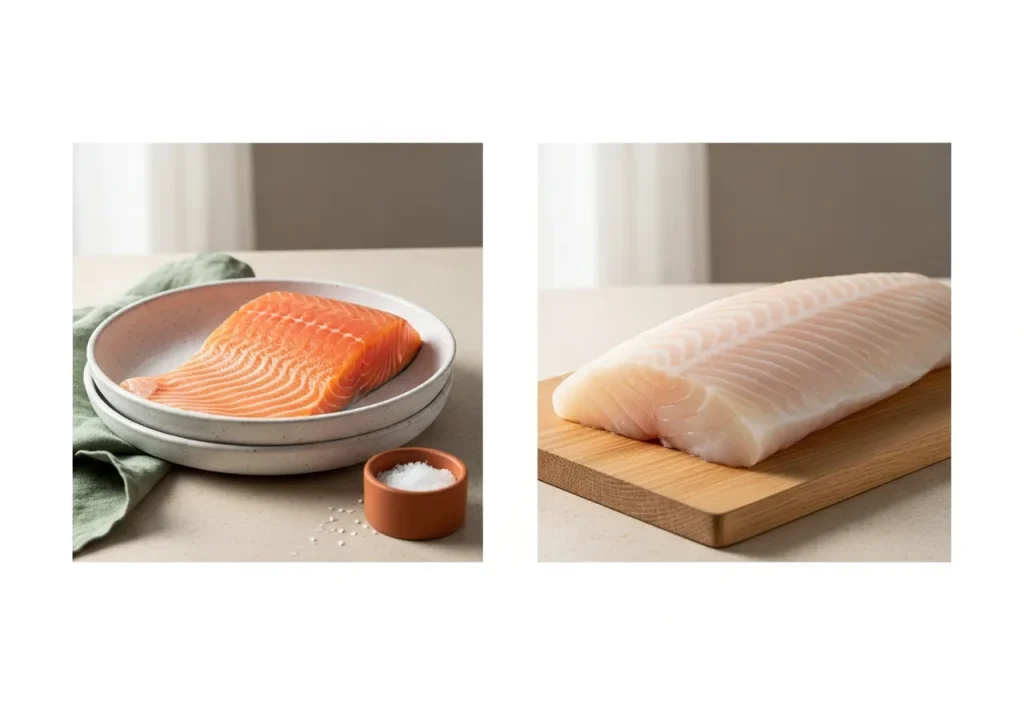
Salmon and cod are both kitchen staples, but they sit at opposite ends of the “fatty vs lean” fish spectrum — a genuinely useful difference to know depending on what you’re cooking, or what you’re eating fish for in the first place.
| Nutrient | Salmon (Atlantic) | Cod |
|---|---|---|
| Calories | 197 kcal | 82 kcal |
| Protein | 20.3 g ✓ | 17.81 g |
| Total Carbohydrate | 0 g | 0 g |
| Dietary Fiber | 0 g | 0 g |
| Total Sugars | 0 g | 0 g |
| Total Fat | 13.1 g | 0.67 g |
| Saturated Fat | 2.28 g | 0.13 g ✓ |
| Sodium | 49.5 mg ✓ | 54 mg |
Notable compounds in each
When to choose each
Reach for salmon when omega-3s are the goal — it’s substantially higher in fat overall, most of it unsaturated, along with a strong showing of vitamin B12 and CoQ10. Reach for cod when you want a lean, mild-tasting fish with far fewer calories for the same weight, and notably it’s the better source of iodine between the two, an often under-supplied nutrient in a typical diet. Neither is the “healthier” fish outright — they simply do different jobs on the plate.
Common questions
Is cod a good substitute for salmon? For texture and cooking method, often yes — both flake well and suit similar preparations. Nutritionally they’re quite different: cod won’t deliver salmon’s omega-3 content, so if that’s specifically what you’re after, it isn’t a like-for-like swap.
Which is better for weight management? Cod’s lower calorie density makes it the more efficient choice if you’re managing calories closely, while salmon’s higher fat content supports fullness in a different way. Both are excellent lean-protein anchors for a meal either way.