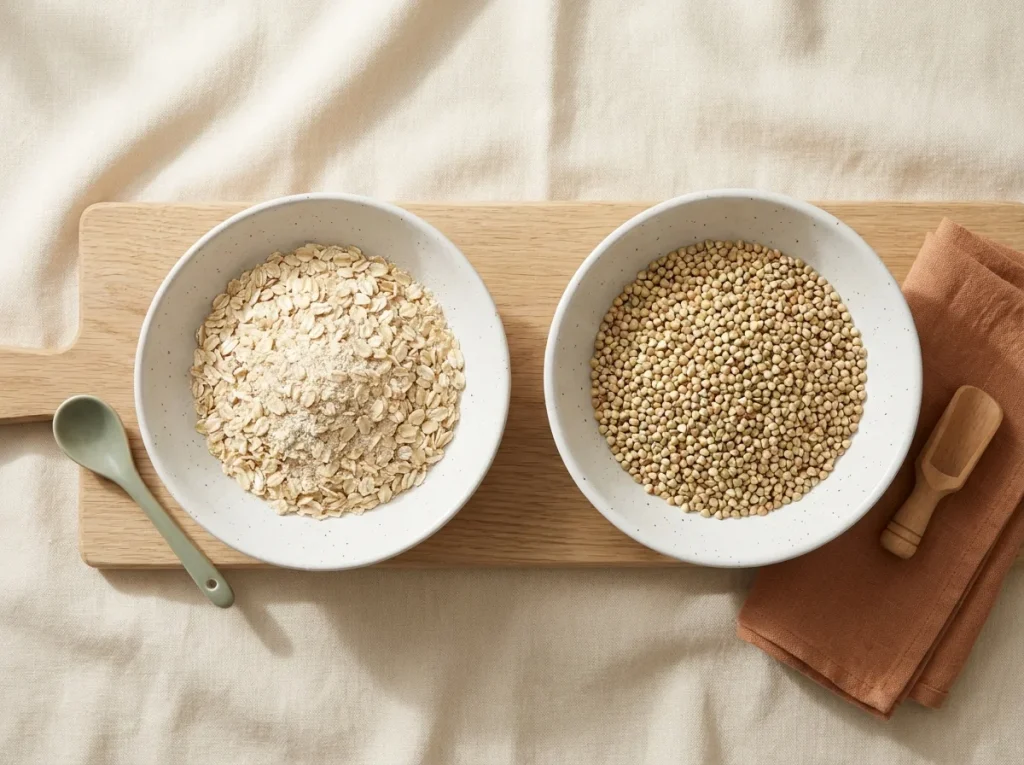
On the headline numbers these two are almost the same food. Per 100 g dry, oats carry 13.15 g of protein and 10.1 g of fibre; buckwheat carries 13.25 g and 10 g. What separates them is everything else: oats have nearly twice the fat (6.52 g against 3.4 g) and about 10% more calories (379 against 343), while buckwheat has two-thirds more magnesium (231 mg against 138 mg) and about a quarter more potassium (460 mg against 362 mg).
They are not related. Oats are a true cereal grass. Buckwheat is not a grain at all and has nothing to do with wheat: it is the seed of a broad-leaved plant in the same family as rhubarb and sorrel, which is why it is naturally free of gluten.
| Nutrient | Oats | Buckwheat |
|---|---|---|
| Calories | 379 kcal | 343 kcal |
| Protein | 13.15 g | 13.25 g ✓ |
| Total Carbohydrate | 67.7 g | 71.5 g |
| Dietary Fiber | 10.1 g ✓ | 10 g |
| Total Sugars | 0.99 g ✓ | 2.6 g |
| Total Fat | 6.52 g | 3.4 g |
| Saturated Fat | 1.11 g | 0.74 g ✓ |
| Sodium | 6 mg | 1 mg ✓ |
Notable compounds in each
When to choose each
Reach for oats when the soluble fibre is the point. A large share of their fibre is beta-glucan, the viscous fibre behind the cholesterol-lowering reputation of oats, and they carry nearly twice the iron (4.25 mg against 2.2 mg) and close to three times the manganese (3.63 mg against 1.3 mg). Reach for buckwheat when you want the leaner, more mineral-dense seed: fewer calories, about half the fat, more magnesium and potassium, and a protein unusually rich in lysine, the amino acid true cereals run short of. It is also the simpler choice if you avoid gluten, because it needs no special handling to be free of it.
Oats vs buckwheat nutrition per 100g
Both sets of figures are for the dry, uncooked food: rolled oats and raw buckwheat groats. That matters when reading them, because nobody eats 100 g of either dry. A typical portion is 40 to 50 g, and both are cooked in water, so a bowl of porridge or a serving of cooked groats is mostly water and reads far lower per 100 g than the table above.
Sugar and sodium are trivial in both: 0.99 g and 2.6 g of sugars, 6 mg and 1 mg of sodium. The table marks a winner on each of those rows, but neither difference is one to choose a breakfast on. Saturated fat follows total fat, at 1.11 g for oats against 0.74 g for buckwheat, and most of the fat in oats is unsaturated.
See how each compares with its other near neighbour: oats vs barley and barley vs buckwheat.
Common questions
Is buckwheat healthier than oats? Neither is healthier overall. Per 100 g dry they are within 0.1 g of each other on both protein and fibre. Buckwheat has fewer calories, about half the fat and more magnesium and potassium. Oats have more iron and manganese, and their beta-glucan fibre has far more research behind it.
Is buckwheat the same as oats? No. Oats are a cereal grass, like wheat and barley. Buckwheat is the seed of a broad-leaved plant related to rhubarb, and despite the name it is not a type of wheat. They are used in similar ways, as porridge, flakes and flour, which is why they get compared.
Which has more protein, oats or buckwheat? They are effectively equal: 13.25 g per 100 g dry for buckwheat against 13.15 g for oats. The difference is in the type of protein. Buckwheat is richer in lysine, which is the amino acid cereals such as oats are lowest in.
Are oats and buckwheat gluten free? Buckwheat is naturally gluten free. Oats contain no wheat gluten either, but ordinary oats are usually grown and milled alongside wheat and barley, so they pick up traces. Oats sold as gluten free are handled separately to avoid that.
Which is better for cholesterol, oats or buckwheat? Oats have the stronger evidence. Their beta-glucan is one of the few food components with an approved cholesterol-lowering claim, based on 3 g of it a day. Buckwheat has been studied far less, so oats are the better-supported choice on this one point.