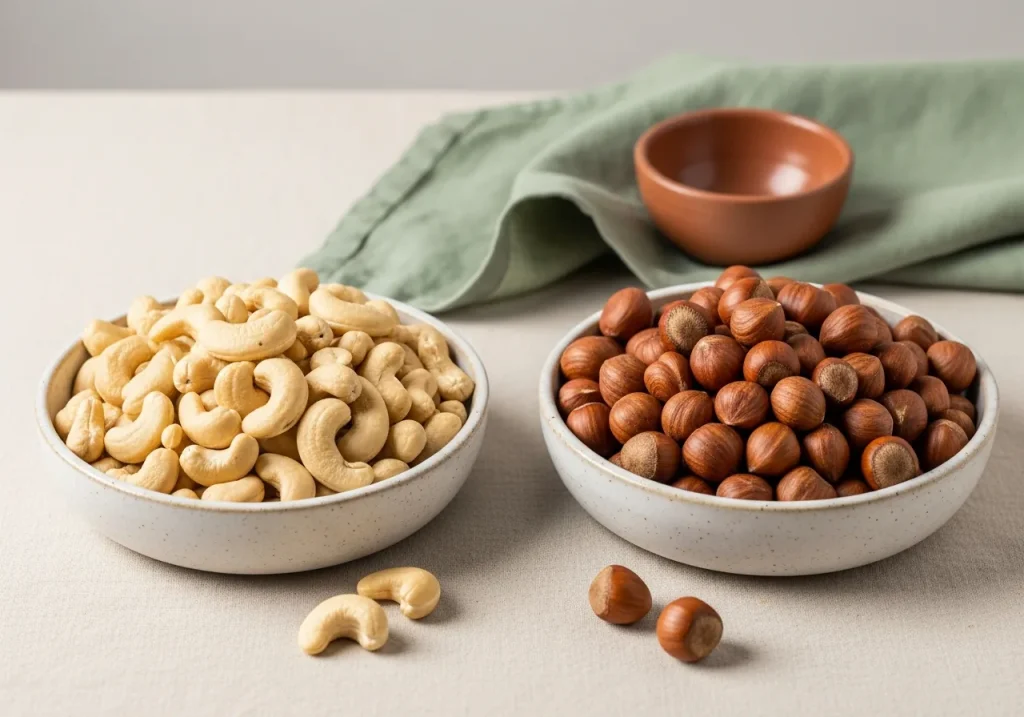
Cashews and hazelnuts are both rich, creamy tree nuts, though cashews’ unusually starchy texture sets them apart from most other nuts, hazelnuts included.
| Nutrient | Cashews | Hazelnuts |
|---|---|---|
| Calories | 565 kcal | 641 kcal |
| Protein | 17.4 g ✓ | 13.5 g |
| Total Carbohydrate | 36.3 g | 26.5 g |
| Dietary Fiber | 4.1 g | 8.41 g ✓ |
| Total Sugars | 5.91 g | 4.34 g ✓ |
| Total Fat | 38.9 g | 53.5 g |
| Saturated Fat | 7.78 g | 4.46 g ✓ |
| Sodium | 4.76 mg | 0 mg ✓ |
Notable compounds in each
When to choose each
Cashews carry more protein, while hazelnuts pull ahead on fibre and are essentially sodium-free. Cashews are notably higher in carbohydrate than most tree nuts, which is part of why they blend so well into creamy sauces and “nut milk” substitutes, a trait most other nuts don’t share to the same degree. Hazelnuts are the more calorie-dense of the two, largely down to their higher fat content. Both are excellent, versatile nuts; the choice here comes down to texture and use as much as nutrition.
Common questions
Why are cashews used to make creamy sauces and cheeses? Their relatively high starch content and soft texture when soaked let them blend into a genuinely creamy consistency, unlike most other nuts, which is why cashews became the go-to base for dairy-free cream sauces, cheeses and desserts.
Which has more fibre, cashews or hazelnuts? Hazelnuts, by a clear margin — around 8.4g per 100g versus roughly 4.1g for cashews, making hazelnuts the better pick if fibre is a specific priority between the two.