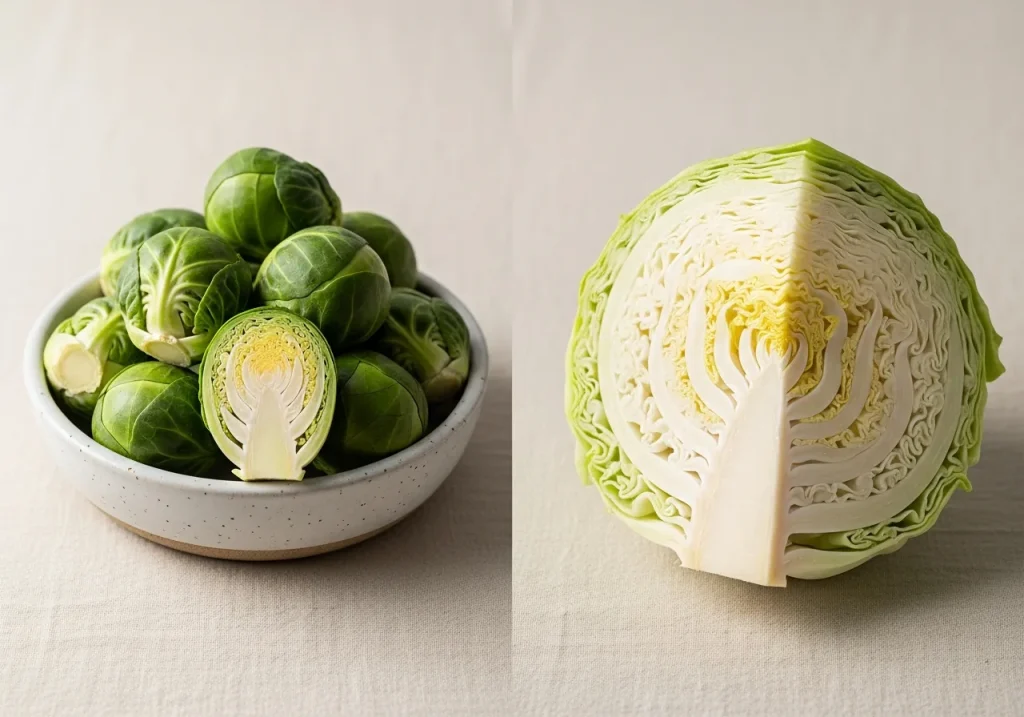
Brussels sprouts and cabbage are close relatives on the same brassica family tree, but one is considerably more nutrient-dense than the other per 100g.
| Nutrient | Brussels Sprouts | Cabbage |
|---|---|---|
| Calories | 59.5 kcal | 31.4 kcal |
| Protein | 3.98 g ✓ | 0.96 g |
| Total Carbohydrate | 9.62 g | 6.38 g |
| Dietary Fiber | 4.78 g ✓ | 2.5 g |
| Total Sugars | 2.2 g ✓ | 3.2 g |
| Total Fat | 0.56 g | 0.23 g |
| Saturated Fat | 0.062 g | 0.034 g ✓ |
| Sodium | 25.7 mg | 16.1 mg ✓ |
Notable compounds in each
When to choose each
Brussels sprouts are the more nutrient-dense of the two — around four times the protein of cabbage, well over double the potassium, and a solid source of fibre, gram for gram. Cabbage counters with fewer calories and a little less sodium, and its mild flavour and crunch make it easier to eat in bulk raw — slaws, ferments — than brussels sprouts typically are. Both are cruciferous vegetables and share the same family of sulphur compounds behind their characteristic flavour and much of their health interest.
Common questions
Are brussels sprouts more nutritious than cabbage? By the numbers here, yes on most counts — more protein, more potassium and more fibre per 100g — though cabbage is lower in calories and very easy to eat in large raw quantities, which has its own benefit for bulk and satiety.
Why are brussels sprouts and cabbage grouped together? Both are cruciferous (brassica) vegetables, along with broccoli, cauliflower and kale — a family known for glucosinolate compounds that break down into sulphur-containing compounds linked to several health benefits, and to their characteristic sharp flavour and smell when cooked.