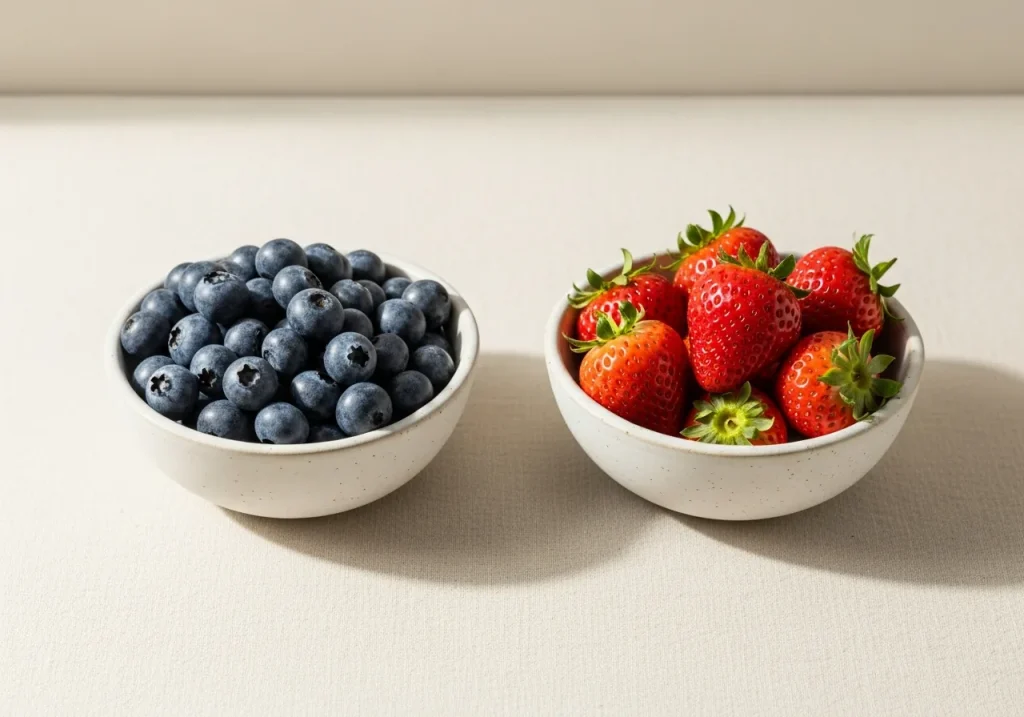
Strawberries are the lighter berry, by more than most people expect. Per 100 g they carry 36 calories to blueberries’ 64, and half the sugar — 4.9 g against 10 g. They also hold nearly twice the potassium, 161 mg against 86 mg. Fibre is close, 2 g against 2.4 g.
Blueberries earn their reputation elsewhere: they are among the densest sources of anthocyanins, the pigment compounds that make them blue, and that is what most of the research interest in them is about rather than anything in the macros.
| Nutrient | Blueberries | Strawberries |
|---|---|---|
| Calories | 63.9 kcal | 36.4 kcal |
| Protein | 0.7 g ✓ | 0.64 g |
| Total Carbohydrate | 14.6 g | 7.96 g |
| Dietary Fiber | 2.4 g ✓ | 2 g |
| Total Sugars | 10 g | 4.89 g ✓ |
| Total Fat | 0.31 g | 0.22 g |
| Saturated Fat | 0.028 g | 0.02 g ✓ |
| Sodium | 0 mg | 0 mg |
Notable compounds in each
When to choose each
Reach for strawberries when you want volume for very few calories — they are one of the lightest fruits in the database and unusually high in vitamin C for a berry. Reach for blueberries for anthocyanins, where they are among the best sources available, and for the fact that they freeze well without collapsing, which strawberries do not.
Blueberries vs strawberries nutrition per 100g
Both raw. 100 g is roughly a large handful of blueberries or about seven medium strawberries, so these figures are close to a real portion for once.
The sugar difference is the clearest gap between them, and it is worth reading alongside the calories rather than on its own: blueberries are not a high-sugar food in absolute terms, they are simply denser than strawberries.
Common questions
Which is healthier, blueberries or strawberries? Strawberries for fewer calories, less sugar and more potassium; blueberries for anthocyanin content, where they are among the richest common foods. Both are whole fruit and the difference is smaller than the marketing around blueberries suggests.
Do strawberries have less sugar than blueberries? Yes, about half — 4.9 g per 100 g against 10 g, with fewer calories to match.
Are frozen berries as good as fresh? Nutritionally they are very close, and frozen fruit is usually picked riper than fruit destined to be shipped fresh. Freezing damages texture, which is why frozen strawberries suit smoothies and baking better than eating straight.
Which berry has the most antioxidants? Among these two, blueberries — their anthocyanin content is what most of the research attention is about. Antioxidant rankings vary a lot by how they are measured, so treat any single league table with caution.