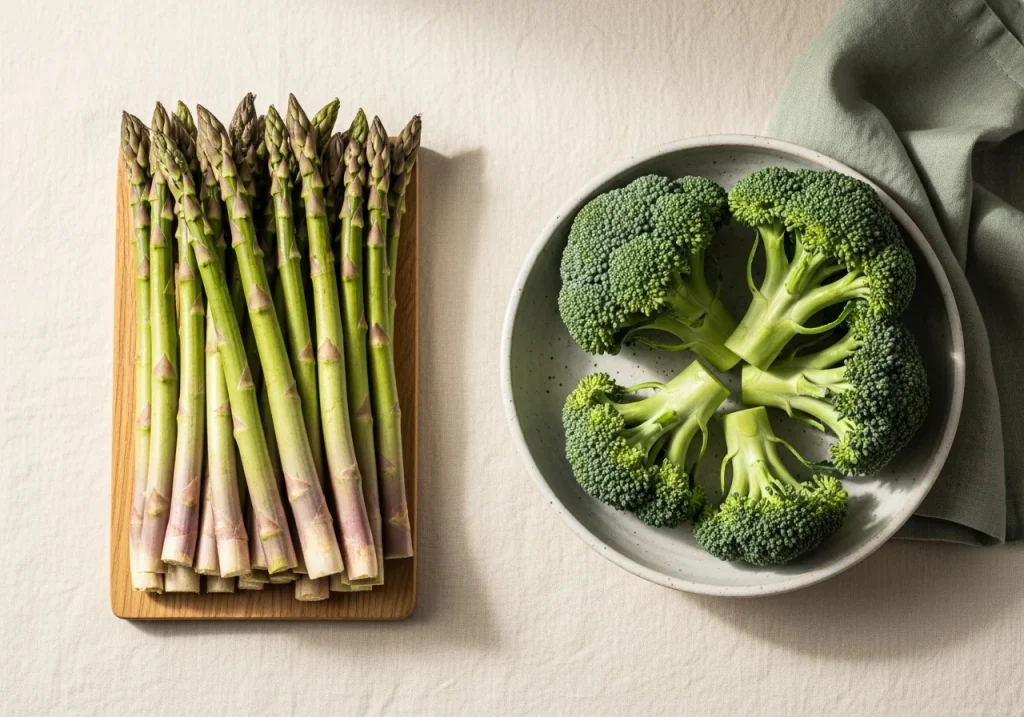
Both green, both spring-vegetable staples, asparagus and broccoli take slightly different nutritional paths.
| Nutrient | Asparagus | Broccoli |
|---|---|---|
| Calories | 28.1 kcal | 34 kcal |
| Protein | 1.44 g | 2.82 g ✓ |
| Total Carbohydrate | 5.1 g | 6.64 g |
| Dietary Fiber | 1.88 g | 2.6 g ✓ |
| Total Sugars | 1.88 g | 1.7 g ✓ |
| Total Fat | 0.22 g | 0.37 g |
| Saturated Fat | 0.04 g ✓ | 0.11 g |
| Sodium | 2.46 mg ✓ | 33 mg |
Notable compounds in each
When to choose each
Broccoli is the more nutrient-dense of the two on the numbers that are directly comparable — more protein and more fibre per 100g — while asparagus stays lower in sodium and slightly lower in calories. Both are classic green vegetables with a strong reputation for vitamin K and folate. The gap here is real but modest; either is an excellent everyday vegetable.
Common questions
Is broccoli more nutritious than asparagus? On protein and fibre, broccoli has a real edge per 100g. Asparagus isn’t far behind and brings its own strengths, including a long-standing reputation as a natural diuretic and a good folate source — both are excellent choices.
Why does asparagus make urine smell different? Asparagus contains a sulphur compound that, once digested, produces a distinctive smell in urine for some people — it’s completely harmless and comes down to individual genetics affecting who can detect the smell at all.