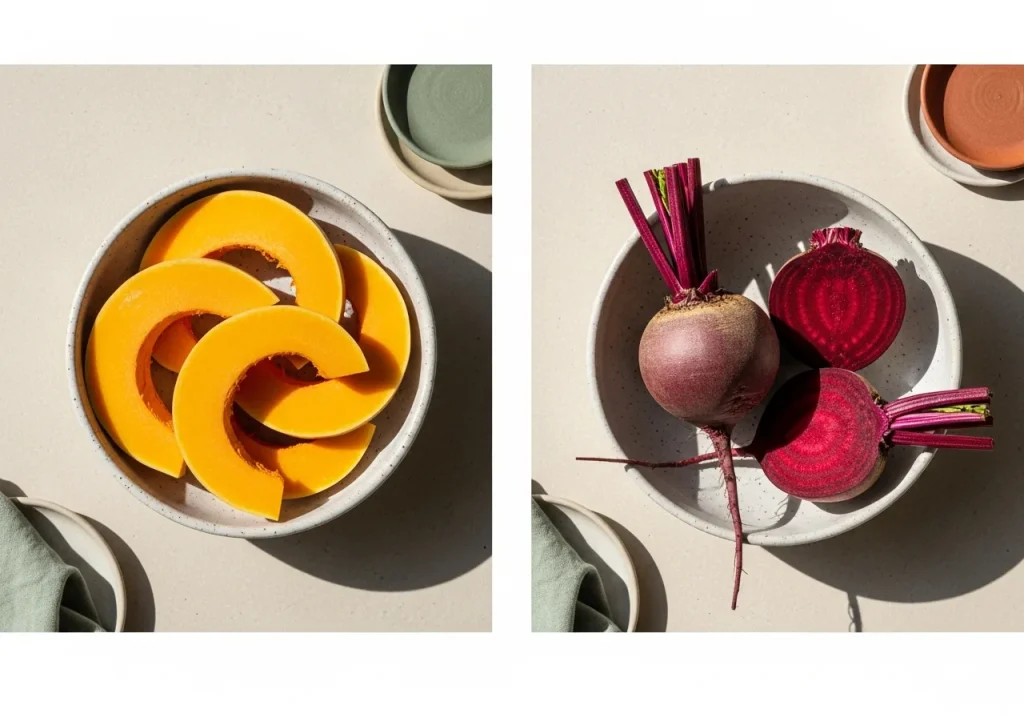
Butternut squash and beetroot are both earthy, naturally sweet roasting-tray vegetables that hold their own against high heat.
| Nutrient | Butternut Squash | Beetroot |
|---|---|---|
| Calories | 48.1 kcal | 43 kcal |
| Protein | 1.15 g | 1.61 g ✓ |
| Total Carbohydrate | 10.5 g | 9.56 g |
| Dietary Fiber | 1.96 g | 2.8 g ✓ |
| Total Sugars | 2.2 g ✓ | 6.76 g |
| Total Fat | 0.17 g | 0.17 g |
| Saturated Fat | 0.021 g ✓ | 0.03 g |
| Sodium | 0 mg ✓ | 78 mg |
Notable compounds in each
When to choose each
Beetroot carries more protein and fibre, while butternut squash is virtually sodium-free and a touch lower in calories. Both are earthy, naturally sweet roasting-tray vegetables that hold up well to high heat. Beetroot’s dietary nitrates are its standout feature, studied for blood pressure and exercise performance; butternut squash’s orange flesh signals its beta-carotene content, the same compound behind sweet potato and carrot’s colour. Either works as a hearty, warming side.
Common questions
Is beetroot higher in sugar than butternut squash? Yes — beetroot carries roughly three times the sugar of butternut squash per 100 g (6.8 g vs 2.2 g), making it clearly the sweeter root vegetable, which is part of why it works in desserts and even as a natural food colouring.
Which is better for roasting, beetroot or butternut squash? Both roast well, but they behave differently — beetroot holds its shape and turns tender with a slightly earthy sweetness, while butternut squash softens further and caramelises more, making it better suited to purees, soups and mash.