Cinnamon and turmeric are two of the most talked-about “healing spices” in wellness circles, both used in tiny amounts but carrying an outsized reputation.
| Nutrient | Cinnamon | Turmeric |
|---|---|---|
| Calories | 247 kcal | 312 kcal |
| Protein | 3.99 g | 9.68 g ✓ |
| Total Carbohydrate | 80.59 g | 67.1 g |
| Dietary Fiber | 53.1 g ✓ | 22.7 g |
| Total Sugars | 2.17 g ✓ | 3.21 g |
| Total Fat | 1.24 g | 3.25 g |
| Saturated Fat | 0.345 g ✓ | 1.84 g |
| Sodium | 10 mg ✓ | 27 mg |
Notable compounds in each
When to choose each
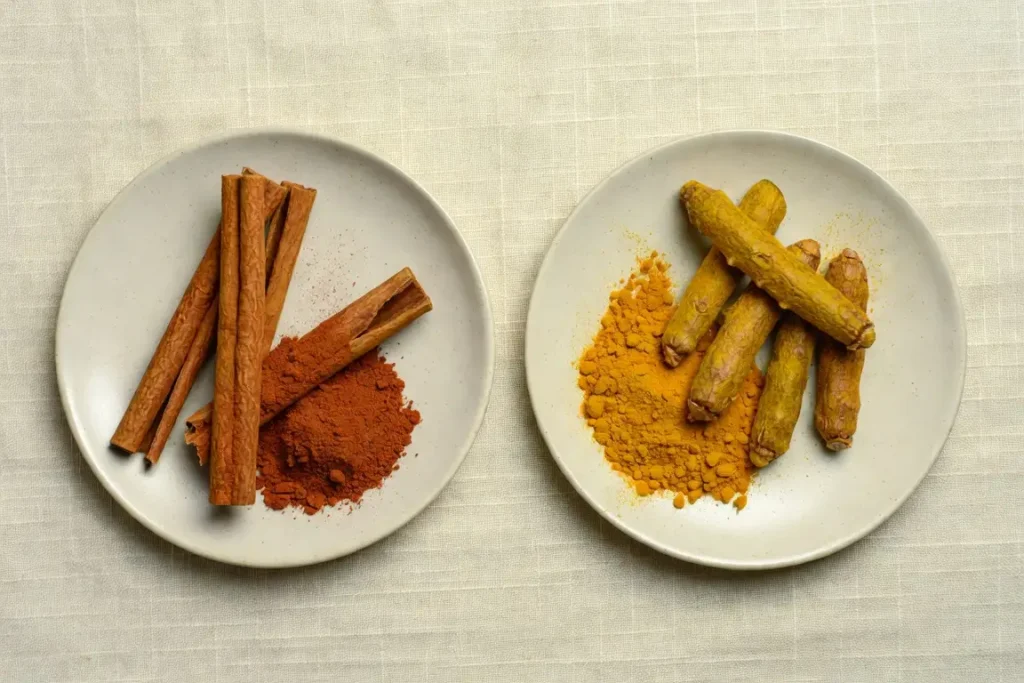
Both dried spices carry surprisingly dense nutrition profiles for how little of each you’d actually use – cinnamon in particular is exceptionally high in fibre, over 50g per 100g, among the highest of any food on this site, though a typical serving is a fraction of a gram. Turmeric has more protein and dramatically more potassium. As with most spice comparisons, the numbers matter far less than the compounds: cinnamon’s cinnamaldehyde and turmeric’s curcumin are the reasons either gets reached for, not their macronutrient content at quantities nobody actually eats.
Common questions
Is cinnamon really that high in fibre? Yes – ground cinnamon is genuinely one of the most fibre-dense foods measured per 100g, largely because it’s dried tree bark, but a typical serving, a teaspoon, roughly 2.6g, delivers only about 1.4g of fibre in practice, nowhere near what the per-100g figure implies.
Does cinnamon help control blood sugar? There’s a mixed research base on this – some studies suggest a modest effect on fasting blood sugar, particularly in people with type 2 diabetes, but results are inconsistent and cinnamon shouldn’t be relied on as a treatment. It’s a reasonable flavour swap for sugar, not a substitute for medical management.