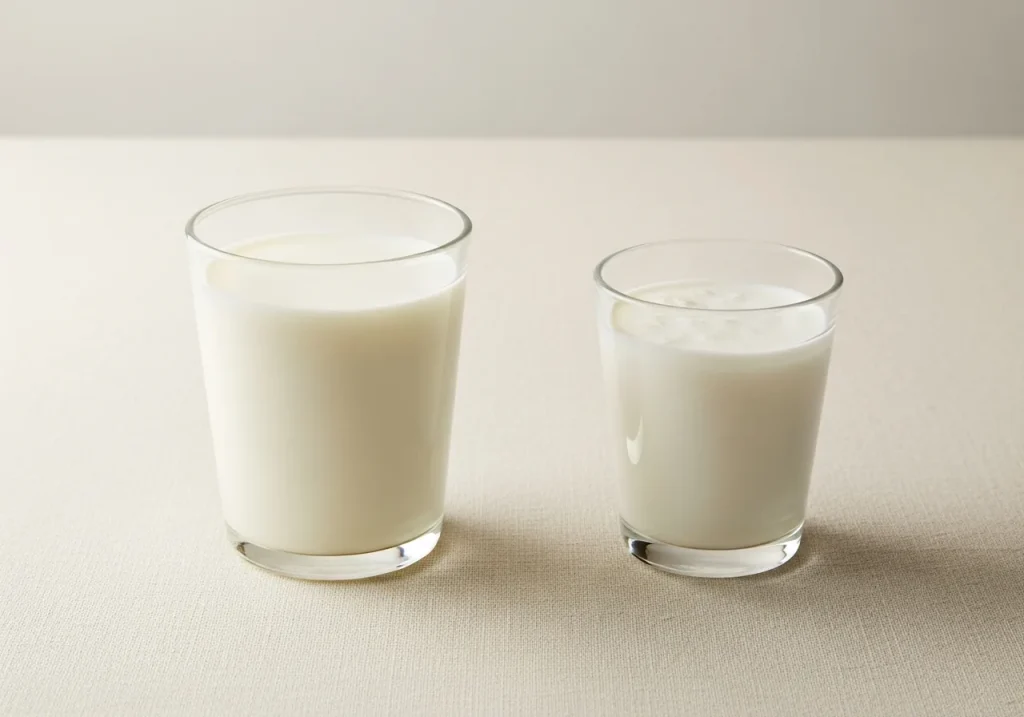
Whole milk and kefir share the same dairy base, but fermentation, and in this case fat content, sets them apart.
| Nutrient | Whole Milk | Kefir |
|---|---|---|
| Calories | 61 kcal | 43 kcal |
| Protein | 3.15 g | 3.79 g ✓ |
| Total Carbohydrate | 4.8 g | 4.77 g |
| Dietary Fiber | 0 g | 0 g |
| Total Sugars | 5.05 g | 4.61 g ✓ |
| Total Fat | 3.25 g | 1.02 g |
| Saturated Fat | 1.87 g | 0.66 g ✓ |
| Sodium | 43 mg | 40 mg ✓ |
Notable compounds in each
When to choose each
Kefir edges ahead on every directly comparable number here, most notably saturated fat, though it’s worth knowing that reflects a lowfat kefir specifically; a whole-milk kefir would sit much closer to whole milk’s fat and calorie numbers. What kefir brings that whole milk doesn’t is fermentation: kefir grains introduce a wide range of probiotic bacteria and yeast strains that plain milk simply doesn’t have. If you want the probiotic benefit with less fat, a lowfat kefir like this is a reasonable dairy swap for whole milk; if you specifically want whole milk’s fat content, a whole-milk kefir would be the more direct comparison.
Common questions
Is kefir just fermented milk? Essentially, yes — kefir is milk fermented with kefir grains, a live culture of bacteria and yeast, which is what gives it its tangy flavour and thinner, drinkable texture compared with yogurt, plus a wider range of probiotic strains than most yogurts contain.
Does kefir have less fat than milk? It depends on which kefir — this comparison uses a lowfat kefir, which is why it looks lighter than whole milk here. A whole-milk kefir would carry a similar fat content to whole milk itself, since kefir doesn’t remove fat by default; it’s simply fermented milk of whatever fat level you start with.