Greek yogurt carries nearly three times the protein; kefir is a drink, not a strained curd. Per 100 g Greek yogurt gives 10.3 g of protein to kefir’s 3.8 g, for 61 calories against 43. That gap is almost entirely about straining — Greek yogurt has had its whey removed, which concentrates what is left.
Kefir’s case is not the macros. It is fermented with a much wider mix of bacteria and yeasts than yogurt, so the reason to drink it is microbial variety rather than anything in the table below.
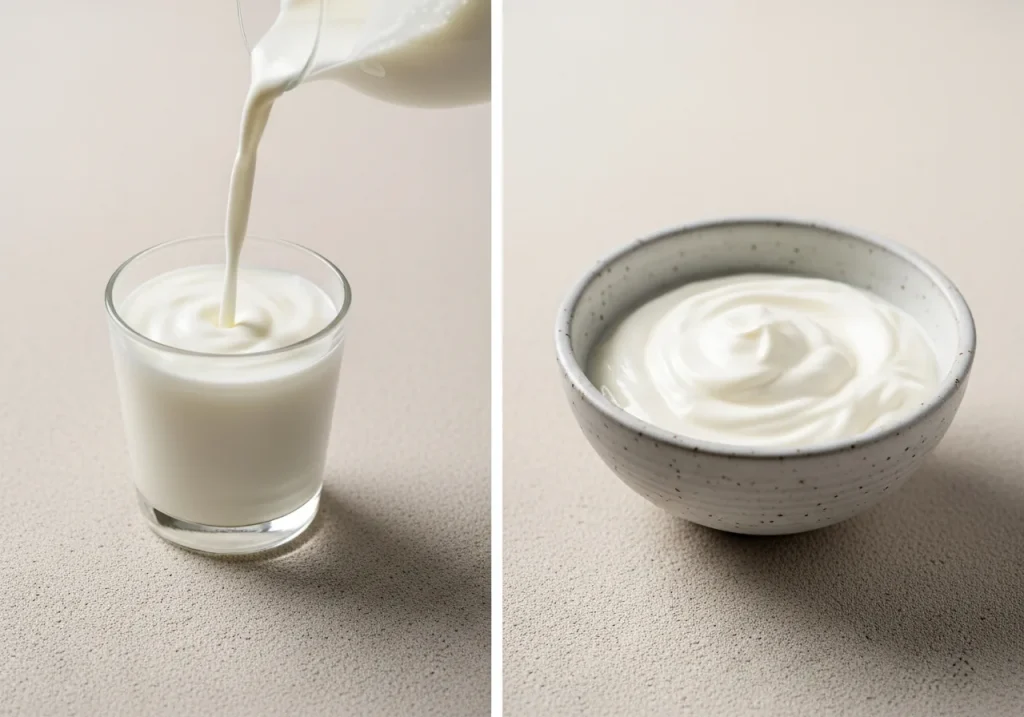
| Nutrient | Kefir | Greek Yogurt (plain, nonfat) |
|---|---|---|
| Calories | 43 kcal | 61 kcal |
| Protein | 3.79 g | 10.3 g ✓ |
| Total Carbohydrate | 4.77 g | 3.64 g |
| Dietary Fiber | 0 g | 0 g |
| Total Sugars | 4.61 g | 3.2 g ✓ |
| Total Fat | 1.02 g | 0.37 g |
| Saturated Fat | 0.66 g | 0.11 g ✓ |
| Sodium | 40 mg | 36 mg ✓ |
Notable compounds in each
When to choose each
Reach for Greek yogurt when protein is the point — nearly three times as much per 100 g, and thick enough to eat as a meal. Reach for kefir when you want a drinkable ferment with a broader range of cultures, or something to pour rather than spoon. If gut health is the goal, kefir is the more interesting of the two; if protein is, it is not close.
Kefir vs Greek yogurt nutrition per 100g
Both plain and unsweetened; the Greek yogurt here is the nonfat version. Flavoured kefir is common and usually carries substantially more sugar than the 4.6 g of natural lactose shown.
Portions differ in practice: kefir is drunk in 200–250 ml servings and Greek yogurt eaten in 150–200 g ones, so the real-world protein gap is narrower than per 100 g suggests — though still large.
Common questions
Is kefir better than Greek yogurt? For protein, no — Greek yogurt has almost three times as much. For microbial diversity, kefir generally carries a wider range of bacteria and yeasts. They are answers to different questions.
Does kefir have more probiotics than yogurt? Kefir is typically fermented with a broader mix of cultures, including yeasts that yogurt does not contain. Counts vary by product and how it has been stored, so the label is a better guide than the category.
How much protein is in kefir? 3.8 g per 100 g, so around 9 g in a 250 ml glass. Greek yogurt is 10.3 g per 100 g.
Can you drink kefir every day? For most people it is an ordinary fermented dairy food and daily is fine. If you are not used to fermented foods, starting with a small glass is sensible — some people find a large first serving unsettling.