Sesame and chia are both small seeds with an outsized nutrition reputation, though they’ve built that reputation on different strengths.
Are sesame seeds and chia seeds the same?
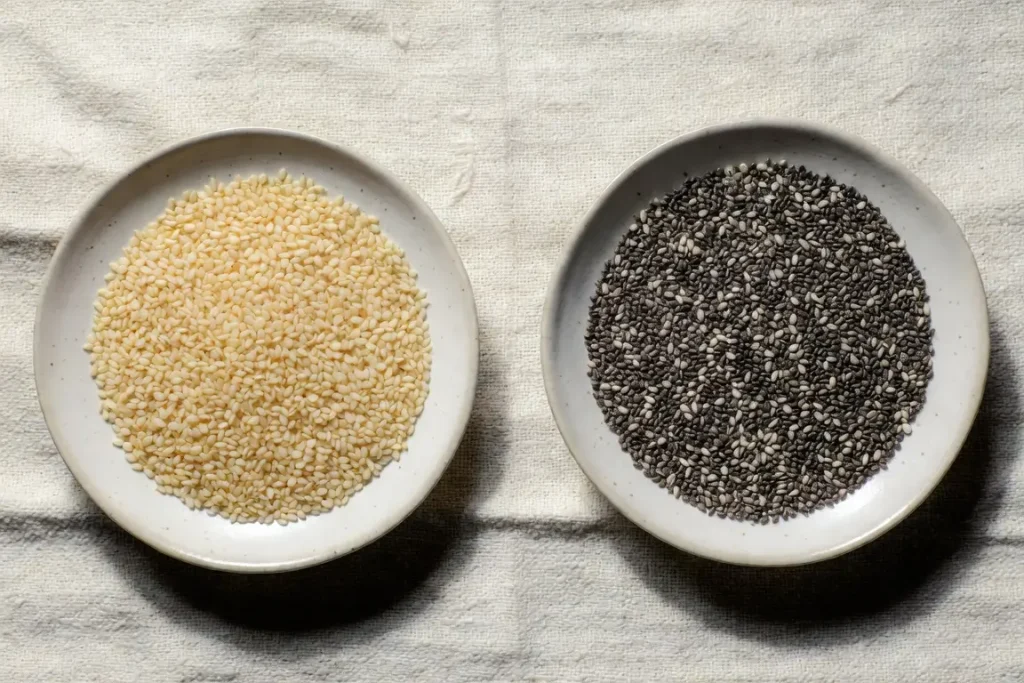
No, sesame and chia are entirely different plants. Sesame comes from Sesamum indicum; chia is the seed of Salvia hispanica, a sage in the mint family. The confusion is usually visual, because black sesame and chia are both small, dark, matte seeds of a similar size. Water is the easiest test: chia forms a gel within minutes and sesame does not. Nutritionally they diverge sharply — chia carries nearly three times the fibre (34.4 g per 100 g against 11.8 g), while sesame is the fattier and more calcium-rich of the two.
| Nutrient | Sesame Seeds | Chia Seeds |
|---|---|---|
| Calories | 573 kcal | 517 kcal |
| Protein | 17.7 g ✓ | 17 g |
| Total Carbohydrate | 23.4 g | 38.3 g |
| Dietary Fiber | 11.8 g | 34.4 g ✓ |
| Total Sugars | 0.3 g | — |
| Total Fat | 49.7 g | 32.9 g |
| Saturated Fat | 6.96 g | 3.33 g ✓ |
| Sodium | 11 mg | 0 mg ✓ |
Notable compounds in each
When to choose each
Chia seeds pull ahead on almost every directly comparable number — dramatically more fibre, less saturated fat, and virtually no sodium — while sesame seeds hold a small protein edge. Sesame’s real strength doesn’t show up in this table: it’s one of the richest plant sources of calcium and other minerals around, which is why tahini and sesame-heavy diets are often flagged as useful for people avoiding dairy. Both are worth keeping in the kitchen; they’re not really substitutes for each other so much as complementary.
Common questions
Are sesame seeds a good source of calcium? Yes, sesame seeds are one of the richest plant sources of calcium available, which matters in particular for anyone limiting dairy, though the calcium in whole sesame seeds is less absorbable than in tahini or hulled seeds due to compounds in the seed coat.
Why is chia so much higher in fibre than sesame? It’s simply a trait of the seed – chia’s fibre content, largely soluble fibre that forms a gel with water, is exceptionally high even compared with other seeds, which is why chia is often used specifically for its gelling, thickening properties in puddings and jams.
Are sesame seeds and chia seeds the same? No, they come from unrelated plants. They are confused because black sesame seeds and chia seeds look almost identical. Soak them to tell them apart: chia gels, sesame stays loose.
Are black sesame seeds and chia seeds the same? No. They are close in size and colour, which is why they are mistaken for each other, but they belong to different plant families and behave differently — only chia forms a gel in liquid.