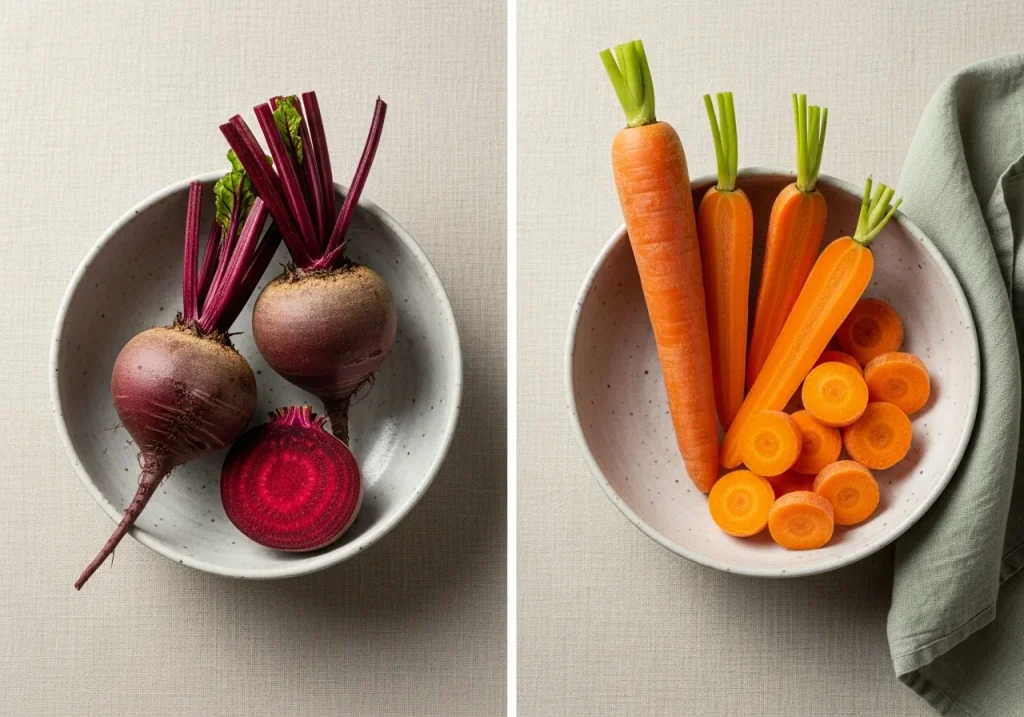
Beetroot and carrot are the two default roasting-tray root vegetables, and close enough nutritionally that the choice usually comes down to flavour.
| Nutrient | Beetroot | Carrot |
|---|---|---|
| Calories | 43 kcal | 41 kcal |
| Protein | 1.61 g ✓ | 0.93 g |
| Total Carbohydrate | 9.56 g | 9.58 g |
| Dietary Fiber | 2.8 g | 2.8 g |
| Total Sugars | 6.76 g | 4.74 g ✓ |
| Total Fat | 0.17 g | 0.24 g |
| Saturated Fat | 0.03 g | 0.03 g |
| Sodium | 78 mg | 69 mg ✓ |
Notable compounds in each
When to choose each
Beetroot and carrot are both earthy, naturally sweet root vegetables with very similar calories and fibre. Beetroot has a modest protein edge and is well known for its dietary nitrates, compounds studied for their role in blood pressure and exercise performance. Carrot runs a little lower in sugar and sodium, and is the standard-bearer for beta-carotene among root vegetables. Both are excellent roasted, grated raw into a salad, or juiced.
Common questions
Why does beetroot turn urine or stool pink or red? A harmless pigment called betalain, found in beetroot, passes through the digestive system undigested in some people — genetics determine who experiences it, and it’s completely benign either way.
Is beetroot really good for exercise performance? There’s a reasonable evidence base for this — beetroot’s dietary nitrate content can be converted into nitric oxide in the body, which has been studied for its role in blood flow and exercise efficiency, though effects vary between individuals.