Butternut squash and sweet potato both roast to the same sweet, orange-fleshed finish — but one carries meaningfully more calories for the same weight.
Is butternut squash the same as sweet potato?
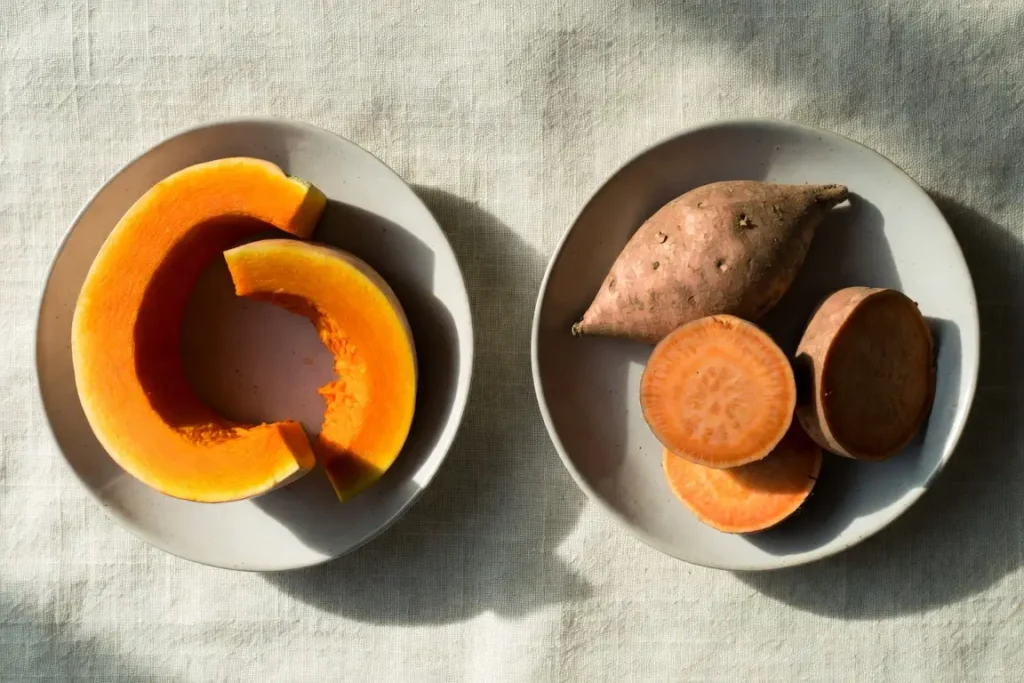
No, they are not the same, and they are not even related. Butternut squash is a winter squash, Cucurbita moschata, botanically a fruit in the gourd family. Sweet potato is a root, Ipomoea batatas, in the morning glory family. The confusion comes from the plate rather than the plant: both roast to the same sweet orange flesh, and both get that colour from beta-carotene. Nutritionally sweet potato is the heavier of the two, carrying about 64% more calories for the same weight (79 kcal against 48) along with more fibre and more sugar.
| Nutrient | Butternut Squash | Sweet Potato |
|---|---|---|
| Calories | 48.1 kcal | 79 kcal |
| Protein | 1.15 g | 1.58 g ✓ |
| Total Carbohydrate | 10.5 g | 17.33 g |
| Dietary Fiber | 1.96 g | 3 g ✓ |
| Total Sugars | 2.2 g ✓ | 4.18 g |
| Total Fat | 0.17 g | 0.38 g |
| Saturated Fat | 0.021 g | 0.018 g ✓ |
| Sodium | 0 mg | 0 mg |
Notable compounds in each
When to choose each
Butternut squash is the lighter option calorie-for-calorie — nearly 40% fewer calories than sweet potato for the same weight — while sweet potato carries more protein and meaningfully more potassium. Both owe their orange colour to a well-known depth of beta-carotene. Either works as a starchy-vegetable side; butternut squash is the better pick when you want the same roasted-orange-vegetable satisfaction for fewer calories.
Common questions
Is butternut squash lower in carbs than sweet potato? Yes, butternut squash carries around 10.5g of carbohydrate per 100g versus roughly 17g for sweet potato, making it the lighter option if carbohydrate intake is a specific focus.
Do butternut squash and sweet potato have similar vitamin content? Broadly, yes, both are excellent sources of beta-carotene, the plant compound the body converts to vitamin A, which is exactly what gives them, and carrots, their characteristic orange colour.
Is butternut squash the same as sweet potato? No, they are different plants entirely. Butternut squash is a gourd (Cucurbita moschata) and sweet potato is a root from the morning glory family (Ipomoea batatas). The resemblance is in the cooked flesh, not the botany.
Is butternut squash or sweet potato healthier? It depends what you are optimising for. Butternut squash is the lighter option at 48 kcal per 100 g against 79. Sweet potato is denser in almost everything, including fibre (3 g against 2 g), because it carries less water.