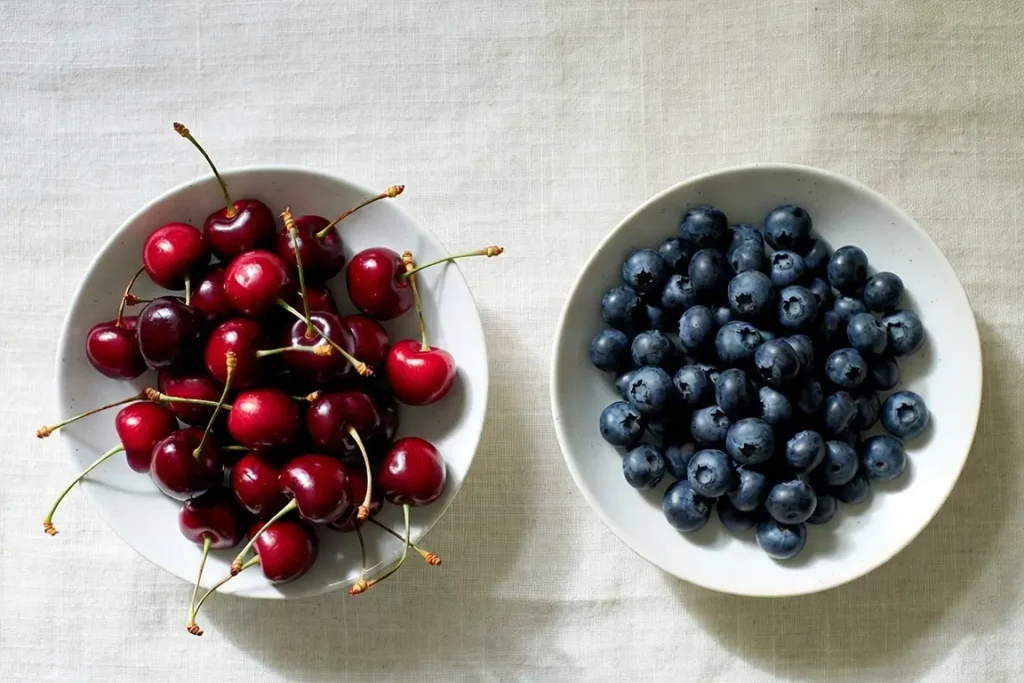
Two antioxidant-famous fruits that share a shelf at the height of summer – cherries and blueberries overlap more than they differ.
| Nutrient | Cherries | Blueberries |
|---|---|---|
| Calories | 70.5 kcal | 63.9 kcal |
| Protein | 1.04 g ✓ | 0.7 g |
| Total Carbohydrate | 16.2 g | 14.6 g |
| Dietary Fiber | 2.1 g | 2.4 g ✓ |
| Total Sugars | 12.8 g | 10 g ✓ |
| Total Fat | 0.19 g | 0.31 g |
| Saturated Fat | 0.038 g | 0.028 g ✓ |
| Sodium | 0 mg | 0 mg |
Notable compounds in each
Cherries
No standout compounds recorded.
When to choose each
Both are antioxidant-rich stone and berry fruits with a lot of nutritional overlap. Cherries have a modest protein edge; blueberries bring a well-documented fibre content and are one of the most-studied fruits for anthocyanin content, the polyphenols behind their deep colour. Calories are close enough – around 70 versus 64 per 100g – that this comes down to flavour and season rather than a clear nutritional winner.
Common questions
Which has more antioxidants, cherries or blueberries? Both are well regarded for polyphenol content – blueberries are particularly well studied for anthocyanins, while tart cherries have their own research base around anthocyanins and exercise recovery. Neither is a clear-cut winner; both are excellent choices.
Are cherries or blueberries lower in calories? Blueberries are slightly lower – about 64 kcal per 100g versus roughly 70 kcal for cherries – though the difference is small enough not to matter for most people’s choices.