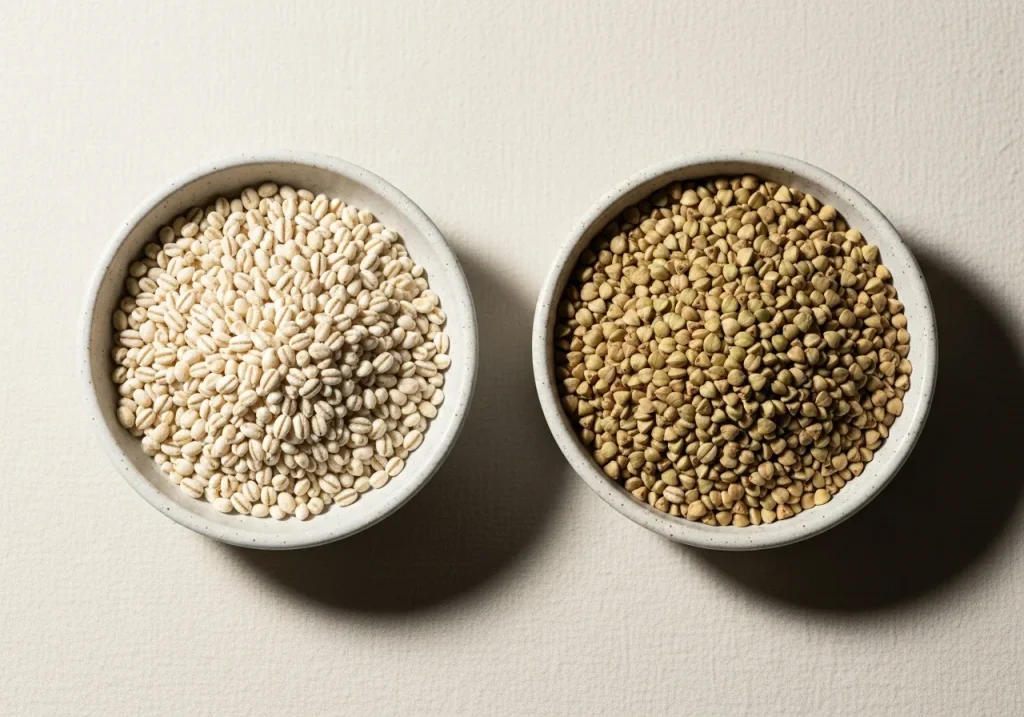
Barley and buckwheat are both reached for as a rice alternative, but only one of them is actually related to wheat — the other just borrows the name.
| Nutrient | Barley | Buckwheat |
|---|---|---|
| Calories | 352 kcal | 343 kcal |
| Protein | 9.91 g | 13.25 g ✓ |
| Total Carbohydrate | 77.7 g | 71.5 g |
| Dietary Fiber | 15.6 g ✓ | 10 g |
| Total Sugars | 0.8 g ✓ | 2.6 g |
| Total Fat | 1.16 g | 3.4 g |
| Saturated Fat | 0.244 g ✓ | 0.74 g |
| Sodium | 9 mg | 1 mg ✓ |
Notable compounds in each
When to choose each
Barley edges ahead on fibre — noticeably more per 100g than buckwheat — while buckwheat carries appreciably more protein and is virtually sodium-free. Both are dense, filling whole grains eaten as a rice alternative or cooked into a porridge. The practical difference for most people: barley generally contains gluten, while buckwheat, despite its name, is naturally gluten-free.
Common questions
Is buckwheat actually a type of wheat? No — despite the name, buckwheat isn’t a true grain at all botanically (it’s more closely related to rhubarb) and contains no gluten, which is why it’s a popular grain substitute for people avoiding gluten.
Is barley gluten-free? No — barley is a true cereal grain closely related to wheat and contains gluten, so it isn’t suitable for a gluten-free diet.