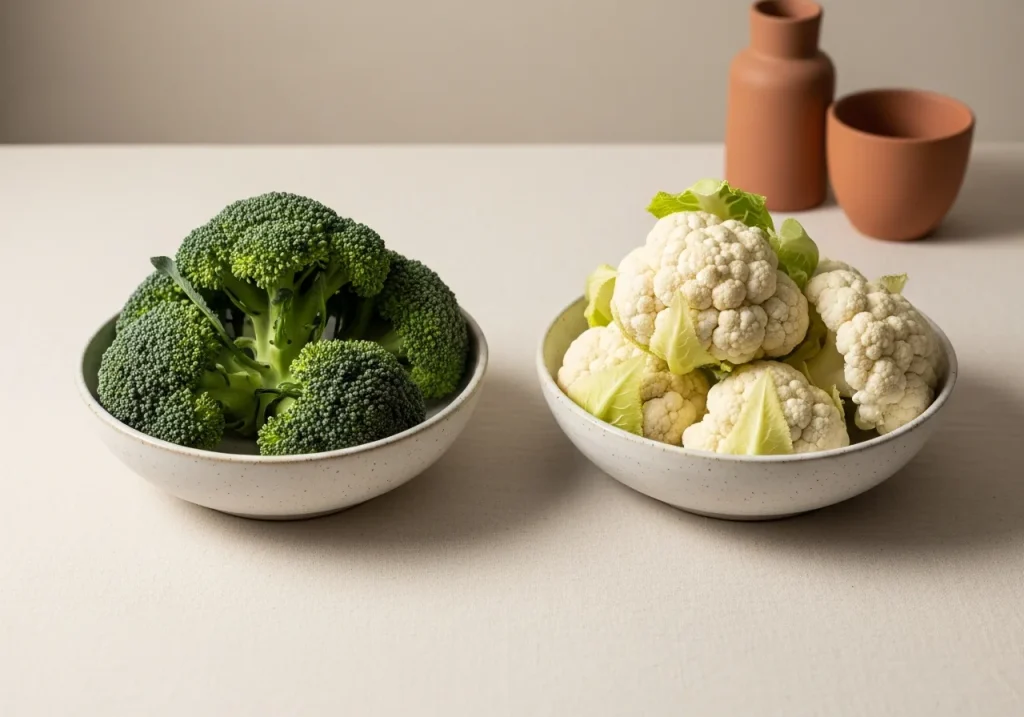
Broccoli is the more nutrient-dense of the two; cauliflower is the lighter and blander one. Per 100 g broccoli carries 2.82 g of protein to cauliflower’s 1.64 g, more fibre (2.6 g against 2 g) and more potassium (316 mg against 274 mg), for 34 calories against 28.
Both are brassicas and both supply glucosinolates, the sulphur compounds that give the family its smell and most of its research interest. Broccoli is the better-studied source, particularly for sulforaphane.
| Nutrient | Broccoli | Cauliflower |
|---|---|---|
| Calories | 34 kcal | 27.6 kcal |
| Protein | 2.82 g ✓ | 1.64 g |
| Total Carbohydrate | 6.64 g | 4.72 g |
| Dietary Fiber | 2.6 g ✓ | 1.95 g |
| Total Sugars | 1.7 g ✓ | 1.91 g |
| Total Fat | 0.37 g | 0.24 g |
| Saturated Fat | 0.11 g ✓ | 0.13 g |
| Sodium | 33 mg | 20 mg ✓ |
Notable compounds in each
When to choose each
Reach for broccoli when you want more from the same plate — more protein, more fibre, more potassium and a stronger claim on the compounds brassicas are known for. Reach for cauliflower when you want a neutral base: its mildness and lower carbohydrate are exactly why it works riced, mashed or as a pizza crust, jobs broccoli cannot do.
Broccoli vs cauliflower nutrition per 100g
Both raw. Boiling either leaches water-soluble vitamins into the water; steaming, roasting or microwaving keeps more of them, and the difference is large enough to be worth the change in habit.
100 g is roughly a large serving of florets for either, so these figures are close to a real portion.
Common questions
Is broccoli healthier than cauliflower? On the numbers, yes — more protein, fibre and potassium for a similar calorie count, and a better-established source of sulforaphane. Cauliflower is not a poor choice; it is simply less dense in most things.
Which has fewer carbs, broccoli or cauliflower? Cauliflower: 4.72 g per 100 g against broccoli’s 6.64 g. That is the main reason it turns up as a low-carb substitute for rice and potato.
Is cauliflower rice actually healthy? It is just cauliflower, chopped fine, so it carries cauliflower’s nutrition — far fewer calories and carbohydrate than rice, and far less protein. It is a reasonable swap if you want volume for fewer calories, not a nutritional upgrade in every sense.
Does cooking destroy the nutrients in broccoli? Some. Boiling loses the most because water-soluble vitamins leach into the water. Steaming and microwaving retain considerably more, and light cooking makes some compounds easier to absorb, so cooked broccoli is not simply worse than raw.