Pistachios and sunflower seeds are both portable, nutrient-dense snacks, close enough in nutrition that shell and portion size matter as much as the numbers.
| Nutrient | Pistachios | Sunflower Seeds |
|---|---|---|
| Calories | 598 kcal | 609 kcal |
| Protein | 20.5 g ✓ | 18.9 g |
| Total Carbohydrate | 27.7 g | 24.5 g |
| Dietary Fiber | 6.97 g | 7.22 g ✓ |
| Total Sugars | 7.66 g | 2.62 g ✓ |
| Total Fat | 45 g | 48.4 g |
| Saturated Fat | 5.91 g | 4.46 g ✓ |
| Sodium | 0 mg | 0 mg |
Notable compounds in each
When to choose each
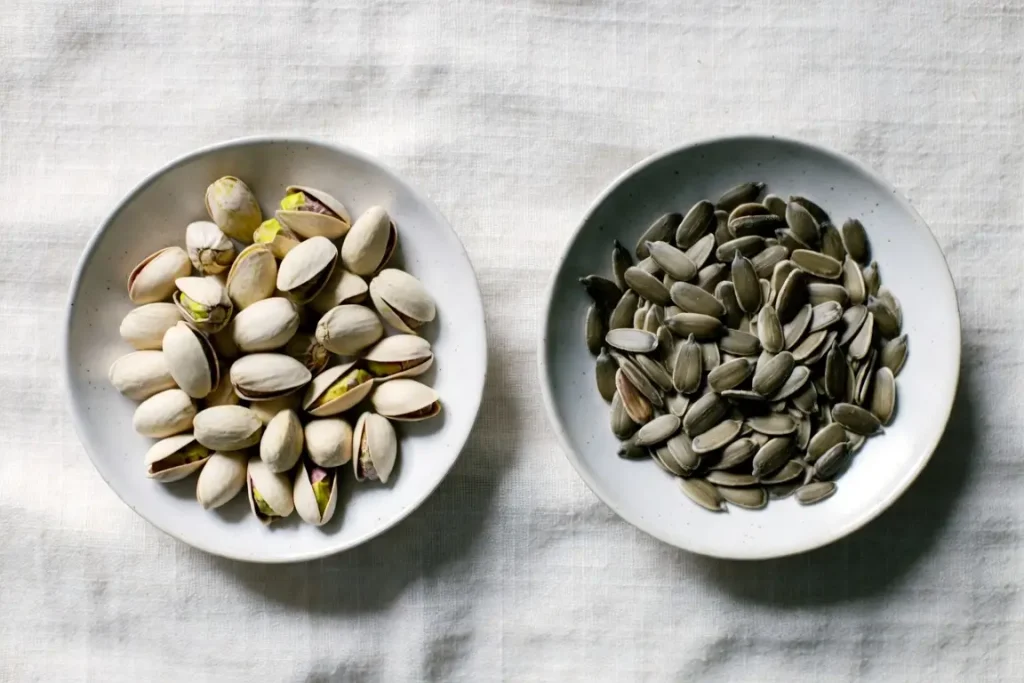
These two are remarkably close, with pistachios carrying a small protein edge and sunflower seeds a small fibre edge, differences too minor to matter in practice. Pistachios stand out for potassium, meaningfully more than sunflower seeds and among the highest of any nut or seed on this site. Both are easy, portable, nutrient-dense snacks; pistachios have the advantage of being sold in-shell, which naturally slows down eating and portion size.
Common questions
Why are pistachios sometimes recommended for portion control? Because they’re commonly sold in-shell, the process of shelling each one slows down how quickly you eat them, and the empty shells provide a visual cue for how much you’ve had, both of which have been studied as a mild but real portion-control effect compared with pre-shelled snacks.
Are pistachios a good source of potassium? Yes – pistachios are one of the richest nut sources of potassium available, meaningfully ahead of sunflower seeds and most other nuts on this site.