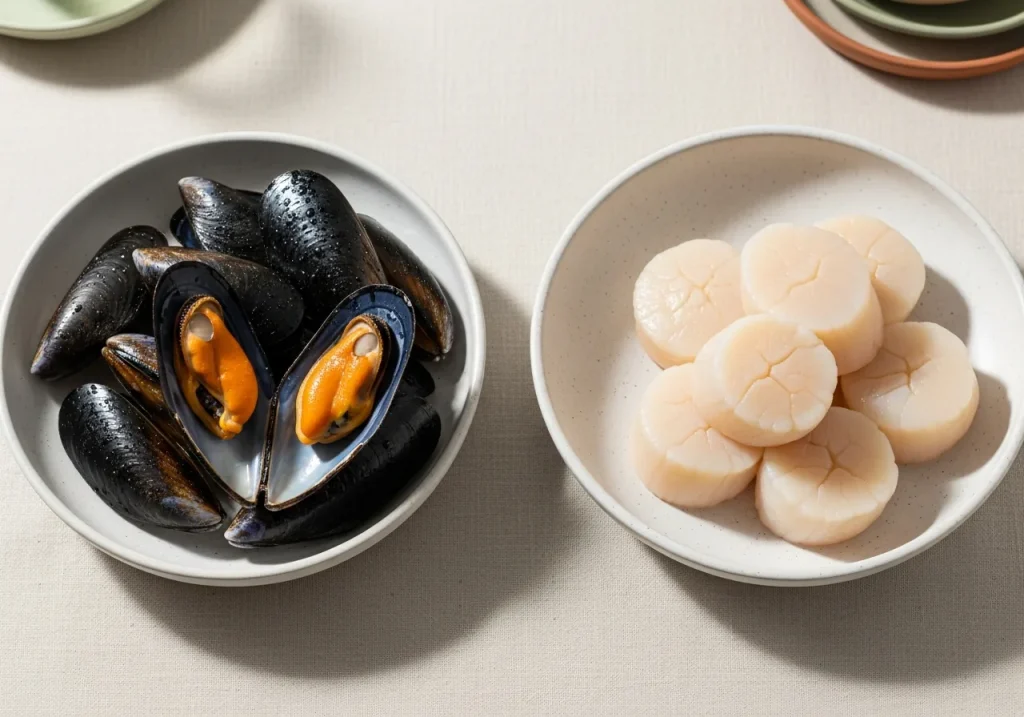
Mussels and scallops both headline a seafood platter, at very different price points for surprisingly similar nutrition.
| Nutrient | Mussels | Scallops |
|---|---|---|
| Calories | 86 kcal | 69 kcal |
| Protein | 11.9 g | 12.1 g ✓ |
| Total Carbohydrate | 3.69 g | 3.18 g |
| Dietary Fiber | 0 g | 0 g |
| Total Sugars | 0 g | 0 g |
| Total Fat | 2.24 g | 0.49 g |
| Saturated Fat | 0.43 g | 0.13 g ✓ |
| Sodium | 286 mg ✓ | 392 mg |
Notable compounds in each
When to choose each
Scallops carry a touch more protein and less saturated fat, while mussels are meaningfully lower in sodium, a real point in their favour given how sodium-heavy shellfish tends to run as a category. Mussels are the more affordable, higher-yield option in most markets; scallops are the pricier, more delicate choice usually reserved for a special-occasion sear. Both are lean, quick-cooking shellfish with a similar place on the plate.
Common questions
Why are scallops more expensive than mussels? Mostly down to how they’re harvested — scallops require more labour-intensive diving or dredging and have a lower yield per catch, while mussels are widely and efficiently farmed on ropes or beds, which keeps their cost much lower.
Are mussels sustainable? Generally, yes — farmed mussels are often cited as one of the most environmentally sustainable proteins available, since they require no feed, filter water as they grow, and have a very low carbon footprint compared with most animal proteins.