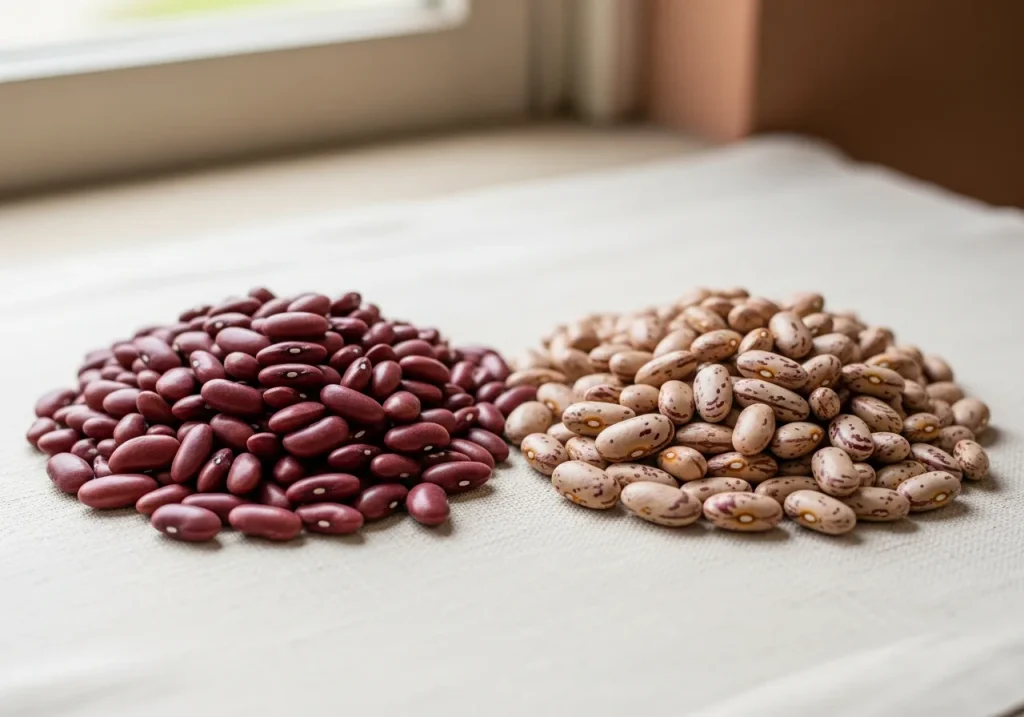
Two pantry-staple legumes that show up in chilli, stews and salads worldwide — and, per 100g dry weight, sit remarkably close together on the numbers.
| Nutrient | Kidney Beans | Pinto Beans |
|---|---|---|
| Calories | 337 kcal | 347 kcal |
| Protein | 22.5 g ✓ | 21.42 g |
| Total Carbohydrate | 61.3 g | 62.55 g |
| Dietary Fiber | 15.2 g | 15.5 g ✓ |
| Total Sugars | 2.1 g ✓ | 2.11 g |
| Total Fat | 1.06 g | 1.23 g |
| Saturated Fat | 0.15 g ✓ | 0.235 g |
| Sodium | 12 mg | 12 mg |
Notable compounds in each
When to choose each
These two are remarkably close: both are raw dry legumes with almost identical calories, protein and fibre per 100g. Kidney beans edge ahead very slightly on protein, fibre and saturated fat; pinto beans carry noticeably less natural sugar. In practice, the choice here comes down to flavour and the dish you’re cooking rather than any meaningful nutritional gap — both are excellent everyday sources of plant protein and fibre.
Common questions
Are kidney beans and pinto beans nutritionally interchangeable? Almost — the two are close enough in calories, protein and fibre that you can generally swap one for the other in a recipe without a meaningful nutritional trade-off.
Do beans need to be cooked before eating? Yes, always. The values shown here reflect the raw dry bean; dried kidney and pinto beans must be soaked and thoroughly cooked before eating, since raw or undercooked kidney beans in particular contain a natural toxin that proper cooking destroys.