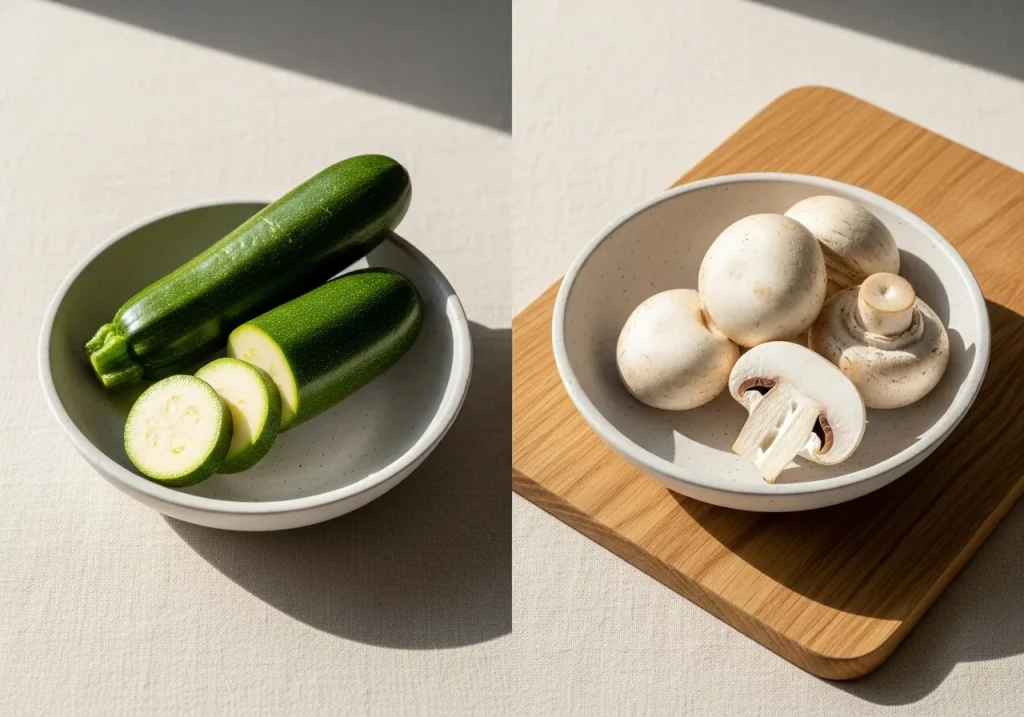
Courgette and white mushrooms are both low-calorie, high-volume vegetables that show up in the same dishes more often than they compete.
| Nutrient | Courgette (Zucchini) | White Mushrooms |
|---|---|---|
| Calories | 17 kcal | 22 kcal |
| Protein | 1.21 g | 3.09 g ✓ |
| Total Carbohydrate | 3.11 g | 3.26 g |
| Dietary Fiber | 1 g | 1 g |
| Total Sugars | 2.5 g | 1.98 g ✓ |
| Total Fat | 0.32 g | 0.34 g |
| Saturated Fat | 0.08 g | 0.05 g ✓ |
| Sodium | 8 mg | 5 mg ✓ |
Notable compounds in each
Courgette (Zucchini)
White Mushrooms
When to choose each
Both are low-calorie, high-volume vegetables often used to bulk out a dish without adding much energy, but mushrooms have a real protein edge, nearly three times courgette’s per 100g, unusually high for a vegetable. The rest of the differences here are marginal: both are excellent, versatile low-calorie choices, and often used together in the same dishes, stir-fries, pasta bakes, rather than as a straight substitute for one another.
Common questions
Are mushrooms a good source of protein for a vegetable? Relatively, yes — mushrooms carry noticeably more protein than most vegetables gram for gram, which is part of why they’re a popular meat-extender or partial meat substitute in dishes like bolognese or burgers.
Is courgette (zucchini) mostly water? Yes — courgette is around 94-95% water by weight, which is exactly why it’s so low in calories and works well as a bulking ingredient or a base for low-carb “noodles” (courgetti).