Cod and tilapia are the two mildest, most versatile white fish on most menus, the ones that taste like whatever you cook them with.
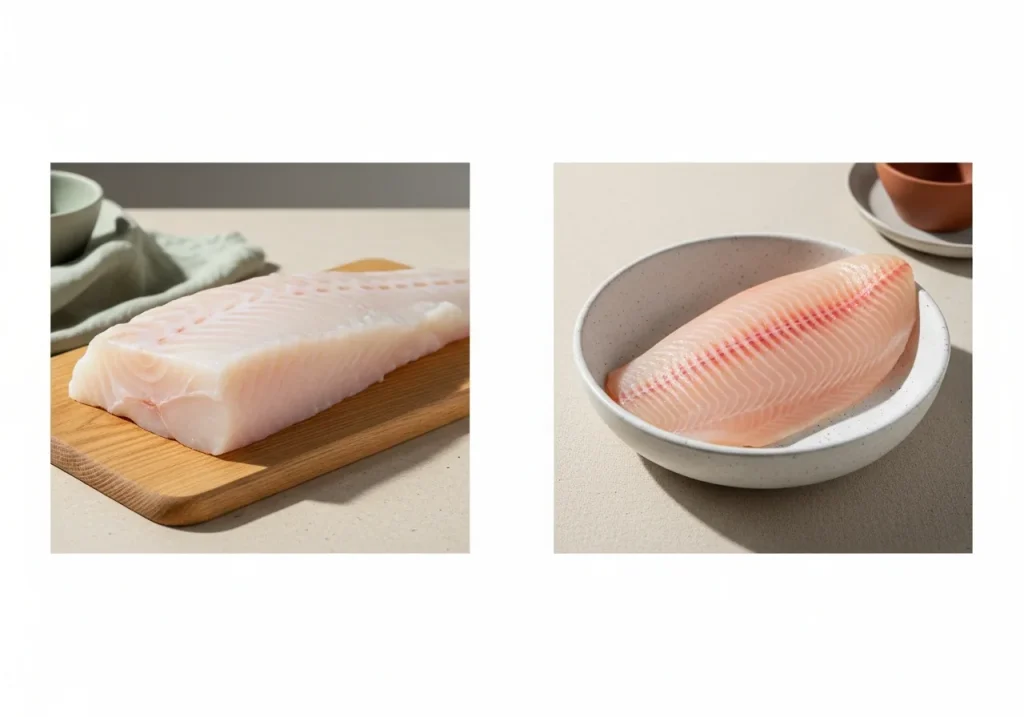
| Nutrient | Cod | Tilapia |
|---|---|---|
| Calories | 82 kcal | 94.7 kcal |
| Protein | 17.81 g | 19 g ✓ |
| Total Carbohydrate | 0 g | 0 g |
| Dietary Fiber | 0 g | 0 g |
| Total Sugars | 0 g | 0 g |
| Total Fat | 0.67 g | 2.48 g |
| Saturated Fat | 0.13 g ✓ | 0.65 g |
| Sodium | 54 mg ✓ | 93.7 mg |
Notable compounds in each
When to choose each
Cod is the leaner choice on both saturated fat and sodium, while tilapia carries a touch more protein. Both are mild, widely available white fish that take on other flavours well rather than tasting strongly of fish themselves, the classic fish-and-chips or fish-taco base. Cod is generally the more sustainably certified option depending on the fishery, while tilapia’s mild flavour and low price have made it one of the most farmed fish in the world.
Common questions
Which is a more sustainable choice, cod or tilapia? It depends on the specific fishery or farm — look for a Marine Stewardship Council or Aquaculture Stewardship Council label on either, since sustainability varies considerably by source rather than being a fixed trait of the species itself.
Why is tilapia so widely farmed? It grows quickly, tolerates a wide range of conditions, and has a very mild flavour that takes on seasoning well, all of which make it cheap and easy to farm at scale, which is why it’s become one of the most widely available fish worldwide.