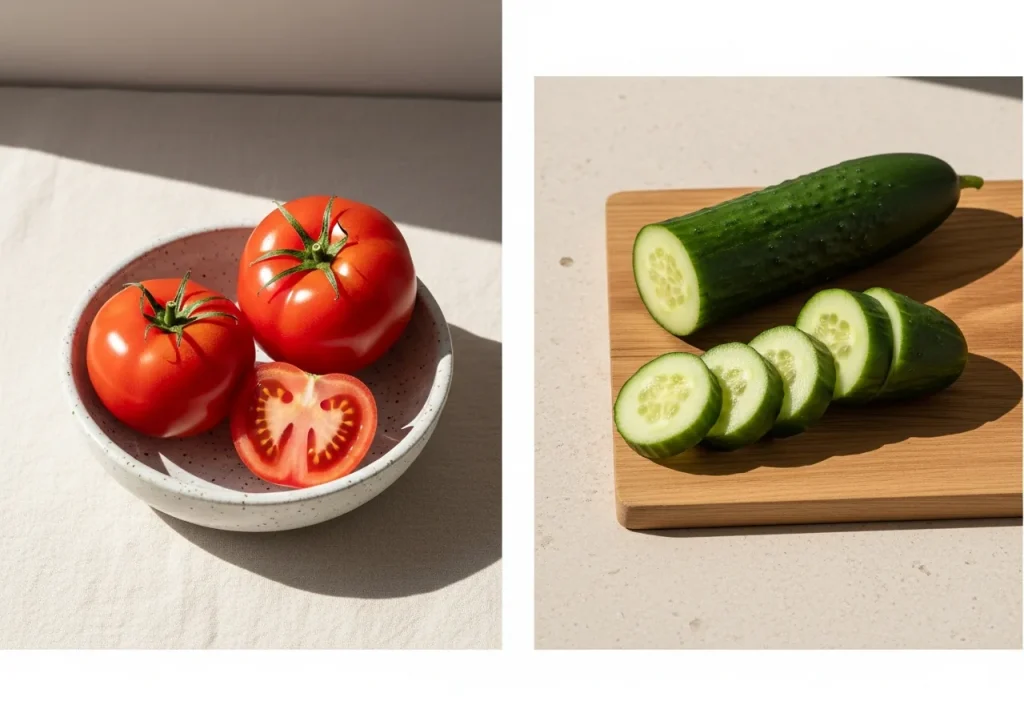
Tomato and cucumber are the two default salad-drawer vegetables, both mostly water but built quite differently underneath.
| Nutrient | Tomato | Cucumber |
|---|---|---|
| Calories | 18 kcal | 15.9 kcal |
| Protein | 0.88 g ✓ | 0.63 g |
| Total Carbohydrate | 3.89 g | 2.95 g |
| Dietary Fiber | 1.2 g ✓ | 0.5 g |
| Total Sugars | 2.63 g | 1.67 g ✓ |
| Total Fat | 0.2 g | 0.18 g |
| Saturated Fat | 0.03 g ✓ | 0.037 g |
| Sodium | 5 mg | 1.52 mg ✓ |
Notable compounds in each
When to choose each
Tomato carries a bit more protein and fibre, while cucumber is lower in both calories and sodium. Both are watery, refreshing salad staples — cucumber is roughly 95% water, even more than tomato, which is why it’s the go-to for a low-calorie, high-volume crunch. Tomato brings lycopene and a much stronger flavour profile; cucumber is closer to a neutral, hydrating filler. Most salads benefit from both rather than choosing one over the other.
Common questions
Is cucumber mostly water? Yes — cucumber is around 95-96% water by weight, among the most water-dense foods commonly eaten, which is exactly why it’s so low in calories and so effective at adding bulk and crunch without adding much energy.
Is tomato a fruit or a vegetable? Botanically, tomato is a fruit, the seed-bearing structure of the plant, but it’s used and classified as a vegetable in cooking, and, famously, in a 19th-century US Supreme Court ruling on tariff law.