Asparagus and green beans are both spear-or-pod green vegetables that show up in the same side-dish rotation.
Are green beans and asparagus the same?
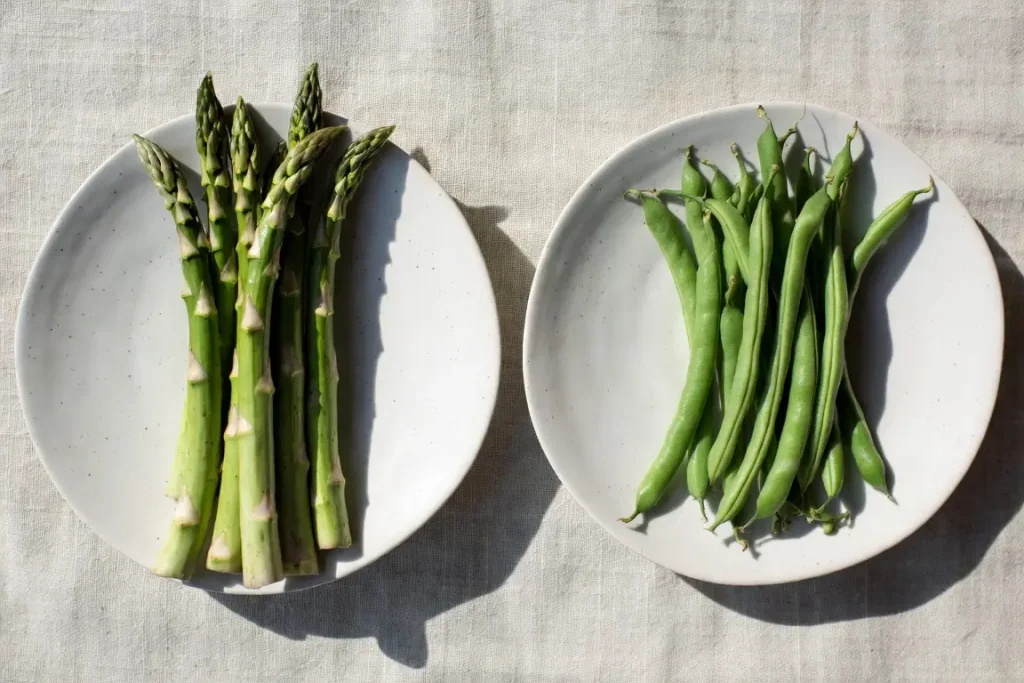
No, asparagus and green beans are unrelated plants. Asparagus is the young shoot of Asparagus officinalis, a perennial that sends up spears each spring. Green beans are the immature pods of the common bean, Phaseolus vulgaris, a legume. Both are green, both snap, and both land in the same side dish – but nothing else connects them. Asparagus is the lighter at 28 kcal per 100 g against 40, while green beans carry more fibre.
| Nutrient | Asparagus | Green Beans |
|---|---|---|
| Calories | 28.1 kcal | 40 kcal |
| Protein | 1.44 g | 1.97 g ✓ |
| Total Carbohydrate | 5.1 g | 7.41 g |
| Dietary Fiber | 1.88 g | 3.01 g ✓ |
| Total Sugars | 1.88 g ✓ | 3.26 g |
| Total Fat | 0.22 g | 0.28 g |
| Saturated Fat | 0.04 g ✓ | 0.05 g |
| Sodium | 2.46 mg | 0 mg ✓ |
Notable compounds in each
When to choose each
Green beans edge ahead on protein, fibre and sodium, while asparagus is the lower-calorie option of the two. Both are classic green vegetables that show up in the same side-dish rotation, steamed, roasted, or stir-fried. Asparagus brings its own well-known folate content and a long-standing reputation as a natural diuretic; green beans are the more filling, slightly more substantial choice for the same reason they carry more fibre and protein.
Common questions
Are green beans a legume like other beans? Botanically, yes – green beans are the young, unripe pod of a bean plant, eaten pod and all, unlike mature dry beans (kidney, black, pinto) which are eaten as just the seed. That’s part of why green beans sit nutritionally between a true vegetable and a legume.
Is asparagus a good source of folate? Yes – asparagus is one of the better vegetable sources of folate, a B vitamin particularly important during pregnancy, alongside its long-standing reputation as a mild natural diuretic.
Are green beans and asparagus the same? No. Asparagus is a shoot from a perennial plant; green beans are the pod of a legume. They are unrelated botanically and resemble each other only on the plate.
Are green beans or asparagus healthier? Close enough that either is a good choice. Asparagus is lower in calories and higher in folate and vitamin K; green beans carry more fibre per 100 g. Neither gap is large enough to decide between them on nutrition alone.