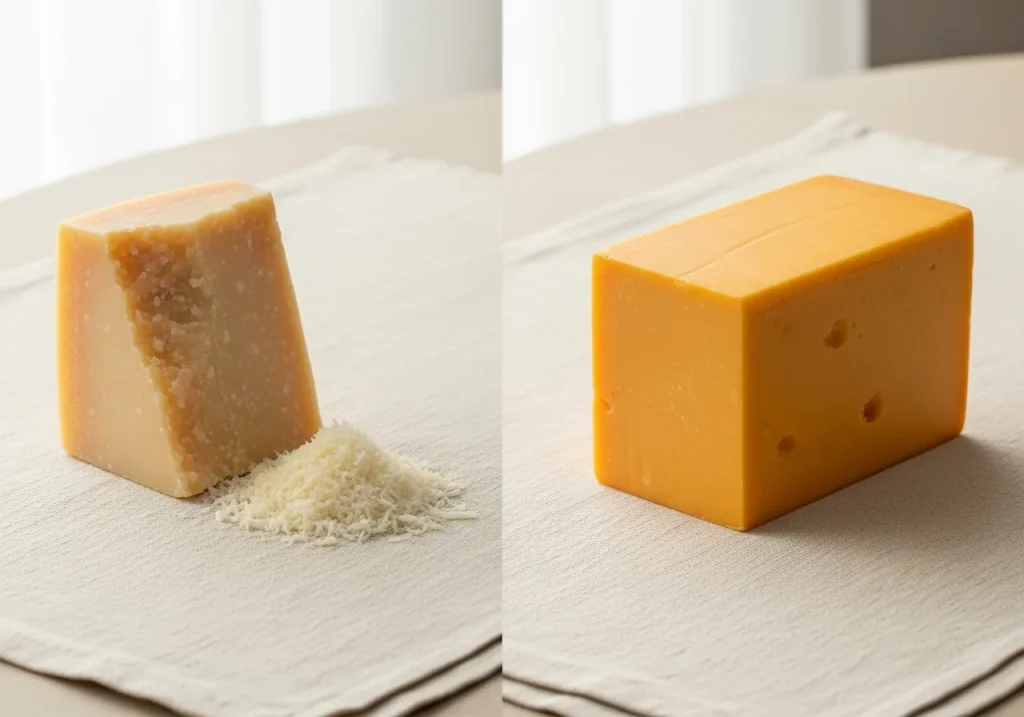
Parmesan and cheddar are two of the most-used hard-to-semi-hard cheeses in Western kitchens, made very differently from one another.
| Nutrient | Parmesan | Cheddar Cheese |
|---|---|---|
| Calories | 392 kcal | 410 kcal |
| Protein | 35.75 g ✓ | 24.25 g |
| Total Carbohydrate | 3.22 g | 2.13 g |
| Dietary Fiber | 0 g | 0 g |
| Total Sugars | 0.11 g ✓ | 0.27 g |
| Total Fat | 25 g | 33.82 g |
| Saturated Fat | 14.85 g ✓ | 19.37 g |
| Sodium | 1175 mg | 644 mg ✓ |
Notable compounds in each
When to choose each
Parmesan is the more protein-dense of the two, meaningfully more protein and less saturated fat per 100g than cheddar, but that concentration comes at a real cost in sodium: parmesan carries nearly double cheddar’s sodium content, a direct result of how long and heavily-salted its ageing process is. Cheddar is the more moderate, everyday melting cheese; parmesan is typically used in small grated amounts rather than eaten in equivalent quantities, which naturally limits its sodium impact in practice.
Common questions
Why is parmesan so much higher in sodium than cheddar? It comes down to how it’s made — parmesan is aged for much longer than cheddar, often a year or more, and salt plays a central role in that ageing process both for flavour and as a natural preservative, which concentrates sodium considerably compared with a younger cheese.
Is parmesan a good source of protein? Very much so — parmesan is one of the most protein-dense cheeses available, around 36g per 100g, though because it’s typically used as a garnish in small grated amounts rather than eaten in large portions, its practical contribution to daily protein intake is usually modest.