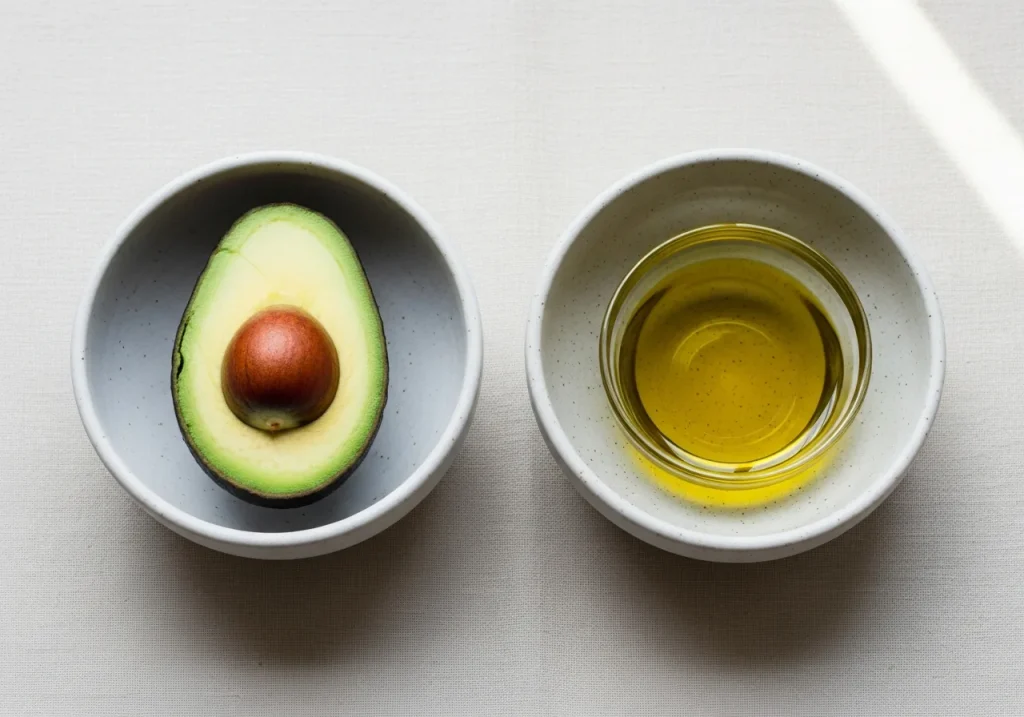
Avocado and extra virgin olive oil are the two headline monounsaturated-fat foods of the Mediterranean diet, though they play very different roles in the kitchen.
| Nutrient | Avocado | Extra Virgin Olive Oil |
|---|---|---|
| Calories | 160 kcal | 884 kcal |
| Protein | 2 g ✓ | 0 g |
| Total Carbohydrate | 8.53 g | 0 g |
| Dietary Fiber | 6.7 g ✓ | 0 g |
| Total Sugars | 0.66 g | 0 g ✓ |
| Total Fat | 14.66 g | 100 g |
| Saturated Fat | 2.126 g ✓ | 15.4 g |
| Sodium | 7 mg | 2 mg ✓ |
Notable compounds in each
When to choose each
These aren’t really competing for the same job in the kitchen, but they’re worth comparing on their shared reputation as flagship monounsaturated-fat foods. Avocado is a whole food, lower in calories per 100g, with real fibre and protein that pure oil simply can’t offer. Extra virgin olive oil is far more calorie-dense, since it’s essentially 100% fat with no water content diluting it, which matters if you’re using it as a cooking fat rather than eating it by the spoonful. Both are similarly low in saturated fat relative to their total fat content, around 14-15% either way, which is the real signature of a heart-healthy fat source.
Common questions
Is avocado or olive oil healthier? They’re not really interchangeable — avocado is a whole food you eat for its own sake, with fibre and micronutrients built in, while olive oil is a cooking and dressing fat used in small amounts. Both are well-regarded monounsaturated-fat sources central to the Mediterranean diet; neither replaces the other.
Why is olive oil so much higher in calories than avocado? Because it’s pure fat — 100g of olive oil is literally 100g of fat, with none of the water, fibre or protein that dilutes avocado’s calorie density as a whole food. Weight for weight, any oil will always be far more calorie-dense than the whole food it came from.