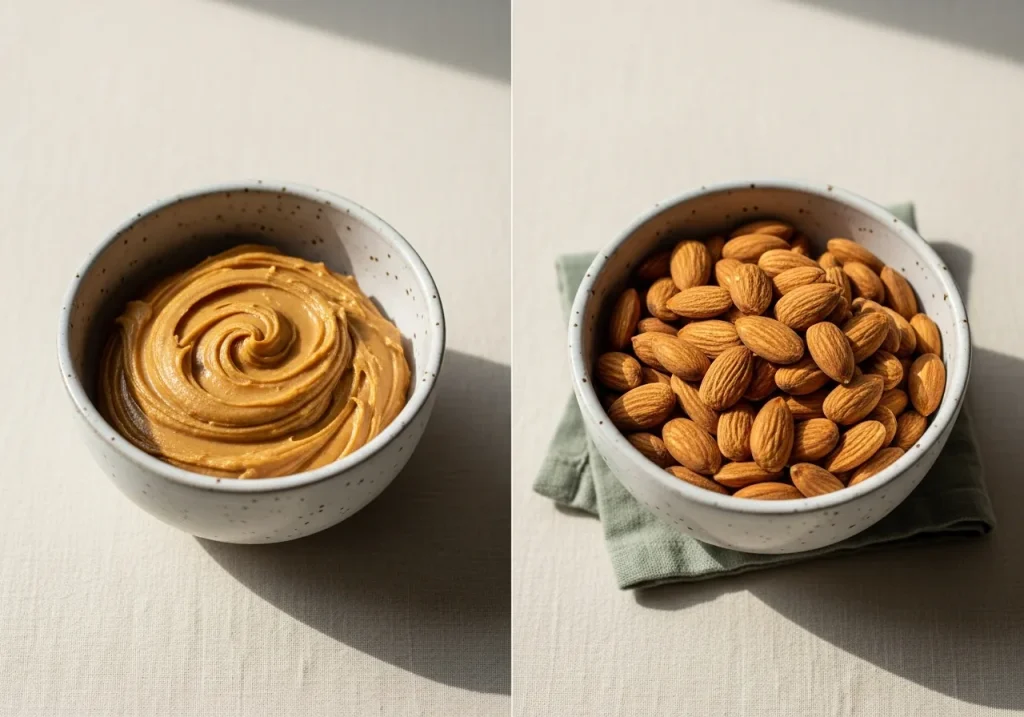
A spoonful of peanut butter and a handful of almonds are both go-to protein-and-fat snacks — but one is a whole food and the other a processed spread, and that distinction shows up clearly in the numbers.
| Nutrient | Peanut Butter | Almonds |
|---|---|---|
| Calories | 632 kcal | 626 kcal |
| Protein | 24 g ✓ | 21.5 g |
| Total Carbohydrate | 22.7 g | 20.0 g |
| Dietary Fiber | 6.32 g | 10.8 g ✓ |
| Total Sugars | 9.2 g | 4.35 g ✓ |
| Total Fat | 49.4 g | 51.1 g |
| Saturated Fat | 8.42 g | 3.79 g ✓ |
| Sodium | 221 mg | 0 mg ✓ |
Notable compounds in each
When to choose each
Almonds come out ahead on every directly comparable number here — more protein, more fibre, less sugar, less saturated fat, and dramatically less sodium. That’s not really an apples-to-apples fight, though: whole almonds are an unprocessed food, while peanut butter is a prepared spread that typically has salt, and sometimes sugar or oil, added during processing. A natural or “no added salt” peanut butter narrows this gap considerably, particularly on sodium.
Common questions
Is peanut butter unhealthy compared to almonds? Not inherently — the gap shown here is mostly down to processing, added salt in particular, rather than the peanut itself. Choosing a natural or no-added-salt peanut butter closes most of the difference.
Which has more protein per calorie, peanut butter or almonds? Peanut butter, narrowly: 24 g of protein per 632 kcal against 21.5 g per 626 kcal for almonds, so about 3.8 g per 100 kcal against 3.4 g. Both are calorie-dense, protein-rich foods and the gap is small enough that texture and how you use them matter more.