Two rich, buttery tree nuts that often sit side by side in a snack mix — but one is noticeably more calorie-dense than the other, and the fibre gap is bigger than it looks.
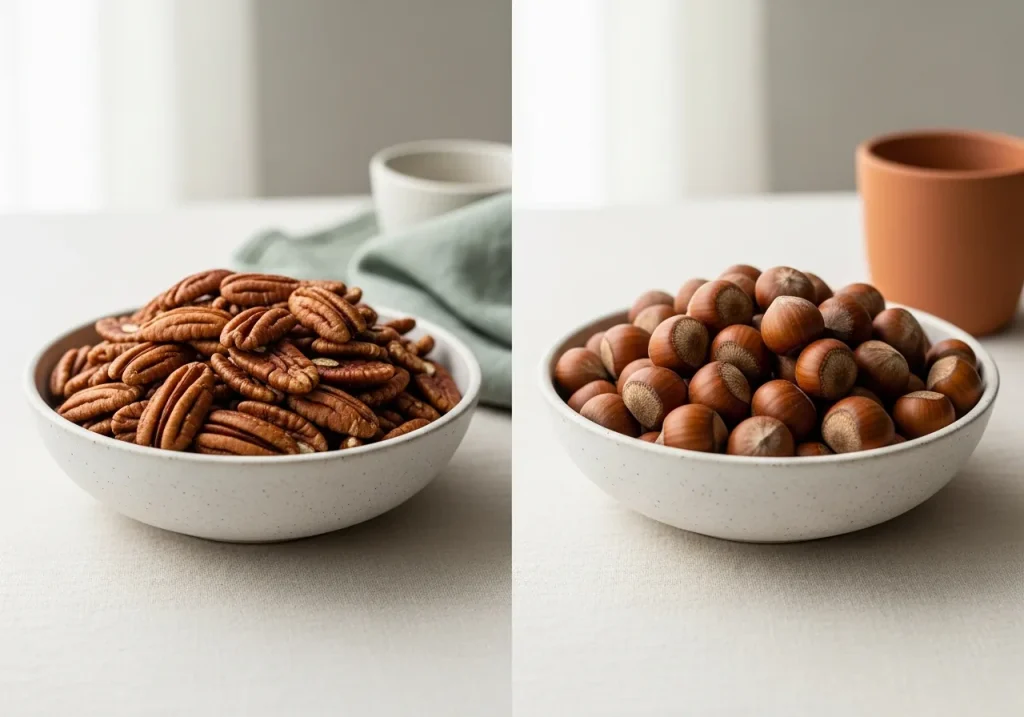
| Nutrient | Pecans | Hazelnuts |
|---|---|---|
| Calories | 750 kcal | 641 kcal |
| Protein | 9.96 g | 13.5 g ✓ |
| Total Carbohydrate | 12.7 g | 26.5 g |
| Dietary Fiber | 5.79 g | 8.41 g ✓ |
| Total Sugars | 3.97 g ✓ | 4.34 g |
| Total Fat | 73.3 g | 53.5 g |
| Saturated Fat | 6.46 g | 4.46 g ✓ |
| Sodium | 0 mg | 0 mg |
Notable compounds in each
When to choose each
Hazelnuts come out ahead on the figures that are directly comparable — more protein and more fibre per 100g, with fewer calories and less fat overall. Pecans are the richer, more calorie-dense nut of the two, with a higher proportion of fat (most of it unsaturated) — better suited to occasions where richness is the point, like a pecan pie, than to fibre or protein goals. Neither carries any sodium, and both are genuinely nutrient-dense whole foods in moderation.
Common questions
Which nut has more protein, pecans or hazelnuts? Hazelnuts — roughly 13.5g per 100g versus just under 10g for pecans, alongside more fibre too.
Are pecans or hazelnuts better for weight management? Hazelnuts are the lower-calorie, higher-fibre option of the two, which tends to support fullness better gram for gram — though both are calorie-dense and best portioned rather than eaten freely from the bag.