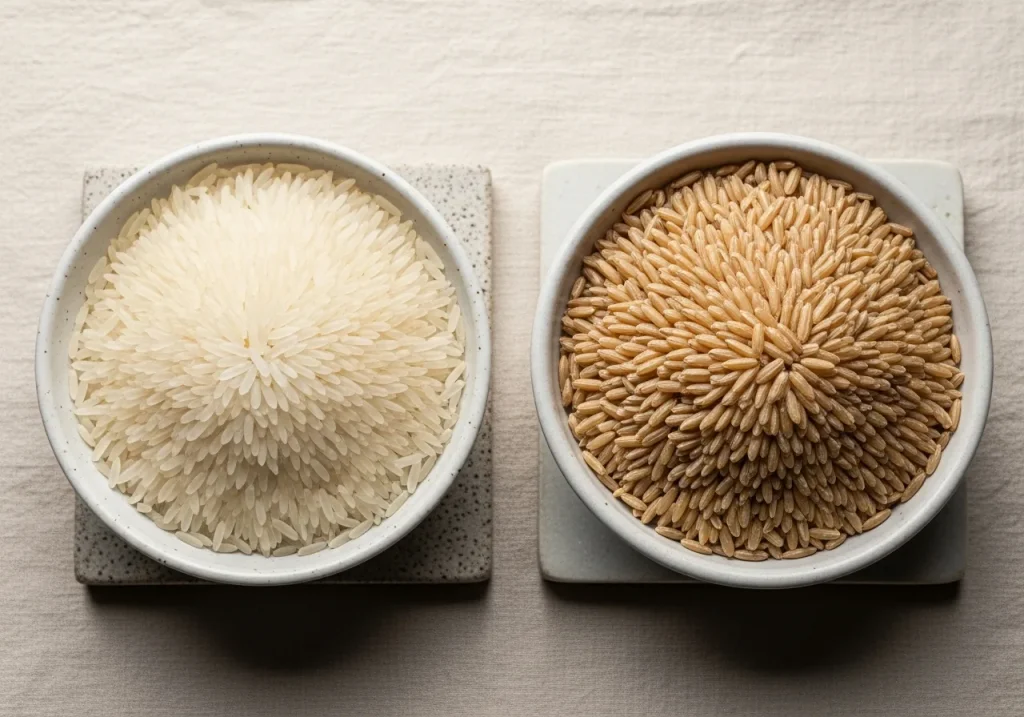
White and brown rice come from exactly the same grain — the only difference is how much of it survives milling. That single fact explains almost the entire nutrition gap below.
| Nutrient | White Rice | Brown Rice |
|---|---|---|
| Calories | 365 kcal | 367 kcal |
| Protein | 7.13 g | 7.54 g ✓ |
| Total Carbohydrate | 80 g | 76.25 g |
| Dietary Fiber | 1.3 g | 3.6 g ✓ |
| Total Sugars | 0.12 g ✓ | 0.66 g |
| Total Fat | 0.66 g | 3.2 g |
| Saturated Fat | 0.18 g ✓ | 0.59 g |
| Sodium | 5 mg | 5 mg |
Notable compounds in each
When to choose each
Reach for brown rice for its retained bran and germ: meaningfully more potassium, a little more fibre, and the natural fats that come with keeping the grain intact. Reach for white rice for a milder flavour, a faster cook time, and an easier-to-digest option when fibre needs to be limited, such as during a digestive flare-up. Calories and protein are essentially identical gram for gram, so this is a nutrient-density and digestibility choice, not a weight-management one.
Common questions
Does brown rice really have a lower glycaemic impact than white rice? Yes, on average — the intact bran slows digestion, which lowers brown rice’s glycaemic index even though the two are nearly identical in calories and carbohydrate per 100g.
Is switching to brown rice worth it for weight loss? Not on calories alone — gram for gram they’re almost the same. The case for brown rice is fibre, potassium and micronutrients, which support fullness and steadier blood sugar rather than a direct calorie cut.