The only thing that really changes is the fat. Per 100 g skim milk has 0.08 g of fat against whole milk’s 3.25 g, and that alone takes it from 61 calories to 34. Protein is the same to within a rounding error (3.37 g against 3.15 g), and so is sugar — 5.09 g against 5.05 g, all of it natural lactose.
So skimming does not remove the protein, the calcium or the lactose. It removes the fat, which takes about 44% of the calories with it, along with the saturated fat: 0.06 g against 1.87 g.
| Nutrient | Skim Milk | Whole Milk |
|---|---|---|
| Calories | 34 kcal | 61 kcal |
| Protein | 3.37 g ✓ | 3.15 g |
| Total Carbohydrate | 4.96 g | 4.8 g |
| Dietary Fiber | 0 g | 0 g |
| Total Sugars | 5.09 g | 5.05 g ✓ |
| Total Fat | 0.08 g | 3.25 g |
| Saturated Fat | 0.06 g ✓ | 1.87 g |
| Sodium | 42 mg ✓ | 43 mg |
Notable compounds in each
When to choose each
Reach for skim milk when you want the protein and calcium of milk without the calories — it is the more efficient choice per calorie and the difference adds up quickly if you drink several glasses a day. Reach for whole milk for the texture and for the fat itself: it carries the fat-soluble vitamins, it makes milk more satiating, and it is what most recipes assume. Neither choice changes the protein you get.
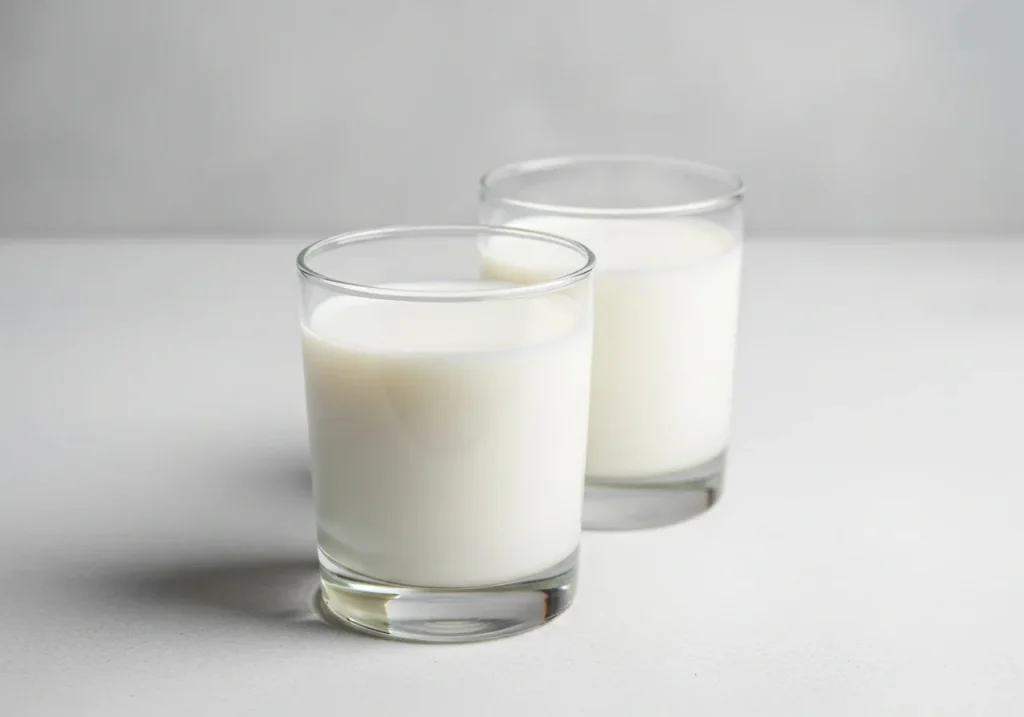
Skim milk vs whole milk nutrition per 100g
Figures are per 100 ml, which is roughly 100 g for milk. A 250 ml glass is about 85 calories of skim or 153 of whole.
Skim milk slightly out-points whole on potassium, 156 mg against 132 mg, for the simple reason that removing fat concentrates everything else a little. The same applies to its protein figure.
Common questions
Is skim milk healthier than whole milk? It depends what you are optimising for. Skim gives the same protein and sugar for about half the calories and almost no saturated fat. Whole milk carries fat-soluble vitamins and is more filling. Neither is a bad choice, and the evidence on whole-fat dairy and heart health has become less clear-cut than it once seemed.
Does skim milk have less protein than whole milk? No — it has marginally more, 3.37 g per 100 ml against 3.15 g, because removing fat concentrates what remains. Skimming does not touch the protein.
Does skim milk have more sugar than whole milk? No. Both are around 5 g per 100 ml and it is lactose, occurring naturally in the milk. Nothing is added to skim milk to compensate for the fat.
How many calories are in a glass of milk? A 250 ml glass is roughly 85 calories of skim milk or 153 of whole milk.