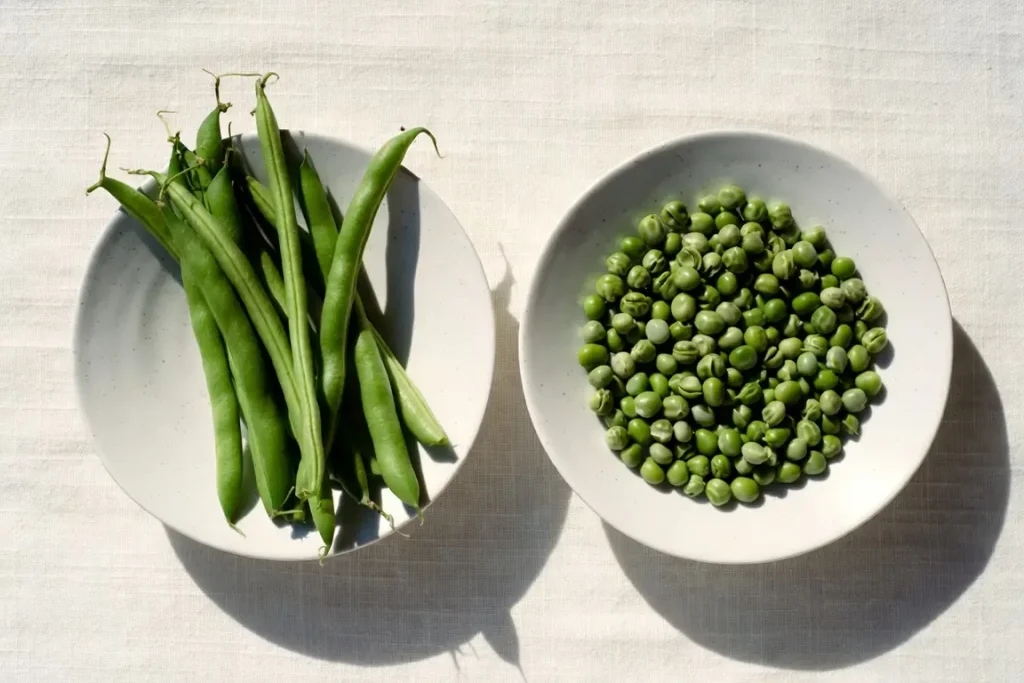
Both green and both classic side-vegetable staples, green beans and green peas actually sit in different nutritional leagues once you look past the colour.
| Nutrient | Green Beans | Green Peas |
|---|---|---|
| Calories | 40 kcal | 81 kcal |
| Protein | 1.97 g | 5.42 g ✓ |
| Total Carbohydrate | 7.41 g | 14.4 g |
| Dietary Fiber | 3.01 g | 5.7 g ✓ |
| Total Sugars | 3.26 g ✓ | 5.67 g |
| Total Fat | 0.28 g | 0.4 g |
| Saturated Fat | 0.05 g ✓ | 0.07 g |
| Sodium | 0 mg ✓ | 5 mg |
Notable compounds in each
When to choose each
Green peas are the more nutrient-dense of the two — nearly three times the protein and noticeably more fibre than green beans, gram for gram, though also more than double the calories. Green beans are lighter across the board and virtually sodium-free, making them the better choice when you want vegetable volume without adding much energy. Peas lean more towards a starchy-vegetable, almost legume-like profile, while green beans stay closer to a true low-calorie green.
Common questions
Are green peas a vegetable or a legume? Botanically, peas are a legume – the edible seed of a pod-bearing plant – which is exactly why they carry more protein and starch than a typical green vegetable like green beans.
Which is better for weight management, green beans or green peas? Green beans, if calorie volume is the priority – they deliver more food for fewer calories. Green peas offer more protein and fibre per 100g, which can matter more for fullness than raw volume.