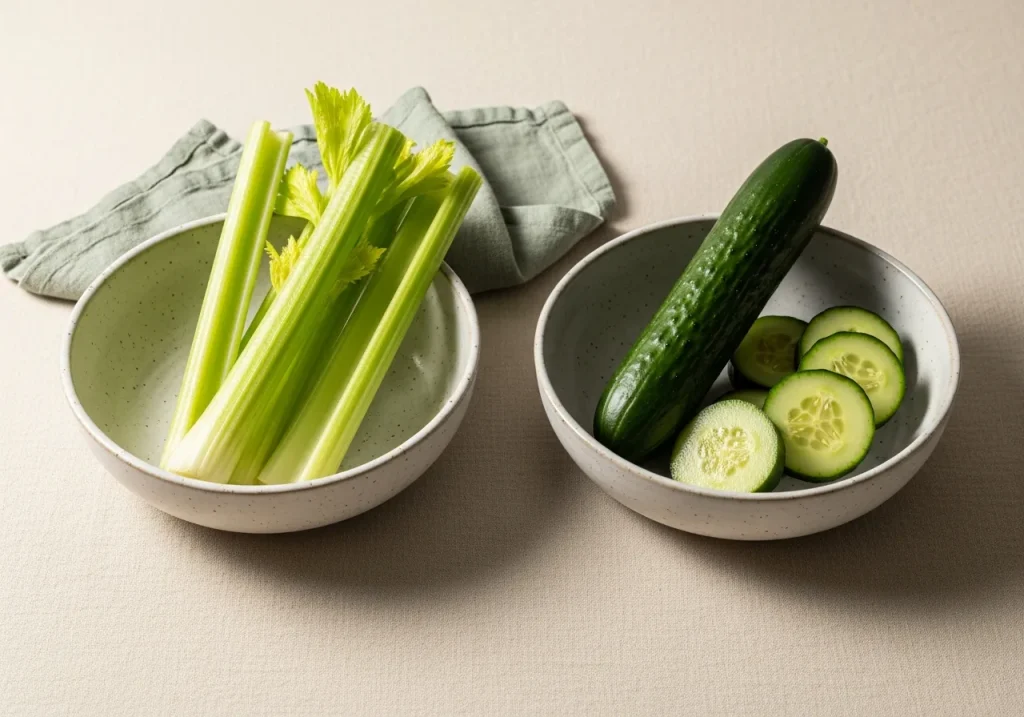
Celery and cucumber are the two low-calorie, high-crunch vegetables everyone reaches for as a virtually free snack — interchangeable in a lot of people’s minds, though one quietly differs from the other in a way worth knowing.
| Nutrient | Celery | Cucumber |
|---|---|---|
| Calories | 16.7 kcal | 15.9 kcal |
| Protein | 0.49 g | 0.63 g ✓ |
| Total Carbohydrate | 3.32 g | 2.95 g |
| Dietary Fiber | 1.6 g ✓ | 0.5 g |
| Total Sugars | 1.34 g ✓ | 1.67 g |
| Total Fat | 0.16 g | 0.18 g |
| Saturated Fat | 0.042 g | 0.037 g ✓ |
| Sodium | 97.2 mg | 1.52 mg ✓ |
Notable compounds in each
When to choose each
Reach for cucumber when sodium is a consideration — celery is naturally one of the higher-sodium vegetables, a genuine surprise to most people given how “light” it tastes. Reach for celery for its distinctive flavour in soups, stocks and mirepoix, where cucumber’s watery mildness doesn’t hold up the same way. Both are about as low-calorie as whole foods get, useful for volume without much calorie cost either way.
Common questions
Why is celery higher in sodium than most vegetables? It’s a natural feature of the plant, not added salt — celery genuinely accumulates more sodium from the soil than most other vegetables. It’s still a modest amount in absolute terms compared to processed foods.
Is cucumber mostly just water? Largely, yes — cucumber is over 95% water, which is exactly why it’s so low in calories and so refreshing, even if it means less concentrated nutrition per bite than denser vegetables.