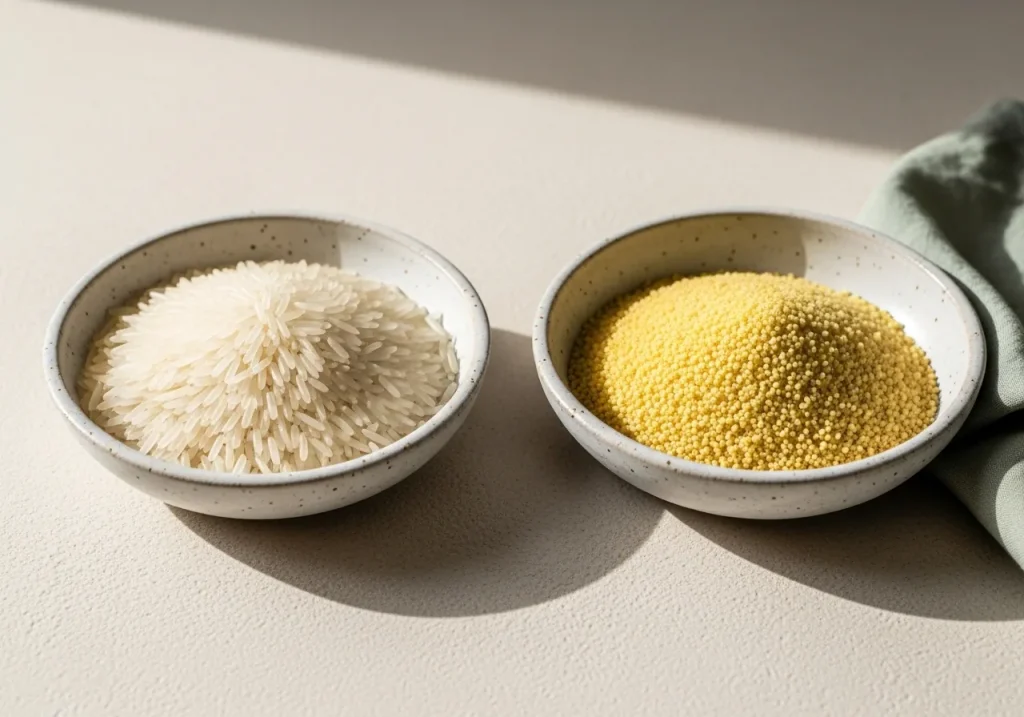
White rice and couscous are both quick-cooking, neutral-flavoured staples reached for on busy weeknights, though one carries meaningfully more nutrition than the other.
| Nutrient | White Rice | Couscous |
|---|---|---|
| Calories | 365 kcal | 376 kcal |
| Protein | 7.13 g | 12.8 g ✓ |
| Total Carbohydrate | 80 g | 77.4 g |
| Dietary Fiber | 1.3 g | 5 g ✓ |
| Total Sugars | 0.12 g | 0.1 g ✓ |
| Total Fat | 0.66 g | 0.64 g |
| Saturated Fat | 0.18 g | 0.12 g ✓ |
| Sodium | 5 mg ✓ | 10 mg |
Notable compounds in each
Couscous
When to choose each
Couscous is the more nutrient-dense of the two — meaningfully more protein and fibre than white rice, gram for gram, since it’s made from wheat semolina rather than a milled grain. White rice runs a touch lower in sodium and is naturally gluten-free, which couscous, as a wheat product, is not. Both cook quickly and work as a neutral base for other flavours; the gluten question is likely to matter more to most people than the modest nutrition gap.
Common questions
Is couscous healthier than white rice? On protein and fibre, yes, couscous has a real edge — but white rice is naturally gluten-free, which matters far more than the nutrition gap for anyone avoiding gluten. Neither is a clearly “unhealthy” choice; both are refined-ish quick-cooking staples.
Is couscous rice or pasta? Neither, technically — couscous is small steamed pellets of rolled semolina wheat, more closely related to pasta than rice, which is why, unlike rice, it contains gluten and cooks in minutes rather than needing to simmer.